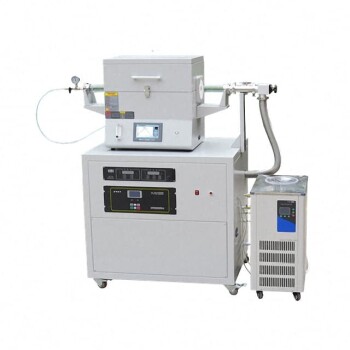
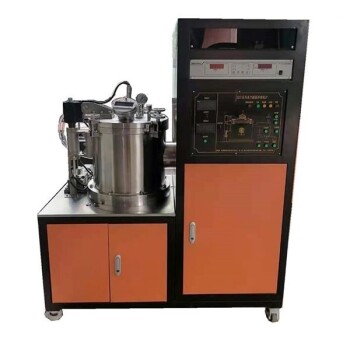
A laboratory vacuum tube furnace is the optimal choice for sintering aluminum matrix composites due to its ability to eliminate oxygen and provide precise thermal profiles. By maintaining a vacuum or inert atmosphere, these furnaces prevent the formation of deleterious oxide films that typically inhibit bonding in aluminum powders. This controlled environment ensures high material purity, superior density, and optimized microhardness in the finished composite.
Vacuum tube furnaces enable the production of high-purity aluminum matrix composites by preventing oxidation and allowing for precise control over diffusion kinetics. This results in superior interface bonding and predictable mechanical properties that are difficult to achieve in conventional air-cooled environments.
Elimination of Oxidation and Contamination
The Critical Role of a Vacuum Environment
Aluminum is highly reactive and forms an oxide scale almost instantly when exposed to oxygen at high temperatures. A vacuum tube furnace removes this risk by creating a low-pressure environment (often down to 0.098 Pa), ensuring that the aluminum matrix remains pure throughout the heating cycle.
Maintaining Matrix Purity
Beyond oxygen, the vacuum prevents other environmental pollutants from entering the material. This is essential for sintering high-purity ceramic reinforcements within the aluminum matrix, ensuring that the interface between the metal and the reinforcement remains free of contamination.
Surface Decarburization Prevention
Precise atmospheric control prevents surface reactions such as decarburization during high-temperature solution treatments. This maintains the chemical integrity of the material's surface, which is a critical foundation for subsequent aging and precipitation hardening processes.
Precision Control of Sintering Kinetics
Managing Grain Growth
Precision temperature control systems allow researchers to manage heating rates, sometimes as low as 1°C per minute. This level of granularity is vital for controlling grain growth, which directly impacts the final composite's microhardness and tensile strength.
Stable Thermal Fields
Tube furnaces provide a highly stable thermal field at specific temperatures, such as 600°C. This stability ensures that the aluminum atoms have consistent energy to promote diffusion kinetics, leading to uniform "neck" growth between powder particles.
Atmosphere Flexibility
These furnaces are not limited to vacuums; they can also provide high-purity argon protective atmospheres. This flexibility allows for different processing techniques depending on the specific alloying elements and their sensitivity to vacuum levels.
Improving Interface Bonding and Density
Facilitating Atom Diffusion
By maintaining temperatures slightly below the melting point of aluminum, the furnace promotes solid-state diffusion. This process induces particle necking, effectively transforming a loose green compact into a dense, high-strength solid composite.
Removal of Adsorbed Gases
The vacuum environment helps eliminate adsorbed gases trapped within the gaps between powder particles. Removing these gases is essential for eliminating residual pores and achieving a high-quality, clean interfacial bond between the matrix and reinforcements like graphene or ceramics.
Enhancing Microhardness
The combination of pore elimination and grain size control leads to a significant increase in the microhardness of the final product. A vacuum-sintered part is typically more consistent in its mechanical properties than one sintered in a less controlled environment.
Understanding the Trade-offs and Limitations
Absence of Mechanical Pressure
Unlike a vacuum hot press, a standard tube furnace does not apply axial pressure during sintering. This means that achieving theoretical density may take longer or require higher temperatures, as there is no mechanical force to assist in the collapse of internal pores.
Scaling and Throughput
Laboratory tube furnaces are designed for research and development, not mass production. While they offer incredible design flexibility and quick turnarounds for small batches, they are not suited for manufacturing large-scale industrial components.
Maintenance of Vacuum Integrity
The high-vacuum environment requires diligent maintenance of seals and pumps. Any leak in the system can lead to immediate oxidation of the aluminum powder, potentially ruining the entire composite sample.
Making the Right Choice for Your Goal
To achieve the best results with aluminum matrix composites, you must align your furnace settings with your specific material objectives.
- If your primary focus is maximum material purity: Utilize the highest vacuum setting (e.g., 0.098 Pa) to ensure all oxygen and adsorbed gases are removed before reaching sintering temperatures.
- If your primary focus is controlled microstructure: Prioritize a furnace with a programmable PID controller to maintain slow, steady heating rates (1°C/min) to prevent uncontrolled grain growth.
- If your primary focus is surface finish and brightness: Use a vacuum environment rather than an inert gas to ensure parts emerge clean and "bright" without the need for post-process cleaning.
By leveraging the precise atmosphere and temperature controls of a vacuum tube furnace, researchers can consistently produce aluminum matrix composites with superior structural integrity.
Summary Table:
| Key Feature | Advantage for Aluminum Matrix Composites (AMCs) | Impact on Final Product |
|---|---|---|
| High Vacuum Environment | Eliminates oxygen to prevent deleterious oxide film formation. | Superior material purity and interface bonding. |
| Precise PID Control | Enables slow heating rates (1°C/min) to strictly manage grain growth. | Optimized microhardness and tensile strength. |
| Stable Thermal Field | Promotes consistent solid-state diffusion and particle necking. | Uniform density and predictable properties. |
| Adsorbed Gas Removal | Extracts trapped gases from powder gaps during the heating cycle. | Elimination of residual pores and defects. |
Elevate Your Material Research with KINTEK Precision
Achieving the perfect microstructure in aluminum matrix composites requires uncompromising control over atmosphere and temperature. KINTEK specializes in high-performance laboratory equipment designed to meet the rigorous demands of modern material science. Our extensive range of high-temperature furnaces (vacuum, tube, muffle, CVD, and PECVD) ensures your sintering processes are free from oxidation and contamination.
Beyond furnaces, KINTEK offers a comprehensive ecosystem for your lab, including:
- Sample Preparation: Crushing and milling systems, sieving equipment, and hydraulic pellet presses.
- Specialized Reactors: High-temperature high-pressure reactors and autoclaves.
- Research Tools: Electrolytic cells, battery research consumables, and homogenizers.
- Essential Consumables: High-purity ceramics, crucibles, and PTFE products.
Ready to optimize your sintering kinetics and achieve theoretical density? Contact our technical experts today to discuss how KINTEK can provide the precision tools your research deserves.
References
- Srikanth Bathula, Anup Choudhury. Investigation of sustainable production opportunity in fabrication of hybrid Aluminum metal matrix composites by Powder Metallurgy technique. DOI: 10.1504/ijmatei.2023.10055926
This article is also based on technical information from Kintek Solution Knowledge Base .
Related Products
- Vacuum Sealed Continuous Working Rotary Tube Furnace Rotating Tube Furnace
- Laboratory High Pressure Vacuum Tube Furnace
- Laboratory Vacuum Tilt Rotary Tube Furnace Rotating Tube Furnace
- Split Chamber CVD Tube Furnace with Vacuum Station Chemical Vapor Deposition System Equipment Machine
- 1200℃ Controlled Atmosphere Furnace Nitrogen Inert Atmosphere Furnace
People Also Ask
- What are the process advantages of using a rotary tube furnace for WS2 powder? Achieve Superior Material Crystallinity
- What are the advantages of using a rotary tube furnace for MoVOx catalysts? Elevate Uniformity and Crystallinity
- Why is a vacuum tube furnace with argon protection required for RGO/Cu? Ensure Conductivity and Material Purity
- Why is a rotary tube furnace preferred over a fixed tube furnace for the carbonization of asphaltenes? Superior Quality
- Why is a rotary tube furnace recommended for the calcination stage of potassium vanadium oxide catalysts? Optimize Purity