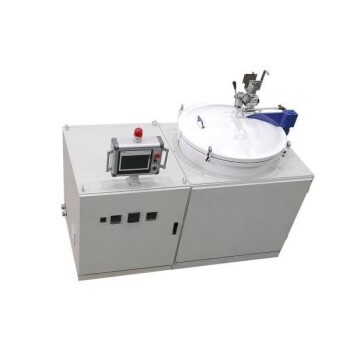
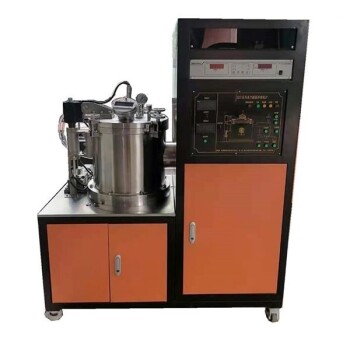
The primary technical advantage of using a vacuum diffusion bonding furnace is its ability to facilitate atomic-level bonding without compromising the titanium’s chemical stability. By maintaining a high-vacuum environment, the furnace prevents oxidation and embrittlement while applying the heat and pressure necessary to fuse multiple layers into a single, high-strength structural component.
Core Takeaway Near-alpha titanium alloys are highly reactive to oxygen at the temperatures required for bonding. The vacuum furnace solves this by isolating the material, allowing for the formation of a uniform equiaxed alpha grain microstructure that delivers exceptional impact toughness and strength.
Preserving Material Integrity
The success of manufacturing titanium laminates hinges on controlling the manufacturing environment.
Preventing Oxidation and Embrittlement
Titanium alloys act as "getters" at high temperatures, aggressively absorbing gases like oxygen and hydrogen. If exposed to air during heating, the material develops an oxide layer that leads to severe embrittlement.
The vacuum furnace creates an oxygen-free environment. This ensures the titanium retains its ductility and inherent mechanical properties throughout the thermal cycle.
Eliminating Surface Contaminants
For diffusion bonding to occur, the surfaces must be chemically clean. The high-vacuum environment helps inhibit or remove surface oxide layers that would otherwise act as a barrier to bonding.
Achieving Atomic-Level Fusion
Unlike traditional welding, which melts the base metal, diffusion bonding is a solid-state process.
Facilitating Atomic Diffusion
The furnace applies precise heat and pressure (often utilizing argon gas via flexible membranes) to the stacked sheets. This energy drives atoms to migrate across the interface boundaries.
The result is a continuous metallurgical bond where the original distinct layers become virtually indistinguishable.
Pore-Free Interfaces
A critical advantage of this equipment is the elimination of interfacial voids. The combination of uniform pressure and time at temperature collapses microscopic gaps between the sheets.
This creates a pore-free interface, which is essential for preventing stress concentrations that could lead to premature failure under load.
Optimizing Microstructure for Performance
The ultimate goal of using this specific furnace type is to control the grain structure of the final laminate.
Formation of Equiaxed Alpha Grains
According to the primary technical data, this process ensures the microstructure transforms into uniform equiaxed alpha grains. This specific grain structure is pivotal for near-alpha alloys, as it directly correlates to superior mechanical stability.
Isotropic Mechanical Properties
Because the bond is atomic and the interfaces are eliminated, the laminated material behaves as a single solid unit. It exhibits isotropic properties, meaning it possesses uniform strength and toughness in all directions, rather than having weak points along the bond lines.
Understanding the Trade-offs
While vacuum diffusion bonding offers superior material quality, it presents specific operational challenges.
Process Cycle Time
Diffusion bonding is not instantaneous; it relies on time-dependent atomic migration. This results in longer cycle times compared to fusion welding or adhesive bonding, potentially impacting throughput for high-volume production.
Equipment Complexity and Cost
Achieving and maintaining a high vacuum at elevated temperatures requires sophisticated equipment. The capital investment for vacuum furnaces and the cost of inert gases (like argon) are significantly higher than standard atmosphere furnaces.
Making the Right Choice for Your Goal
When evaluating this technology for your manufacturing process, consider your specific performance requirements:
- If your primary focus is maximum impact toughness: The vacuum process is essential to produce the uniform equiaxed alpha grains that resist fracture under load.
- If your primary focus is structural reliability: The elimination of interfacial pores and oxidation ensures the laminate will not suffer from embrittlement or delamination.
Summary: The vacuum diffusion bonding furnace is the only viable solution for creating near-alpha titanium laminates that require theoretical-density bonding and uncompromised ductility.
Summary Table:
| Feature | Technical Advantage | Benefit for Titanium Laminates |
|---|---|---|
| Vacuum Environment | Prevents oxygen and hydrogen absorption | Eliminates embrittlement and maintains ductility |
| Solid-State Diffusion | Atomic migration across interface boundaries | Creates a continuous metallurgical bond without melting |
| Microstructure Control | Formation of equiaxed alpha grains | Delivers superior impact toughness and mechanical stability |
| Uniform Pressure | Elimination of interfacial voids | Ensures pore-free, isotropic material properties |
Elevate Your Material Integrity with KINTEK
Ready to achieve theoretical-density bonding for your high-performance alloys? KINTEK specializes in advanced laboratory and industrial solutions, offering precision-engineered vacuum furnaces, CVD/PECVD systems, and hydraulic presses designed for complex material synthesis. Whether you are working with near-alpha titanium, ceramic composites, or battery research, our high-temperature equipment ensures the chemical stability and structural reliability your project demands.
Contact KINTEK today to find the perfect bonding solution for your lab
References
- Yu. Zorenko, Anna Mrozik. Development of TL and OSL materials for the analyzation of dose and energy distributions of photon beams for radiotherapeutic applications. DOI: 10.21175/rad.abstr.book.2023.42.8
This article is also based on technical information from Kintek Solution Knowledge Base .
Related Products
- 2200 ℃ Tungsten Vacuum Heat Treat and Sintering Furnace
- Small Vacuum Heat Treat and Tungsten Wire Sintering Furnace
- Vacuum Heat Treat and Molybdenum Wire Sintering Furnace for Vacuum Sintering
- Vacuum Arc Induction Melting Furnace
- Vacuum Heat Treat Sintering Brazing Furnace
People Also Ask
- What is the melting point of tungsten in a vacuum? The Real Limit is Sublimation, Not Melting
- What happens to tungsten when heated? Discover Its Extreme Heat Resistance and Unique Properties
- How does a high-temperature vacuum sintering furnace facilitate the post-treatment of Zirconia coatings?
- Why is it necessary to use sintering aids for PLS? Achieve Full Density in Ultra-High Temperature Ceramics
- How does a high-temperature vacuum sintering furnace contribute to the formation of Fe-Cr-Al porous materials?