At its core, producing graphene involves one of two fundamental strategies: either carefully shaving down flakes from a larger block of graphite or meticulously building the single-atomic layer from the bottom up. The primary methods employed today include mechanical and liquid-phase exfoliation (top-down), as well as Chemical Vapor Deposition (CVD) and the sublimation of silicon carbide (bottom-up), with CVD emerging as the most viable for industrial-scale applications.
The central challenge in graphene production is not simply making it, but making the right kind of graphene for a specific purpose. The best method is dictated entirely by whether the goal is pure research, bulk material additives, or high-performance electronics.
The Two Philosophies of Graphene Synthesis
Graphene, a two-dimensional honeycomb lattice of carbon atoms, can be produced through two conceptually opposite approaches. Understanding this distinction is the first step in navigating the landscape of production techniques.
The 'Top-Down' Approach: Starting with Graphite
This strategy involves separating the individual layers of graphene from graphite, which is essentially a stack of countless graphene sheets. It is a process of deconstruction.
The most famous example is mechanical exfoliation, which uses adhesive tape to peel off layers until a single sheet remains. While perfect for producing pristine samples for research, it is not a scalable process.
For mass production, liquid-phase exfoliation is used. Here, graphite is suspended in a liquid and broken apart using energy, such as high-frequency sound waves. This is effective for creating graphene-based inks and composites but often results in lower electrical quality.
The 'Bottom-Up' Approach: Building from Atoms
This philosophy involves constructing the graphene lattice atom by atom on a suitable substrate. This method offers far greater control over the final quality and size of the graphene sheet.
The dominant bottom-up method is Chemical Vapor Deposition (CVD). This process is considered the most promising for creating large, high-quality sheets of graphene suitable for electronics.
Another bottom-up technique is the epitaxial growth on silicon carbide (SiC), where heating SiC to high temperatures causes silicon to sublimate, leaving a layer of carbon atoms that rearrange into graphene. This produces high-quality graphene but is prohibitively expensive for most uses.
A Closer Look at Chemical Vapor Deposition (CVD)
CVD has become the standard for producing graphene for technological applications because it uniquely balances quality with scalability over large areas.
The Core Process
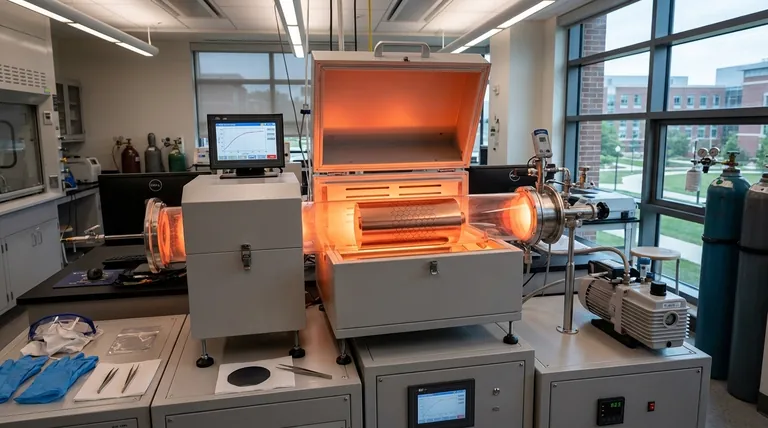
In a CVD system, a substrate—typically a transition metal foil—is heated to a high temperature (around 800–1050 °C) inside a low-pressure chamber.
A hydrocarbon gas, such as methane, is then introduced. The high heat causes the gas to decompose, depositing carbon atoms onto the surface of the metal catalyst.
These carbon atoms then self-assemble into the characteristic honeycomb structure of a graphene film.
The Role of the Substrate
The choice of metal substrate is critical. Copper (Cu) is widely used because it facilitates the growth of large, predominantly single-layer graphene sheets.
Other metals like nickel (Ni) and cobalt (Co) are also used. These materials act as a catalytic surface that is essential for the ordered formation of the graphene lattice.
The Importance of Conditions
The process is highly sensitive to physical conditions. Most systems use low-pressure chemical vapor deposition (LPCVD) to prevent unwanted side reactions in the gas phase and to promote a more uniform deposition across the substrate surface.
Understanding the Trade-offs
No single method is universally superior. The optimal choice is always a function of balancing competing priorities.
Quality vs. Scalability
This is the most fundamental trade-off. Mechanical exfoliation yields the highest-quality, defect-free graphene flakes but has virtually zero scalability. Liquid-phase exfoliation is highly scalable but produces material with more defects and lower electrical performance.
CVD represents the most effective compromise, enabling the production of high-quality graphene over large areas, making it suitable for industrial applications like transparent electrodes and sensors.
Cost and Complexity
The cost and equipment complexity vary dramatically. Liquid-phase exfoliation can be done with relatively simple lab equipment.
In contrast, CVD requires specialized high-temperature furnaces and vacuum systems. The sublimation of SiC is even more expensive due to the high cost of the SiC wafers themselves.
The Challenge of Transfer
A critical drawback of CVD is that the graphene is grown on a metal foil and is almost always needed on a different substrate, like silicon or a flexible polymer. This requires a delicate transfer process that can introduce wrinkles, tears, and contaminants, potentially compromising the final device's performance.
Making the Right Choice for Your Goal
To select the appropriate method, you must first define your primary objective.
- If your primary focus is fundamental research: Mechanical exfoliation remains the gold standard for producing pristine flakes needed for laboratory studies.
- If your primary focus is large-scale composites or conductive inks: Liquid-phase exfoliation offers the most cost-effective path to mass production where perfect electrical properties are not the top priority.
- If your primary focus is high-performance electronics or large-area films: Chemical Vapor Deposition (CVD) is the industry-leading method for producing high-quality, uniform graphene.
Ultimately, selecting the correct synthesis method depends entirely on balancing the demands of quality, scale, and cost for your specific application.
Summary Table:
| Method | Approach | Key Characteristics | Best For |
|---|---|---|---|
| Mechanical Exfoliation | Top-Down | Produces pristine, high-quality flakes; not scalable. | Fundamental research. |
| Liquid-Phase Exfoliation | Top-Down | Scalable for mass production; lower electrical quality. | Composites, conductive inks. |
| Chemical Vapor Deposition (CVD) | Bottom-Up | High-quality, large-area films; industry standard. | High-performance electronics, sensors. |
| Epitaxial Growth on SiC | Bottom-Up | High-quality graphene; very high cost. | Specialized electronic applications. |
Ready to integrate graphene into your research or production line? The right synthesis method is critical to your success. KINTEK specializes in providing the advanced lab equipment, including CVD systems, necessary for high-quality graphene production. Our expertise ensures you have the right tools for your specific application, whether for research, development, or scaling up. Contact our experts today to discuss how we can support your laboratory's innovation goals. Get in touch via our contact form
Visual Guide

Related Products
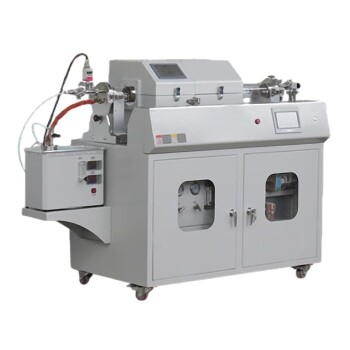
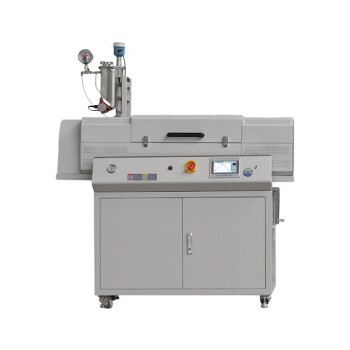
- Chemical Vapor Deposition CVD Equipment System Chamber Slide PECVD Tube Furnace with Liquid Gasifier PECVD Machine
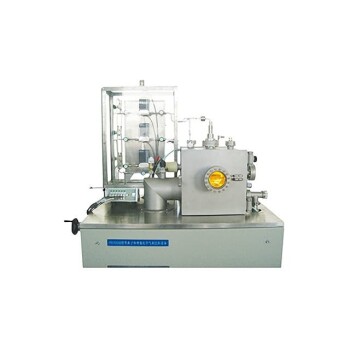
- Inclined Rotary Plasma Enhanced Chemical Vapor Deposition PECVD Equipment Tube Furnace Machine
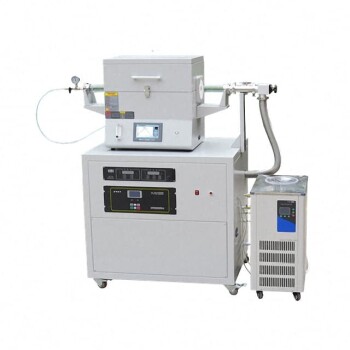
- RF PECVD System Radio Frequency Plasma-Enhanced Chemical Vapor Deposition RF PECVD
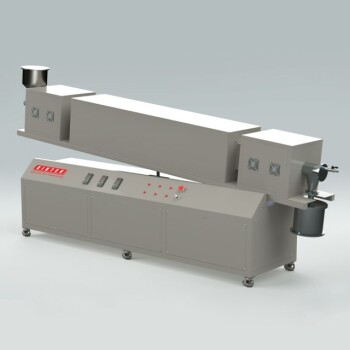
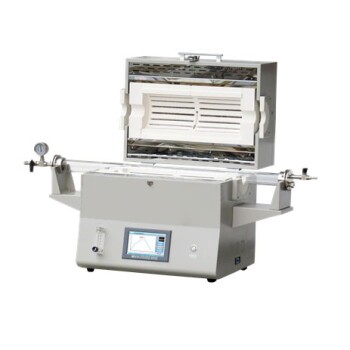
- Customer Made Versatile CVD Tube Furnace Chemical Vapor Deposition Chamber System Equipment
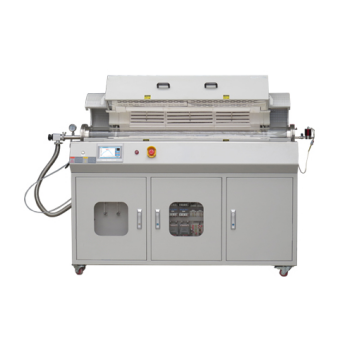
- Split Chamber CVD Tube Furnace with Vacuum Station Chemical Vapor Deposition System Equipment Machine
People Also Ask
- How are PECVD and CVD different? A Guide to Choosing the Right Thin-Film Deposition Process
- What is the precursor gas in PECVD? The Key to Low-Temperature Thin Film Deposition
- What are the advantages of PECVD over CVD? Achieve High-Quality Thin Films at Lower Temperatures
- What are the examples of CVD method? Discover the Versatile Applications of Chemical Vapor Deposition
- What is the difference between thermal CVD and PECVD? Choose the Right Thin-Film Deposition Method