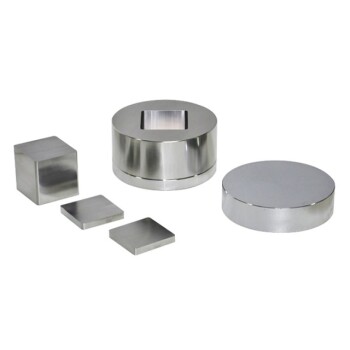
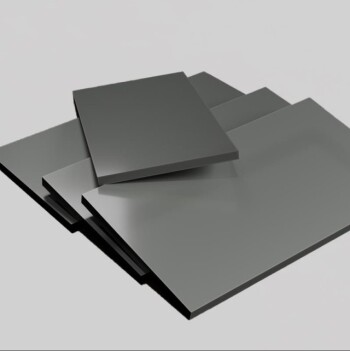
High-purity graphite is the optimal choice for vacuum hot pressing aluminum-tin (Al-Sn) composites due to its unique ability to withstand extreme processing environments while maintaining chemical neutrality. It is selected primarily for its high-temperature mechanical strength, capable of handling pressures such as 40 MPa, and its chemical inertness, which prevents unwanted reactions with the metal matrix.
Core Takeaway Achieving a defect-free Al-Sn composite requires a mold that acts as both a robust pressure vessel and a chemically passive container. High-purity graphite is the standard solution because it ensures efficient thermal transfer and structural stability without contaminating the aluminum or tin, facilitating both precise densification and easy part removal.
The Critical Role of Material Properties
Mechanical Strength Under Thermal Stress
The vacuum hot pressing process subjects molds to simultaneous high heat and significant mechanical force. High-purity graphite is selected because it retains exceptional strength at elevated temperatures, unlike many metals that soften.
It allows the system to apply necessary mechanical pressures—specifically around 40 MPa for Al-Sn composites—without the mold deforming or fracturing. Furthermore, its resistance to thermal shock prevents cracking during rapid heating or cooling cycles, ensuring the dimensional accuracy of the final composite.
Chemical Stability in Vacuum
Aluminum is a highly reactive metal, particularly when molten or near its melting point. A primary reason for using high-purity graphite is its chemical stability within a vacuum environment.
It does not react with aluminum or tin, preventing the formation of brittle carbides or other intermetallic compounds at the interface. This ensures the surface of the sintered composite remains pure and the mold does not degrade chemically over time.
Thermal Conductivity and Heating
Graphite possesses excellent thermal conductivity, which is vital for the sintering process. This property ensures that heat is transferred rapidly and uniformly from the heating source to the Al-Sn powder mixture.
Uniform heating minimizes thermal gradients within the sample, preventing defects such as warping, uneven densification, or local non-bonding within the composite matrix.
Natural Lubricity and Demolding
The physical structure of graphite provides natural lubricity. This is a critical operational advantage during the post-sintering phase.
Because the Al-Sn composite does not adhere to the graphite surface, the final sample can be removed easily from the mold. This reduces the risk of damaging the sample during extraction and minimizes the need for additional release agents that could contaminate the material.
Understanding the Trade-offs
Mechanical Limits and Brittleness
While graphite is strong at high temperatures, it is inherently brittle compared to metal alloys. It handles compressive loads (like the 40 MPa used here) well, but it has low tensile strength and can fracture under shear stress or impact.
Operators must align the press train perfectly to ensure uniaxial loading. Any misalignment can cause the graphite mold to crack catastrophically, ruining the sample and potentially damaging the vacuum chamber.
Oxidation Sensitivity
Graphite is highly susceptible to oxidation at temperatures above 400°C if oxygen is present. While this process is conducted in a vacuum, any leak or insufficient vacuum level will lead to rapid erosion of the mold surfaces.
This degradation compromises the mold's dimensional tolerances and surface finish over repeat cycles. Therefore, the integrity of the vacuum system is just as critical as the quality of the graphite itself.
Making the Right Choice for Your Goal
When designing your vacuum hot pressing setup for Al-Sn composites, consider these strategic priorities:
- If your primary focus is Dimensional Precision: Ensure the graphite grade selected has high density and low porosity to maintain rigid structural stability under the specific 40 MPa load.
- If your primary focus is Surface Quality: Prioritize the highest purity levels available to eliminate any trace contaminants that could induce micro-reactions with the aluminum matrix.
Ultimately, high-purity graphite is not just a container; it is an active component in ensuring the thermal homogeneity and chemical purity of your final Al-Sn composite.
Summary Table:
| Property | Advantage for Al-Sn Vacuum Hot Pressing | Impact on Final Composite |
|---|---|---|
| High-Temp Strength | Supports pressures up to 40 MPa without deformation | Ensures dimensional accuracy and density |
| Chemical Inertness | Prevents reactions with aluminum or tin | Maintains high material purity and surface quality |
| Thermal Conductivity | Enables rapid and uniform heat distribution | Minimizes thermal gradients and defects |
| Natural Lubricity | Facilitates easy sample removal from the mold | Reduces damage risk and contamination during extraction |
| Thermal Shock Resistance | Withstands rapid heating/cooling cycles | Prevents mold cracking and ensures process longevity |
Elevate Your Material Research with KINTEK Precision Solutions
Achieving the perfect Al-Sn composite requires more than just high-purity graphite—it demands the right equipment to control the environment. KINTEK specializes in advanced laboratory equipment designed for extreme conditions. Whether you need a high-performance vacuum hot press, a robust hydraulic pellet press, or precision high-temperature furnaces, we have the tools to ensure your sintering and densification processes are flawless.
Our extensive portfolio for research and production includes:
- High-Temperature Furnaces: Muffle, vacuum, and atmosphere control.
- Pressing Systems: Isostatic, hot, and manual hydraulic presses.
- Essential Consumables: High-purity ceramics, crucibles, and specialized graphite tools.
- Advanced Reactors: High-temperature high-pressure reactors and autoclaves.
Ready to optimize your lab's performance? Contact us today to discuss your specific application needs with our technical experts and discover how KINTEK can provide the precision and reliability your research deserves.
Related Products
- High Purity Pure Graphite Crucible for Evaporation
- Ultra-High Temperature Graphite Vacuum Graphitization Furnace
- Horizontal High Temperature Graphite Vacuum Graphitization Furnace
- Vertical High Temperature Graphite Vacuum Graphitization Furnace
- 2200 ℃ Graphite Vacuum Heat Treat Furnace
People Also Ask
- Why are high-purity graphite crucibles preferred for sulfide solid electrolytes? Achieve Superior Material Purity
- Why is a high-purity graphite crucible required for Chromel-TaC composites? Ensure Peak Purity at 1400°C
- What role do high-purity graphite crucibles play in molten salt corrosion research? Ensure Reactor-Grade Precision
- Why are high-purity graphite crucibles used for magnesium distillation? Ensure 3N8 Purity & Thermal Stability
- Why is a high-purity graphite crucible ideal for nitrogen-doped graphene at 1500 °C? Maximize Purity and Stability