Knowledge What is the pyrolysis process? A Sustainable Solution for Waste Conversion
Author avatar

Tech Team · Kintek Solution

Updated 6 days ago

What is the pyrolysis process? A Sustainable Solution for Waste Conversion


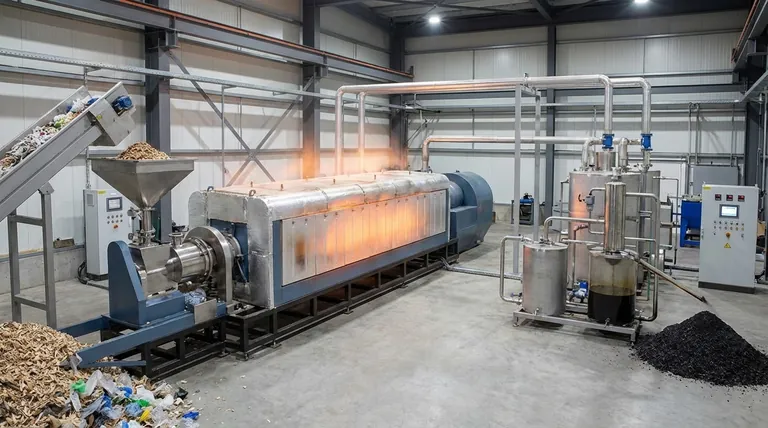
The pyrolysis process is a thermochemical decomposition of organic materials at elevated temperatures in the absence of oxygen, leading to the production of bio-oil, syngas, and biochar. The process typically involves three main stages: drying the feedstock to remove moisture, pyrolyzing the dried material at high temperatures (400-800°C) to break it down into volatile gases, liquid products, and solid char, and finally condensing and collecting the products for further use. The process can be applied to various feedstocks, including biomass and plastic waste, and involves pre-treatment, heating, and refining steps to ensure efficient conversion and recovery of usable byproducts.
What is the pyrolysis process? A Sustainable Solution for Waste Conversion

Key Points Explained:

  1. Drying the Feedstock

    • The first step in pyrolysis is drying the feedstock to remove moisture. This is crucial because moisture can interfere with the pyrolysis reaction and reduce the efficiency of the process.
    • Drying is typically done at lower temperatures (100-150°C) to ensure that the feedstock is free from water without initiating the pyrolysis reaction prematurely.
    • This step is particularly important for biomass, which often contains significant moisture content.
  2. Pyrolysis Reaction

    • The dried feedstock is then subjected to high temperatures (400-800°C) in the absence of oxygen. This step is the core of the pyrolysis process, where the organic material undergoes thermal decomposition.
    • The absence of oxygen prevents combustion and instead leads to the breakdown of the material into smaller molecules.
    • The products of this stage include:
      • Volatile Gases: These are primarily composed of hydrogen, carbon monoxide, carbon dioxide, and methane.
      • Liquid Products (Bio-oil): A mixture of water and organic compounds, which can be further refined into fuels or chemicals.
      • Solid Char (Biochar): A carbon-rich solid residue that can be used as a soil amendment or for carbon sequestration.
  3. Condensation and Collection

    • After the pyrolysis reaction, the volatile gases are condensed into liquid bio-oil. This is typically done by cooling the vapor phase products, causing them to condense into a liquid form.
    • The solid char is collected separately, and the remaining non-condensable gases (syngas) are often captured and used as a source of energy to sustain the pyrolysis process or for other applications.
    • The bio-oil can be further refined to remove impurities and improve its quality for use as a fuel or chemical feedstock.
  4. Pre-Treatment and Sizing

    • For materials like plastic waste, pre-treatment is necessary to remove impurities such as metals, dirt, or other contaminants. This ensures that the pyrolysis process is efficient and that the resulting products are of high quality.
    • The feedstock is also ground or shredded to the required size, which facilitates uniform heating and improves the overall efficiency of the pyrolysis process.
  5. Heating and Vaporization

    • The feedstock is loaded into a pyrolysis reactor, where it is heated to a temperature range of 200-900°C, depending on the type of material and the desired end products.
    • As the material heats up, it melts and vaporizes, breaking down into smaller molecules. This step is critical for the formation of the volatile gases and liquid products.
    • The use of a catalyst may be employed to enhance the breakdown of the material and improve the yield of desired products.
  6. Product Separation and Refinement

    • The final step involves the separation and refinement of the pyrolysis products. The liquid bio-oil is collected and may undergo further refining to remove impurities and improve its stability and usability.
    • The solid char and syngas are also collected and can be used for various applications, such as energy production, soil amendment, or as raw materials for chemical synthesis.
    • The efficiency of this step is crucial for maximizing the economic and environmental benefits of the pyrolysis process.

In summary, the pyrolysis process is a multi-stage operation that involves drying, thermal decomposition, and product collection. Each step is carefully controlled to ensure the efficient conversion of organic materials into valuable byproducts, making pyrolysis a versatile and sustainable method for waste management and resource recovery.

Summary Table:

Stage Key Details
Drying Feedstock Removes moisture at 100-150°C to prevent interference with pyrolysis.
Pyrolysis Reaction Breaks down material at 400-800°C, producing gases, bio-oil, and biochar.
Condensation Cools gases to form bio-oil; collects syngas and biochar for further use.
Pre-Treatment Removes impurities and sizes feedstock for uniform heating.
Heating Heats feedstock to 200-900°C, vaporizing it into smaller molecules.
Refinement Separates and refines bio-oil, biochar, and syngas for various applications.

Discover how pyrolysis can transform waste into valuable resources—contact us today!

Visual Guide
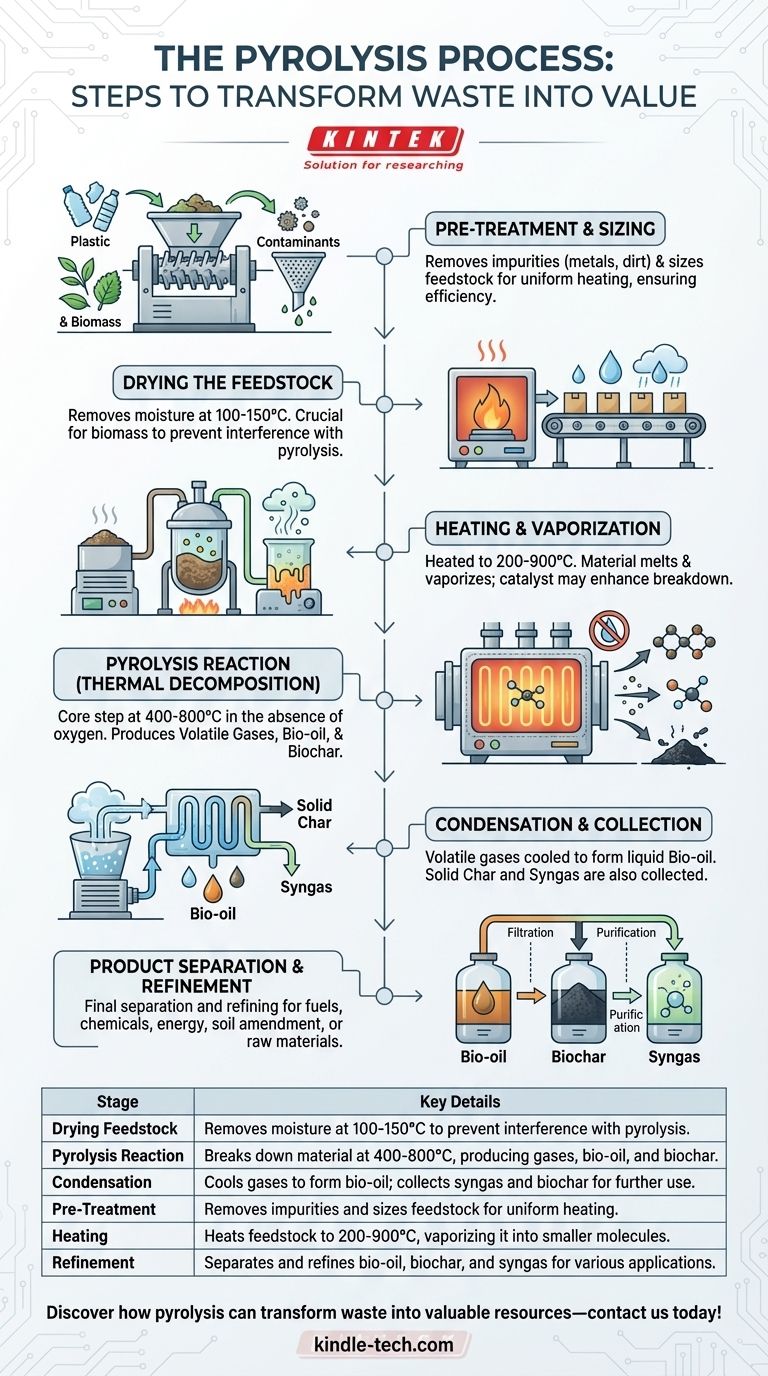
What is the pyrolysis process? A Sustainable Solution for Waste Conversion Visual Guide

Related Products

People Also Ask

Related Products

Electric Rotary Kiln Small Rotary Furnace Biomass Pyrolysis Plant

Electric Rotary Kiln Small Rotary Furnace Biomass Pyrolysis Plant

Learn about Rotary Biomass Pyrolysis Furnaces & how they decompose organic material at high temps without oxygen. Use for biofuels, waste processing, chemicals & more.

Electric Rotary Kiln Continuous Working Small Rotary Furnace Heating Pyrolysis Plant

Electric Rotary Kiln Continuous Working Small Rotary Furnace Heating Pyrolysis Plant

Efficiently calcine and dry bulk powder and lump fluid materials with an electric heating rotary furnace. Ideal for processing lithium ion battery materials and more.

Rotary Tube Furnace Split Multi Heating Zone Rotating Tube Furnace

Rotary Tube Furnace Split Multi Heating Zone Rotating Tube Furnace

Multi zone rotary furnace for high-precision temperature control with 2-8 independent heating zones. Ideal for lithium ion battery electrode materials and high-temperature reactions. Can work under vacuum and controlled atmosphere.

Vacuum Sealed Continuous Working Rotary Tube Furnace Rotating Tube Furnace

Vacuum Sealed Continuous Working Rotary Tube Furnace Rotating Tube Furnace

Experience efficient material processing with our vacuum-sealed rotary tube furnace. Perfect for experiments or industrial production, equipped with optional features for controlled feeding and optimized results. Order now.

600T Vacuum Induction Hot Press Furnace for Heat Treat and Sintering

600T Vacuum Induction Hot Press Furnace for Heat Treat and Sintering

Discover the 600T Vacuum Induction Hot Press Furnace, designed for high-temperature sintering experiments in vacuum or protected atmospheres. Its precise temperature and pressure control, adjustable working pressure, and advanced safety features make it ideal for nonmetal materials, carbon composites, ceramics, and metal powders.

Small Vacuum Heat Treat and Tungsten Wire Sintering Furnace

Small Vacuum Heat Treat and Tungsten Wire Sintering Furnace

The small vacuum tungsten wire sintering furnace is a compact experimental vacuum furnace specially designed for universities and scientific research institutes. The furnace features a CNC welded shell and vacuum piping to ensure leak-free operation. Quick-connect electrical connections facilitate relocation and debugging, and the standard electrical control cabinet is safe and convenient to operate.

Vacuum Heat Treat and Molybdenum Wire Sintering Furnace for Vacuum Sintering

Vacuum Heat Treat and Molybdenum Wire Sintering Furnace for Vacuum Sintering

A vacuum molybdenum wire sintering furnace is a vertical or bedroom structure, which is suitable for withdrawal, brazing, sintering and degassing of metal materials under high vacuum and high temperature conditions. It is also suitable for dehydroxylation treatment of quartz materials.

1200℃ Controlled Atmosphere Furnace Nitrogen Inert Atmosphere Furnace

1200℃ Controlled Atmosphere Furnace Nitrogen Inert Atmosphere Furnace

Discover our KT-12A Pro Controlled atmosphere furnace - high precision, heavy duty vacuum chamber, versatile smart touch screen controller, and excellent temperature uniformity up to 1200C. Ideal for both laboratory and industrial application.

1400℃ Controlled Atmosphere Furnace with Nitrogen and Inert Atmosphere

1400℃ Controlled Atmosphere Furnace with Nitrogen and Inert Atmosphere

Achieve precise heat treatment with KT-14A controlled atmosphere furnace. Vacuum sealed with a smart controller, it's ideal for lab and industrial use up to 1400℃.

Non Consumable Vacuum Arc Induction Melting Furnace

Non Consumable Vacuum Arc Induction Melting Furnace

Explore the benefits of Non-Consumable Vacuum Arc Furnace with high melting point electrodes. Small, easy to operate & eco-friendly. Ideal for laboratory research on refractory metals & carbides.

Chemical Vapor Deposition CVD Equipment System Chamber Slide PECVD Tube Furnace with Liquid Gasifier PECVD Machine

Chemical Vapor Deposition CVD Equipment System Chamber Slide PECVD Tube Furnace with Liquid Gasifier PECVD Machine

KT-PE12 Slide PECVD System: Wide power range, programmable temp control, fast heating/cooling with sliding system, MFC mass flow control & vacuum pump.

Molybdenum Tungsten Tantalum Special Shape Evaporation Boat

Molybdenum Tungsten Tantalum Special Shape Evaporation Boat

Tungsten Evaporation Boat is ideal for vacuum coating industry and sintering furnace or vacuum annealing. we offers tungsten evaporation boats that are designed to be durable and robust, with long operating lifetimes and to ensure consistent smooth and even spreading of the molten metals.

RF PECVD System Radio Frequency Plasma-Enhanced Chemical Vapor Deposition RF PECVD

RF PECVD System Radio Frequency Plasma-Enhanced Chemical Vapor Deposition RF PECVD

RF-PECVD is an acronym for "Radio Frequency Plasma-Enhanced Chemical Vapor Deposition." It deposits DLC (Diamond-like carbon film) on germanium and silicon substrates. It is utilized in the 3-12um infrared wavelength range.

RRDE rotating disk (ring disk) electrode / compatible with PINE, Japanese ALS, Swiss Metrohm glassy carbon platinum

RRDE rotating disk (ring disk) electrode / compatible with PINE, Japanese ALS, Swiss Metrohm glassy carbon platinum

Elevate your electrochemical research with our Rotating Disk and Ring Electrodes. Corrosion resistant and customizable to your specific needs, with complete specifications.

Inclined Rotary Plasma Enhanced Chemical Vapor Deposition PECVD Equipment Tube Furnace Machine

Inclined Rotary Plasma Enhanced Chemical Vapor Deposition PECVD Equipment Tube Furnace Machine

Upgrade your coating process with PECVD coating equipment. Ideal for LED, power semiconductors, MEMS and more. Deposits high-quality solid films at low temps.

VHP Sterilization Equipment Hydrogen Peroxide H2O2 Space Sterilizer

VHP Sterilization Equipment Hydrogen Peroxide H2O2 Space Sterilizer

A hydrogen peroxide space sterilizer is a device that uses vaporized hydrogen peroxide to decontaminate enclosed spaces. It kills microorganisms by damaging their cellular components and genetic material.

High Performance Laboratory Freeze Dryer for Research and Development

High Performance Laboratory Freeze Dryer for Research and Development

Advanced laboratory freeze dryer for lyophilization, preserving sensitive samples with precision. Ideal for biopharmaceuticals, research & food industries.

CVD Diamond for Thermal Management Applications

CVD Diamond for Thermal Management Applications

CVD diamond for thermal management: High-quality diamond with thermal conductivity up to 2000 W/mK, ideal for heat spreaders, laser diodes, and GaN on Diamond (GOD) applications.

Rotating Platinum Disk Electrode for Electrochemical Applications

Rotating Platinum Disk Electrode for Electrochemical Applications

Upgrade your electrochemical experiments with our Platinum Disc Electrode. High-quality and reliable for accurate results.

Electrolytic Electrochemical Cell Gas Diffusion Liquid Flow Reaction Cell

Electrolytic Electrochemical Cell Gas Diffusion Liquid Flow Reaction Cell

Looking for a high-quality gas diffusion electrolysis cell? Our liquid flow reaction cell boasts exceptional corrosion resistance and complete specifications, with customizable options available to suit your needs. Contact us today!


Leave Your Message