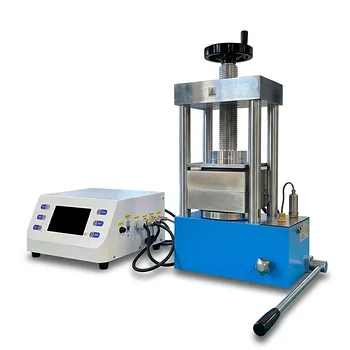
The primary technical advantage of using a manual hydraulic press with carbide dies for Yttria-stabilized Ceria lies in the ability to apply massive axial pressure—typically 300 to 400 MPa—without compromising dimensional stability. This setup forces ceramic particles to overcome inter-particle friction and rearrange into a highly dense, dimensionally precise "green body" (the unfired part).
Core Takeaway The rigidity of carbide dies combined with high hydraulic pressure creates a green body with uniform internal density and precise geometry. This structural integrity is the critical prerequisite for successful, defect-free pressureless sintering.
Achieving High-Density Compaction
The Role of High Axial Pressure
To form a viable green body from oxide powders, you must force the particles to pack tightly together.
A manual hydraulic press generates significant force, typically delivering pressures between 300 MPa and 400 MPa.
Overcoming Friction
At these high pressures, the applied force overcomes the friction between individual ceramic particles.
This allows the particles to slide past one another and rearrange, significantly reducing porosity and increasing the packing density of the material before it ever enters a furnace.
The Critical Role of Carbide Dies
Resisting Deformation
The specific advantage of using carbide (tungsten carbide) rather than standard tool steel is its extreme rigidity and wear resistance.
Under the massive load of 400 MPa, softer die materials might expand or deform elastically.
Carbide dies maintain their shape rigidly, ensuring that the pressure is directed entirely into compressing the powder rather than expanding the mold cavity.
Dimensional Precision and Edge Quality
Because the die does not distort, the resulting green body retains precise geometric dimensions.
This rigidity also results in neat, sharp edges on the pressed part, reducing the need for post-processing or machining of the fragile green body.
Impact on Sintering Performance
Creating a Uniform Foundation
The ultimate goal of pressing is to prepare the material for pressureless sintering.
The combination of high pressure and a rigid die results in uniform internal density throughout the part.
Preventing Defects
If a green body has inconsistent density, it will shrink unevenly during firing, leading to warping or cracking.
By ensuring uniformity at the pressing stage, you provide a high-quality foundation that maximizes the likelihood of a successful, defect-free final ceramic product.
Understanding the Trade-offs
While this setup is excellent for laboratory scale and high-precision prototyping, it is not without limitations.
Manual Variability
Because the system is manual, the rate of pressurization and the dwell time (how long pressure is held) rely on the operator.
Inconsistent operation between batches can lead to slight variations in green density, which may affect reproducibility in a production environment.
Density Gradients
Uniaxial pressing (pressing from one direction), even with carbide dies, can create density gradients in taller parts.
Friction between the powder and the die wall can cause the middle of the cylinder to be less dense than the ends, potentially leading to "hourglassing" during sintering.
Making the Right Choice for Your Goal
When deciding if this method suits your specific application, consider the scale and precision required.
- If your primary focus is research and prototyping: This method is ideal because the carbide die ensures the highest possible geometric accuracy and density for small sample sizes.
- If your primary focus is cost-efficiency for non-critical parts: You may find the cost of carbide tooling unnecessary; standard steel dies may suffice for lower-pressure applications.
The combination of high hydraulic pressure and carbide rigidity is the gold standard for producing green bodies that require minimal post-processing and ensure reliable sintering.
Summary Table:
| Feature | Technical Advantage | Impact on Final Product |
|---|---|---|
| Pressure Range | 300 - 400 MPa axial force | Maximizes packing density and reduces porosity |
| Die Material | Tungsten Carbide (Rigid) | Prevents mold deformation; ensures sharp edges |
| Internal Density | High Uniformity | Minimizes warping and cracking during sintering |
| Dimensional Stability | Minimal Elastic Expansion | Precise geometric accuracy with no post-processing |
Elevate Your Materials Research with KINTEK Precision
Ready to achieve superior green body density? KINTEK specializes in high-performance laboratory equipment, including our robust manual and isostatic hydraulic presses, as well as ultra-durable carbide dies designed for high-pressure applications.
Whether you are working on advanced ceramics, battery research, or powder metallurgy, our comprehensive range of crushing, milling, and high-temperature furnace solutions ensures your samples meet the highest standards of structural integrity.
Contact KINTEK today to find the perfect pressing solution for your lab!
References
- Laurent Brissonneau, Martin-Garin Anna. Microstructure of Yttria-Doped Ceria as a Function of Oxalate Co-Precipitation Synthesis Conditions. DOI: 10.1007/s40553-016-0087-8
This article is also based on technical information from Kintek Solution Knowledge Base .
Related Products
- Manual Heated Hydraulic Press Machine with Heated Plates for Laboratory Hot Press
- Laboratory Manual Hydraulic Pellet Press for Lab Use
- Manual High Temperature Heated Hydraulic Press Machine with Heated Plates for Lab
- Laboratory Manual Hydraulic Pellet Press for Lab Use
- Heated Hydraulic Press Machine with Integrated Manual Heated Plates for Lab Use
People Also Ask
- Why use laboratory manual hydraulic presses for semiconductor pellets? Optimize Annealing & Crystalline Quality
- What is manual hydraulic press? A Guide to Simple, High-Force Compression
- How is a laboratory manual hydraulic press used in solid-state battery testing? Optimize Electrode Performance
- How does a laboratory hydraulic hot press ensure the quality of PHBV/natural fiber composites? Expert Guide
- Why is a laboratory hydraulic hot press essential for high-density, additive-free Silicon Carbide? Unlock Pure SiC.