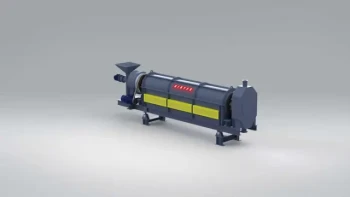
The technical advantage of a $CO_2$-controlled tube furnace lies in its ability to selectively etch carbon surfaces at high temperatures to create dense microporous structures. By maintaining a precise 800°C environment, the furnace facilitates a weak oxidation reaction where $CO_2$ molecules "burn off" specific carbon atoms to clear blocked channels. This process significantly increases the specific surface area and ensures a high-purity final product optimized for adsorption.
The core advantage of this system is the synergy between precise atmosphere isolation and targeted chemical etching. A tube furnace provides the stable, gas-tight environment necessary for $CO_2$ to act as a precision tool for sculpting the carbon skeleton without causing total combustion.
Precision Pore Engineering and Surface Modification
Targeted Disproportionation Reactions
At temperatures between 700°C and 900°C, $CO_2$ acts as a weak oxidizing agent that triggers a disproportionation reaction with the carbon matrix. This reaction selectively removes carbon atoms, effectively "etching" the biochar skeleton to create a highly developed micropore network.
Dredging and Pore Development
The precise airflow of a tube furnace allows $CO_2$ molecules to penetrate deep into the material, dredging original pores that were blocked by tar or volatiles during carbonization. This process generates a massive number of new micropores, which can account for 76% to 90% of the total volume of the activated carbon.
Increasing Specific Surface Area
By clearing blocked pathways and creating new voids, the $CO_2$ atmosphere significantly expands the specific surface area. This expansion is critical for increasing the number of available adsorption sites, making the charcoal highly effective at capturing pigments or Volatile Organic Compounds (VOCs).
Superior Environmental and Thermal Control
Atmosphere Integrity and Sealing
Tube furnaces offer superior gas tightness compared to standard muffle furnaces, ensuring a fully sealed environment. This integrity is essential for preventing oxygen ingress, which would lead to the unwanted aerobic combustion and loss of the carbon material.
Precise Heating Rates and Residence Time
The ability to set exact heating rates (e.g., 10°C per minute) and residence times allows for consistent thermal decomposition. This precision ensures that the dehydration and degassing phases are completed before activation begins, leading to a more uniform pore structure.
Uniform Gas-Solid Interaction
The design of the tube furnace, particularly rotary models, facilitates thorough contact between the $CO_2$ gas and the solid biomass. This uniform interaction ensures that the entire batch of charcoal undergoes the same level of activation, preventing localized over-processing or under-activation.
Understanding the Trade-offs
The Balance of Yield vs. Porosity
While $CO_2$ activation increases surface area, it does so by consuming the carbon skeleton, a process known as burn-off. Higher activation levels result in better adsorption properties but lead to a lower total yield of the final product.
Risks of Over-Activation
If the temperature or exposure time is not strictly controlled, the $CO_2$ may etch the carbon too aggressively. This can cause the walls between micropores to collapse, creating larger macropores that may be less effective for specific gas-phase adsorption tasks.
Equipment Sensitivity and Maintenance
Maintaining the vacuum-tight seals and precision flow meters required for $CO_2$ control adds mechanical complexity. Any leak in the system not only compromises the quality of the activation but can also lead to inconsistent results across different production batches.
How to Apply This to Your Project
When utilizing a tube furnace for biomass activation, your technical parameters should align with your specific material goals:
- If your primary focus is Maximum Adsorption Capacity: Prioritize higher activation temperatures (near 800°C-900°C) and longer residence times to maximize the development of the micropore network.
- If your primary focus is High Product Yield: Utilize lower activation temperatures and shorter $CO_2$ exposure times to minimize carbon burn-off while still clearing essential pore blockages.
- If your primary focus is Purity and Consistency: Ensure the furnace is purged with nitrogen before switching to $CO_2$ to remove all traces of oxygen and volatiles before the activation phase begins.
By leveraging the precise atmosphere control of a tube furnace, you can transform raw biomass into a high-value, engineered carbon material with specific molecular-level properties.
Summary Table:
| Feature | Technical Benefit | Impact on Biochar |
|---|---|---|
| CO2 Atmosphere | Selective surface etching | Dense microporous structure (76-90% volume) |
| Gas-Tight Sealing | Prevents oxygen ingress | High-purity product; prevents aerobic combustion |
| Rotary Design | Uniform gas-solid contact | Consistent activation across the entire batch |
| Precise Heating | Controlled rates/residence time | Optimized dehydration and uniform pore structure |
| Surface Tuning | Targeted chemical etching | Increased specific surface area for adsorption |
Elevate Your Biomass Research with KINTEK Precision
Unlock the full potential of your carbon materials with KINTEK’s industry-leading thermal solutions. Whether you are engineering microporous structures or optimizing specific surface areas for VOC capture, our high-temperature tube furnaces (including rotary, vacuum, and atmosphere-controlled models) deliver the exact thermal stability and gas integrity required for superior activation results.
As specialists in laboratory equipment, KINTEK provides a comprehensive range of tools designed for precision material science, from crushing and milling systems for feedstock preparation to high-pressure reactors, autoclaves, and hydraulic presses for advanced research. We support your entire workflow with reliable cooling solutions, homogenizers, and high-quality consumables like ceramics and crucibles.
Ready to optimize your activation process and ensure consistent material purity? Contact KINTEK today to find the perfect equipment for your laboratory!
References
- Min Hou, Can Liu. Preparation of Biomass Biochar with Components of Similar Proportions and Its Methylene Blue Adsorption. DOI: 10.3390/molecules28176261
This article is also based on technical information from Kintek Solution Knowledge Base .
Related Products
- 1200℃ Controlled Atmosphere Furnace Nitrogen Inert Atmosphere Furnace
- 1700℃ Controlled Atmosphere Furnace Nitrogen Inert Atmosphere Furnace
- 1400℃ Controlled Atmosphere Furnace with Nitrogen and Inert Atmosphere
- Mesh belt controlled atmosphere furnace
- Controlled Nitrogen Inert Hydrogen Atmosphere Furnace
People Also Ask
- What is controlled atmosphere furnace? Precision Heating Without Oxidation for Superior Materials
- What is the function of a high-precision controlled atmosphere furnace for Alloy 617? Simulate Extreme VHTR Conditions
- Why is a high-temperature furnace with a controlled atmosphere required for S@MMPC? Master Precision Synthesis
- What is a controlled atmosphere furnace? Achieve Purity and Precision in High-Temp Processing
- What is a controlled atmosphere furnace for heat treatment? Master Surface Chemistry and Metallurgy