Knowledge What are three applications of evaporation in different industries? From OLEDs to Automotive Parts
Author avatar

Tech Team · Kintek Solution

Updated 6 days ago

What are three applications of evaporation in different industries? From OLEDs to Automotive Parts


Evaporation is a cornerstone of modern manufacturing, enabling the creation of everything from advanced electronics to protective automotive parts and high-end decorative finishes. Three key industrial applications include depositing thin films for OLED screens and solar cells, creating light reflectors for the automotive industry, and applying metallic coatings to consumer goods for EMI shielding or aesthetic appeal.

At its core, industrial evaporation is not about simple drying. It is a sophisticated vacuum deposition technique used to apply ultra-thin, highly pure films of a material onto a surface, giving that product specific optical, electrical, or aesthetic properties.
What are three applications of evaporation in different industries? From OLEDs to Automotive Parts

What is Industrial Thermal Evaporation?

The term "evaporation" in an industrial context almost always refers to thermal evaporation. This is a specific type of Physical Vapor Deposition (PVD), a process for creating high-performance coatings.

The Core Principle: Heating and Vaporization

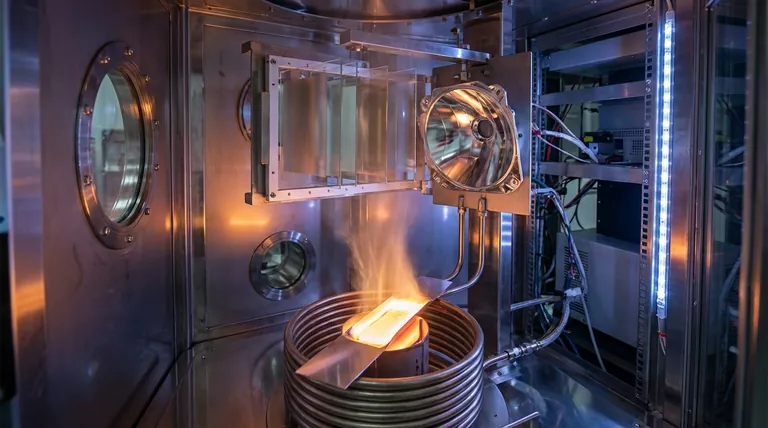
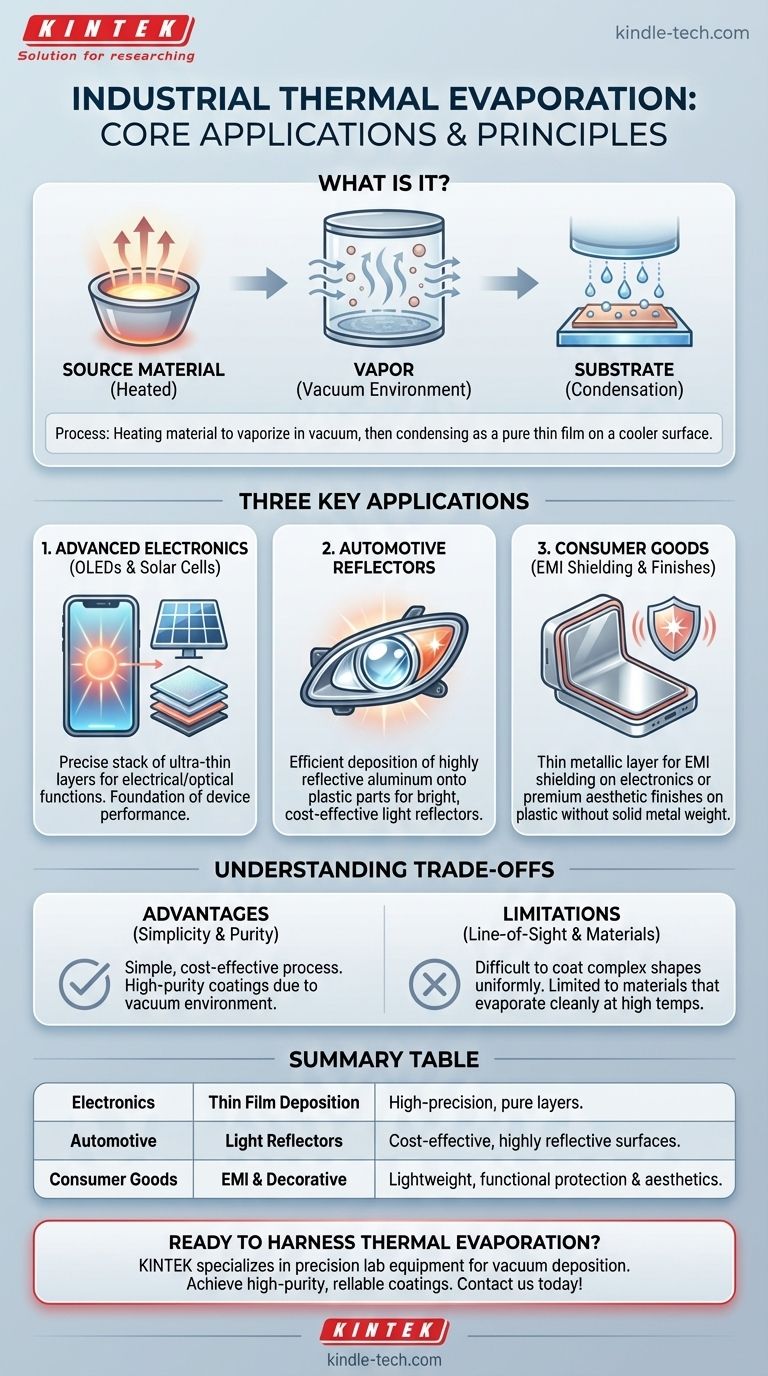
The process begins by placing a source material, such as a metal like aluminum, into a high-vacuum chamber. This material is then heated until it evaporates, turning from a solid into a gas or vapor.

The Deposition Process: Condensation on a Substrate

This vapor then travels through the vacuum and makes contact with a cooler object, known as the substrate. Upon contact, the vapor rapidly condenses back into a solid, forming a very thin, uniform film on the substrate's surface.

Why a Vacuum is Essential

The entire process must occur in a vacuum for two critical reasons. First, the vacuum ensures the vaporized material remains pure and doesn't react with air. Second, it allows the vapor molecules to travel in a straight line directly to the substrate, ensuring a clean and direct coating.

A Closer Look at Key Applications

Thermal evaporation is valued for its versatility, enabling a wide range of products across different sectors.

Application 1: Advanced Electronics (OLEDs & Solar Cells)

In devices like OLED screens and solar cells, performance depends on a precise stack of incredibly thin material layers. Thermal evaporation is used to deposit these layers, each with a specific electrical or optical function, building the foundation of the device's performance.

Application 2: Automotive Light Reflectors

The brilliant, mirror-like surface inside a car's headlight is not polished metal. It is typically a plastic part coated with a thin, highly reflective layer of aluminum applied using thermal evaporation. This process is efficient, cost-effective, and creates a perfect reflective surface.

Application 3: EMI/RFI Shielding & Decorative Finishes

Many plastic electronic casings are coated with a thin layer of metal to provide EMI (electromagnetic interference) shielding, protecting the sensitive components inside. The same process is also used for purely decorative purposes, such as giving a plastic cosmetic cap a premium, metallic finish without the cost or weight of solid metal.

Understanding the Trade-offs

While powerful, thermal evaporation is not the solution for every challenge. It's important to understand its advantages and limitations.

Advantage: Simplicity and Purity

Compared to other deposition methods, thermal evaporation is a relatively simple and cost-effective process. Because it happens in a vacuum, it produces coatings of very high purity.

Limitation: Line-of-Sight Deposition

The vapor travels in a straight line from the source to the substrate. This makes it difficult to uniformly coat complex, three-dimensional shapes with undercuts or hidden surfaces without sophisticated part rotation.

Limitation: Material Constraints

The process is best suited for materials that evaporate cleanly at high temperatures. Materials that decompose or react when heated cannot be effectively deposited using this method.

Making the Right Choice for Your Goal

To apply this knowledge, consider the primary goal of the coating.

  • If your primary focus is high-precision electronics: Evaporation is a critical technology for building the layered, functional structures in components like OLEDs and solar cells.
  • If your primary focus is functional, high-volume surfaces: The process is ideal and cost-effective for creating reflective or conductive coatings for automotive, aerospace, or medical parts.
  • If your primary focus is aesthetic and cost-effective finishes: It provides a premium metallic look for consumer goods without the expense and weight of using solid metal.

Ultimately, thermal evaporation demonstrates how a fundamental physical principle is harnessed to create the sophisticated and reliable products we use every day.

Summary Table:

Application Industry Key Benefit
Thin Film Deposition Electronics (OLEDs, Solar Cells) High-precision, pure layers for device performance
Light Reflectors Automotive Cost-effective, highly reflective surfaces
EMI Shielding & Decorative Coatings Consumer Goods Lightweight, aesthetic, and functional protection

Ready to harness the power of thermal evaporation for your projects? KINTEK specializes in precision lab equipment and consumables for vacuum deposition processes. Whether you're developing advanced electronics, automotive components, or consumer goods, our expertise ensures you achieve high-purity, reliable coatings. Contact us today to discuss how our solutions can elevate your manufacturing process!

Visual Guide
What are three applications of evaporation in different industries? From OLEDs to Automotive Parts Visual Guide

Related Products

People Also Ask

Related Products

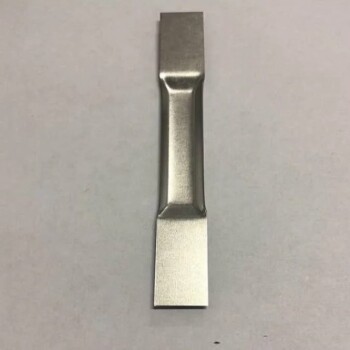
Molybdenum Tungsten Tantalum Evaporation Boat for High Temperature Applications

Molybdenum Tungsten Tantalum Evaporation Boat for High Temperature Applications

Evaporation boat sources are used in thermal evaporation systems and are suitable for depositing various metals, alloys and materials. Evaporation boat sources are available in different thicknesses of tungsten, tantalum and molybdenum to ensure compatibility with a variety of power sources. As a container, it is used for vacuum evaporation of materials. They can be used for thin film deposition of various materials, or designed to be compatible with techniques such as electron beam fabrication.

RF PECVD System Radio Frequency Plasma-Enhanced Chemical Vapor Deposition RF PECVD

RF PECVD System Radio Frequency Plasma-Enhanced Chemical Vapor Deposition RF PECVD

RF-PECVD is an acronym for "Radio Frequency Plasma-Enhanced Chemical Vapor Deposition." It deposits DLC (Diamond-like carbon film) on germanium and silicon substrates. It is utilized in the 3-12um infrared wavelength range.

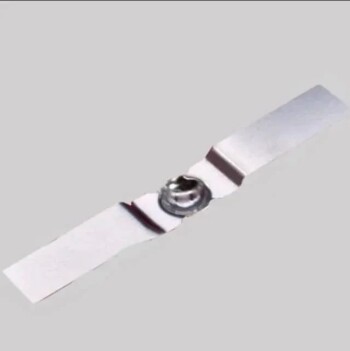
Hemispherical Bottom Tungsten Molybdenum Evaporation Boat

Hemispherical Bottom Tungsten Molybdenum Evaporation Boat

Used for gold plating, silver plating, platinum, palladium, suitable for a small amount of thin film materials. Reduce the waste of film materials and reduce heat dissipation.

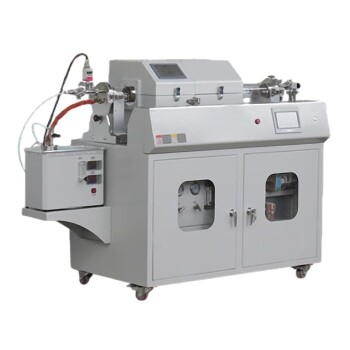
Chemical Vapor Deposition CVD Equipment System Chamber Slide PECVD Tube Furnace with Liquid Gasifier PECVD Machine

Chemical Vapor Deposition CVD Equipment System Chamber Slide PECVD Tube Furnace with Liquid Gasifier PECVD Machine

KT-PE12 Slide PECVD System: Wide power range, programmable temp control, fast heating/cooling with sliding system, MFC mass flow control & vacuum pump.

Evaporation Boat for Organic Matter

Evaporation Boat for Organic Matter

The evaporation boat for organic matter is an important tool for precise and uniform heating during the deposition of organic materials.

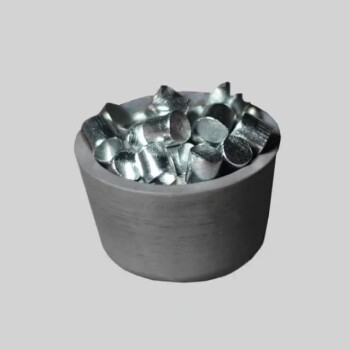
Electron Beam Evaporation Coating Conductive Boron Nitride Crucible BN Crucible

Electron Beam Evaporation Coating Conductive Boron Nitride Crucible BN Crucible

High-purity and smooth conductive boron nitride crucible for electron beam evaporation coating, with high temperature and thermal cycling performance.

Aluminized Ceramic Evaporation Boat for Thin Film Deposition

Aluminized Ceramic Evaporation Boat for Thin Film Deposition

Vessel for depositing thin films; has an aluminum-coated ceramic body for improved thermal efficiency and chemical resistance. making it suitable for various applications.

Tungsten Evaporation Boat for Thin Film Deposition

Tungsten Evaporation Boat for Thin Film Deposition

Learn about tungsten boats, also known as evaporated or coated tungsten boats. With a high tungsten content of 99.95%, these boats are ideal for high-temperature environments and widely used in various industries. Discover their properties and applications here.

E Beam Crucibles Electron Gun Beam Crucible for Evaporation

E Beam Crucibles Electron Gun Beam Crucible for Evaporation

In the context of electron gun beam evaporation, a crucible is a container or source holder used to contain and evaporate the material to be deposited onto a substrate.

Ceramic Evaporation Boat Set Alumina Crucible for Laboratory Use

Ceramic Evaporation Boat Set Alumina Crucible for Laboratory Use

It can be used for vapor deposition of various metals and alloys. Most metals can be evaporated completely without loss. Evaporation baskets are reusable.1

Cylindrical Resonator MPCVD Machine System Reactor for Microwave Plasma Chemical Vapor Deposition and Lab Diamond Growth

Cylindrical Resonator MPCVD Machine System Reactor for Microwave Plasma Chemical Vapor Deposition and Lab Diamond Growth

Learn about Cylindrical Resonator MPCVD Machine, the microwave plasma chemical vapor deposition method used for growing diamond gemstones and films in the jewelry and semi-conductor industries. Discover its cost-effective advantages over traditional HPHT methods.

Vacuum Cold Trap Direct Cold Trap Chiller

Vacuum Cold Trap Direct Cold Trap Chiller

Improve vacuum system efficiency and extend pump life with our Direct Cold Trap. No chilling fluid required, compact design with swivel casters. Stainless steel and glass options available.

VHP Sterilization Equipment Hydrogen Peroxide H2O2 Space Sterilizer

VHP Sterilization Equipment Hydrogen Peroxide H2O2 Space Sterilizer

A hydrogen peroxide space sterilizer is a device that uses vaporized hydrogen peroxide to decontaminate enclosed spaces. It kills microorganisms by damaging their cellular components and genetic material.

304 316 Stainless Steel Vacuum Ball Valve Stop Valve for High Vacuum Systems

304 316 Stainless Steel Vacuum Ball Valve Stop Valve for High Vacuum Systems

Discover 304/316 stainless steel vacuum ball valves, Ideal for high vacuum systems, Ensure precise control and durability. Explore now!

Platinum Sheet Electrode for Laboratory and Industrial Applications

Platinum Sheet Electrode for Laboratory and Industrial Applications

Elevate your experiments with our Platinum Sheet Electrode. Crafted with quality materials, our safe and durable models can be tailored to fit your needs.

RRDE rotating disk (ring disk) electrode / compatible with PINE, Japanese ALS, Swiss Metrohm glassy carbon platinum

RRDE rotating disk (ring disk) electrode / compatible with PINE, Japanese ALS, Swiss Metrohm glassy carbon platinum

Elevate your electrochemical research with our Rotating Disk and Ring Electrodes. Corrosion resistant and customizable to your specific needs, with complete specifications.

Laboratory High Pressure Horizontal Autoclave Steam Sterilizer for Lab Use

Laboratory High Pressure Horizontal Autoclave Steam Sterilizer for Lab Use

The horizontal autoclave steam sterilizer adopts the gravity displacement method to remove the cold air in the inner chamber, so that the inner steam and cold air content is less, and the sterilization is more reliable.

Three-dimensional electromagnetic sieving instrument

Three-dimensional electromagnetic sieving instrument

KT-VT150 is a desktop sample processing instrument for both sieving and grinding. Grinding and sieving can be used both dry and wet. The vibration amplitude is 5mm and the vibration frequency is 3000-3600 times/min.

Rotating Platinum Disk Electrode for Electrochemical Applications

Rotating Platinum Disk Electrode for Electrochemical Applications

Upgrade your electrochemical experiments with our Platinum Disc Electrode. High-quality and reliable for accurate results.

Graphite Vacuum Continuous Graphitization Furnace

Graphite Vacuum Continuous Graphitization Furnace

High-temperature graphitization furnace is a professional equipment for graphitization treatment of carbon materials. It is a key equipment for the production of high-quality graphite products. It has high temperature, high efficiency and uniform heating. It is suitable for various high-temperature treatments and graphitization treatments. It is widely used in metallurgy, electronics, aerospace, etc. industry.


Leave Your Message