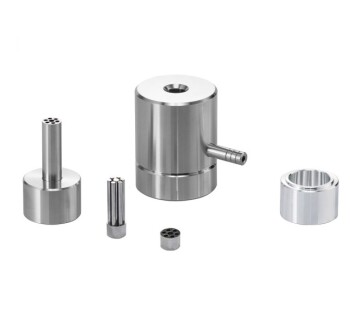
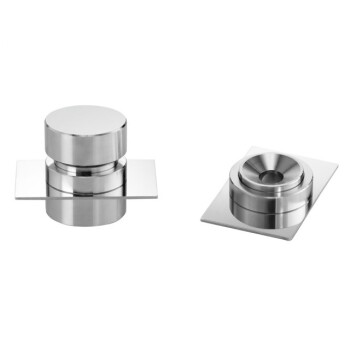
In vacuum hot press sintering, the mold functions as far more than a passive container; it acts as a critical interface for applying both mechanical force and thermal energy to the raw material. While its most obvious role is to define the shape of the powder, its ability to transmit significant pressure while maintaining structural integrity at high temperatures is the deciding factor in the final density of the sintered component.
Core Takeaway Molds in this process serve a dual mandate: they confine the powder to a specific geometry and act as a pressure transfer medium. By withstanding extreme thermal conditions, the mold effectively transmits hydraulic force to the powder, forcing particle contact and expelling gases to achieve high material density.
The Mechanics of Densification
Defining Component Geometry
At its most basic level, the mold serves as a shaping container. It confines the loose composite powder into a fixed volume, determining the final geometric dimensions of the sample once the process is complete.
Transmitting Uniaxial Pressure
The mold acts as the essential link between the machine's hydraulic system and the powder. It transmits uniaxial pressure—often ranging from 10 to over 30 MPa—from the hydraulic head directly to the internal powder mixture.
Driving Particle Cohesion
This transmission of pressure is not merely for containment; it is active and forceful. By compressing the powder, the mold forces particles into intimate contact and expels trapped gases. This mechanical action is vital for eliminating voids and achieving high density in the final sintered material.
Thermal and Structural Integrity
Withstanding Extreme Temperatures
The sintering process often requires temperatures ranging from 650°C to 1500°C. The mold must maintain high structural strength under these conditions to prevent deformation, which would compromise the dimensional accuracy of the final part.
Facilitating Uniform Heating
Materials like graphite are often chosen for molds because of their excellent thermal conductivity. The mold ensures that heat is distributed uniformly across the composite material, preventing thermal gradients that could lead to cracking or uneven sintering.
Acting as an Induction Receptor
In specific setups, the mold serves as an induction heating receptor. It converts electromagnetic energy into heat, effectively becoming the heating element that warms the powder from the outside in.
Chemical Stability and Efficiency
Preventing Chemical Interactions
In a vacuum or reducing atmosphere, the mold material (often graphite) remains chemically stable. It is generally chemically inert to many matrix materials (such as copper or aluminum-silicon alloys), preventing unwanted reactions that could contaminate the sample.
Ensuring Smooth Demolding
Because the mold does not easily bond with the metal matrix in these protective atmospheres, it facilitates easy removal of the finished part. This reduces the risk of damaging the sample during extraction and preserves the surface finish.
Extended Service Life
The vacuum environment minimizes oxidative loss for carbon-based molds like graphite. This protection significantly extends the mold's operational lifespan compared to conventional hot pressing, helping to lower overall production costs.
Understanding the Trade-offs
Material Compatibility Limits
While graphite molds are inert to many materials, they are not universally compatible with every powder type. You must verify that your specific powder mixture will not react with carbon at high temperatures, which could form unwanted carbides or degrade the mold surface.
Mechanical Limits vs. Pressure Needs
The mold must be strong, but materials like graphite can be brittle. There is a delicate balance between applying enough pressure (e.g., up to 100 MPa for some applications) to densify the powder and staying within the mechanical limits of the mold to avoid catastrophic fracture during the press.
Making the Right Choice for Your Goal
To maximize the success of your vacuum hot press sintering process, align your mold selection with your specific project requirements:
- If your primary focus is High Density: Prioritize a mold material with exceptional compressive strength to transmit maximum hydraulic pressure without deformation.
- If your primary focus is Dimensional Precision: Ensure the mold material has a low coefficient of thermal expansion and maintains high rigidity at your peak sintering temperature.
- If your primary focus is Surface Finish: Select a high-purity mold material known for chemical inertness relative to your specific powder to ensure effortless, clean demolding.
Ultimately, the mold is the active vessel that translates raw power and heat into structural integrity.
Summary Table:
| Function | Description | Impact on Final Component |
|---|---|---|
| Geometry Definition | Confines powder into a fixed volume. | Determines final shape and dimensional accuracy. |
| Pressure Transmission | Transmits 10-30+ MPa of uniaxial force. | Drives particle cohesion and eliminates voids/gases. |
| Thermal Conductivity | Distributes heat uniformly up to 1500°C. | Prevents thermal gradients and material cracking. |
| Chemical Stability | Remains inert in vacuum/reducing atmospheres. | Prevents contamination and ensures easy demolding. |
| Induction Heating | Acts as an electromagnetic receptor. | Enables efficient and localized heating of the powder. |
Elevate Your Material Research with KINTEK Precision Solutions
Maximize the success of your sintering processes with high-performance molds and equipment from KINTEK. Whether you are aiming for high density, extreme dimensional precision, or superior surface finishes, our expertise in vacuum hot press sintering ensures your laboratory achieves consistent, high-quality results.
Our comprehensive portfolio includes:
- Advanced Furnaces: Muffle, tube, rotary, vacuum, CVD, and specialized dental furnaces.
- Precision Pressing: Hydraulic pellet presses, hot presses, and isostatic systems.
- Specialized Reactors: High-temperature high-pressure reactors and autoclaves.
- Lab Essentials: Crushing/milling systems, electrolytic cells, and high-purity consumables like graphite and ceramic crucibles.
Don't let equipment limitations hinder your innovation. Let KINTEK provide the structural and thermal integrity your projects demand.
Contact Our Experts Today to Find the Right Solution for Your Lab!
Related Products
- 600T Vacuum Induction Hot Press Furnace for Heat Treat and Sintering
- Vacuum Heat Treat and Molybdenum Wire Sintering Furnace for Vacuum Sintering
- Vacuum Heat Treat and Pressure Sintering Furnace for High Temperature Applications
- Vacuum Heat Treat and Sintering Furnace with 9MPa Air Pressure
- Ball Press Mold for Lab
People Also Ask
- What role does an induction vacuum hot pressing furnace play in sintering? Achieve 98% Density in Carbide Blocks
- What advantages does a vacuum hot press furnace provide for LSLBO ceramic electrolytes? Achieve 94% Relative Density
- What role does a Vacuum Hot Press (VHP) furnace play in the densification of austenitic stainless steel 316 composites?
- What role does mechanical pressure play during the vacuum diffusion bonding of tungsten and copper? Keys to Solid Bonding
- What are the advantages of a vacuum hot press furnace for W-50%Cu? Achieve 99.6% Density at Lower Temperatures