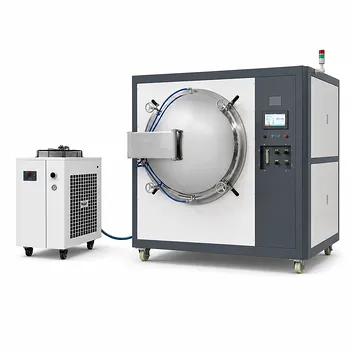
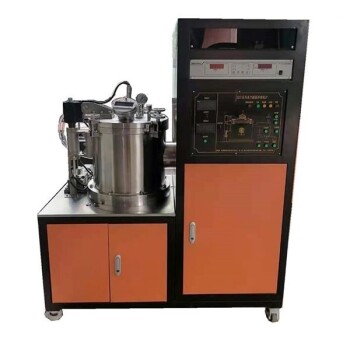
The vacuum sintering furnace provides a triad of critical conditions: a high-vacuum environment, precise high-temperature control, and uniform external pressure. Specifically, the vacuum prevents oxidation and removes existing oxide layers, while the combination of heat and pressure—often applied via argon gas and flexible membranes—facilitates atomic diffusion to bond the titanium layers seamlessly.
By strictly controlling these environmental variables, the furnace enables atomic-level bonding between stacked sheets. This process eliminates interfacial pores and transforms multilayer laminates into a single, isotropic composite with superior strength and toughness.
The Role of the Vacuum Environment
Prevention of Oxidation and Embrittlement
Titanium is highly reactive to oxygen, especially at high temperatures. A high-vacuum environment is non-negotiable because it prevents the formation of oxide layers that would otherwise act as a barrier to bonding.
By maintaining a vacuum, the furnace prevents the titanium from becoming brittle. This preservation of the material's inherent ductility is essential for the final mechanical performance of the laminate.
Surface Oxide Removal
Beyond prevention, the vacuum conditions actively assist in the inhibition or removal of existing surface oxides. This "cleaning" of the interface is a prerequisite for successful diffusion bonding.
When the oxide layer is removed, pure metal-to-metal contact is achieved. This condition allows atoms to migrate freely across the boundary between sheets.
Thermal and Mechanical Mechanisms
Facilitating Atomic Diffusion
The furnace provides the high-temperature environment necessary to increase the kinetic energy of the titanium atoms. Elevated temperatures mobilize the atoms, allowing them to migrate across the interface of the stacked sheets.
This migration creates a solid-state bond. The result is a structure where the original distinct layers merge into a unified whole.
Application of Isostatic Pressure
Heat alone is often insufficient to close all gaps between layers. The furnace applies external pressure, frequently utilizing argon gas in conjunction with a flexible membrane.
This pressure forces the surfaces into intimate contact. It ensures that the atomic diffusion occurs uniformly across the entire surface area of the laminate.
Microstructural Outcomes
Elimination of Interfacial Pores
The combination of atomic diffusion and external pressure effectively eliminates pores at the bond interface. Any voids that exist between the rough surfaces of the sheets are closed during the process.
A pore-free interface is critical for structural integrity. It ensures that the load-bearing capacity of the laminate is not compromised by internal defects.
Creation of Isotropic Properties
The ultimate goal of these process conditions is to produce a material with isotropic composite properties. This means the material exhibits uniform mechanical behavior in all directions.
The interfaces become indistinct, creating a uniform microstructure. This uniformity significantly enhances the material's toughness and resistance to fracture under impact.
Understanding the Trade-offs
Process Complexity and Cycle Time
While vacuum diffusion bonding produces exceptional results, it is a time-intensive batch process. The requirement for high vacuum levels and precise thermal cycles limits production speed compared to other joining methods.
Sensitivity to Surface Preparation
The furnace conditions are powerful, but they are not magic. The effectiveness of the vacuum in removing oxides relies heavily on the initial cleanliness and flatness of the titanium sheets. Poor surface preparation cannot be fully corrected by the furnace conditions alone, potentially leading to weak bonds.
Making the Right Choice for Your Goal
To maximize the performance of your titanium laminates, align your process parameters with your specific engineering requirements:
- If your primary focus is Impact Toughness: Prioritize the precision of the external pressure application (flexible membrane) to ensure absolute elimination of interfacial pores.
- If your primary focus is Material Purity: Ensure your furnace creates and maintains the deepest possible vacuum to completely prevent embrittlement from oxidation.
The success of diffusion bonding lies not just in applying heat and pressure, but in utilizing the vacuum to create a pristine environment where atomic physics can forge a flawless, unified material.
Summary Table:
| Process Condition | Primary Function | Impact on Titanium Laminate |
|---|---|---|
| High-Vacuum | Prevents/removes oxide layers | Ensures material ductility & metal-to-metal contact |
| High-Temperature | Increases atomic kinetic energy | Facilitates atomic migration across interfaces |
| Isostatic Pressure | Forces intimate surface contact | Eliminates interfacial pores for a pore-free bond |
| Controlled Cooling | Manages thermal stress | Results in uniform isotropic mechanical properties |
Elevate your material science capabilities with KINTEK’s industry-leading vacuum sintering furnaces. Whether you are producing complex multilayer titanium laminates or developing advanced isotropic composites, our precision equipment ensures the pristine environments required for perfect diffusion bonding. From high-temperature high-pressure reactors and autoclaves to specialized hydraulic presses and milling systems, KINTEK provides the comprehensive tools needed for superior laboratory and industrial results. Contact our experts today to find the perfect thermal processing solution for your lab!
References
- Damian Komar, V. A. Antonov. Spectrometric gamma radiation detection units based on high-resolution crystals SrI 2(Eu) and LaBr3(Ce). DOI: 10.21175/rad.abstr.book.2023.32.15
This article is also based on technical information from Kintek Solution Knowledge Base .
Related Products
- Vacuum Heat Treat and Molybdenum Wire Sintering Furnace for Vacuum Sintering
- Vacuum Heat Treat and Pressure Sintering Furnace for High Temperature Applications
- Vacuum Heat Treat and Sintering Furnace with 9MPa Air Pressure
- 2200 ℃ Tungsten Vacuum Heat Treat and Sintering Furnace
- Small Vacuum Heat Treat and Tungsten Wire Sintering Furnace
People Also Ask
- What is the pressure for vacuum sintering? Achieve Optimal Material Purity and Density
- What is vacuum hardness? Unlock Superior Material Performance with Vacuum Processing
- What are the critical functions of the vacuum system in a sintering furnace for Cu/Ti3SiC2/C/MWCNTs composites?
- How does a vacuum environment benefit the purification of matrix powders? Optimize Diamond Tool Sintering Efficiency
- What conditions does a vacuum sintering furnace provide for the diffusion bonding of titanium? Achieve Isotropic Purity