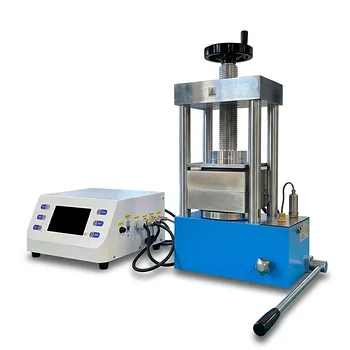
The laboratory hydraulic press is the definitive tool for optimizing the electrochemical interface in electrode fabrication. By applying precise, high-pressure compaction to Sodium Titanium Phosphate (NTP) active materials, the press ensures a robust mechanical bond with the current collector while significantly reducing interfacial resistance.
The core role of the hydraulic press is to transform a loose composite coating into a high-density, integrated electrode. This process is essential for maximizing volumetric energy density and ensuring the structural integrity required for long-term electrochemical cycling.
Enhancing Charge Transport and Conductive Pathways
Minimizing Interfacial Contact Resistance
The primary function of the hydraulic press is to eliminate the microscopic gaps between the active material slurry and the current collector (such as stainless steel or nickel mesh). By applying consistent vertical pressure, the press forces the NTP particles into intimate contact with the substrate, which creates an efficient pathway for electron flow.
Improving Inter-particle Connectivity
Beyond the substrate interface, compaction increases the electrical contact between individual particles within the electrode sheet. This creates a more continuous conductive network involving the active material, conductive carbon black, and binders, which is vital for maintaining low internal resistance during high-current operations.
Eliminating Internal Voids
High-pressure physical molding, often reaching levels like 6 MPa, serves to expel air and eliminate internal voids within the catalyst layer. This process ensures Ohmic contact throughout the electrode, preventing localized areas of high resistance that could skew research data or lead to premature cell failure.
Structural Integrity and Long-term Stability
Bonding the Active Layer to the Current Collector
NTP research requires electrodes that can withstand the physical stresses of battery assembly and electrolyte flushing. The hydraulic press creates a tight mechanical bond that prevents the active material from delaminating or peeling away from the current collector during repeated charge-discharge cycles.
Ensuring Consistency and Uniformity
Precise and stable pressure control allows researchers to achieve a uniform compaction density across the entire electrode sheet. This uniformity minimizes density gradients, ensuring that current distribution remains even and that the observed electrochemical behavior reflects the intrinsic properties of the NTP material rather than fabrication artifacts.
Facilitating High-Current Rate Performance
By optimizing the density and contact points, the hydraulic press directly improves the rate performance of the sodium battery. A well-compacted electrode can handle higher current densities without significant voltage drops, which is a critical metric in evaluating the viability of NTP for fast-charging applications.
Understanding the Trade-offs
Risk of Over-Compaction
While high pressure is necessary, excessive force can lead to electrode brittleness or damage to the current collector's structure, especially when using delicate meshes. Over-compacting can also reduce the porosity of the electrode to the point where electrolyte infiltration is hindered, negatively impacting ion transport.
Substrate Deformation
Applying several tons of pressure to irregular current collectors, such as steel mesh, requires careful calibration. Inconsistent pressure application can cause warping or mechanical failure of the substrate, which compromises the integrity of in-situ gas or pressure testing.
Making the Right Choice for Your Research Goal
How to Apply This to Your Project
To achieve the best results in Sodium Titanium Phosphate electrode fabrication, your pressing strategy should align with your specific research objectives.
- If your primary focus is Long-Cycle Life: Prioritize higher bonding pressures to ensure the active material remains securely attached to the current collector during the volume changes associated with sodium-ion intercalation.
- If your primary focus is High-Rate Performance: Focus on achieving the optimal balance between particle compaction and maintained porosity to allow for rapid electrolyte diffusion while keeping Ohmic resistance low.
- If your primary focus is Data Accuracy in In-Situ Testing: Use a hydraulic press with precise gauge control to ensure perfectly uniform electrode thickness, which eliminates artifacts caused by poor current distribution.
Properly executed hydraulic compaction is the bridge between a promising active material and a high-performance functional electrode.
Summary Table:
| Feature | Impact on NTP Research | Key Benefit |
|---|---|---|
| Compaction | Eliminates voids between NTP particles & current collectors | Minimizes interfacial contact resistance |
| Mechanical Bonding | Secures active material to substrate (mesh/foil) | Prevents delamination during cycling |
| Density Control | Ensures uniform thickness and particle connectivity | Maximizes volumetric energy density |
| Ohmic Contact | Creates continuous conductive pathways | Facilitates high-current rate performance |
Elevate Your Battery Research Precision with KINTEK
Achieve the perfect electrode density and interfacial integrity for your Sodium Titanium Phosphate (NTP) research. KINTEK specializes in high-performance laboratory equipment, providing the precision control researchers need for advanced energy storage solutions. Our robust range of manual and automatic hydraulic presses (pellet, hot, and isostatic) ensures perfectly uniform compaction for consistent, repeatable data.
Beyond electrode fabrication, KINTEK offers a comprehensive portfolio including:
- High-Temperature Furnaces: Muffle, tube, vacuum, and CVD/PECVD systems for material synthesis.
- Material Processing: Crushing, milling, and sieving systems for precursor preparation.
- Advanced Lab Tools: High-pressure reactors, autoclaves, and battery research consumables.
- Support Equipment: ULT freezers, cooling solutions, and precision homogenizers.
Ready to optimize your lab's workflow and performance? Contact KINTEK today for expert guidance and a custom quote!
References
- Nadežda Traškina, Linas Vilčiauskas. Polydopamine Derived NaTi<sub>2</sub>(PO<sub>4</sub>)<sub>3</sub>–Carbon Core–Shell Nanostructures for Aqueous Batteries and Deionization Cells. DOI: 10.1021/acsanm.3c01687
This article is also based on technical information from Kintek Solution Knowledge Base .
Related Products
- Laboratory Hydraulic Press Split Electric Lab Pellet Press
- Automatic Laboratory Hydraulic Press for XRF & KBR Pellet Press
- Ball Press Mold for Lab
- Heated Hydraulic Press Machine with Integrated Manual Heated Plates for Lab Use
- Automatic High Temperature Heated Hydraulic Press Machine with Heated Plates for Lab
People Also Ask
- What role does a laboratory hydraulic press play in platinum recovery research? Enhancing Sample Precision
- What are the specific applications of a lab hydraulic press in biochar evaluation? Optimize density and data accuracy.
- What are the roles of a laboratory hydraulic press and stainless steel molds in the preparation of graphite samples?
- What is the role of a laboratory hydraulic press in electrode prep? Maximize Energy Density & Sealing Precision
- Why must a laboratory hydraulic press equipped with cylindrical molds be used when preparing BZY green bodies? High Density