Knowledge atmosphere furnace What does nitrogen do in a furnace? Control Your Atmosphere to Prevent Oxidation & Ensure Quality
Author avatar

Tech Team · Kintek Solution

Updated 2 months ago

What does nitrogen do in a furnace? Control Your Atmosphere to Prevent Oxidation & Ensure Quality


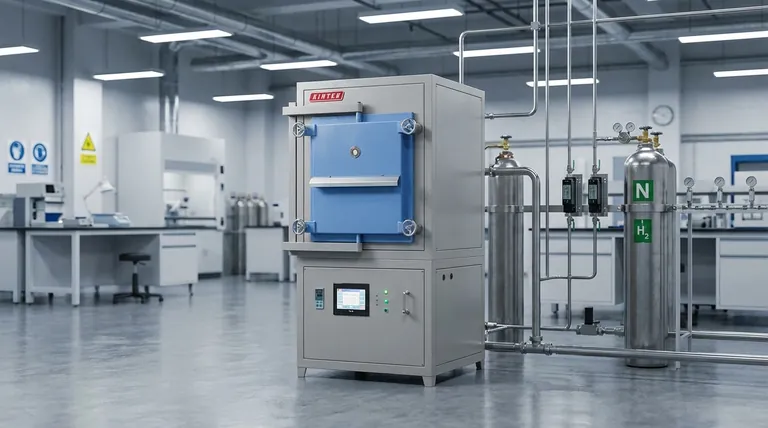
In a furnace, nitrogen's primary role is to create a controlled, inert atmosphere. It is pumped into the heating chamber to displace reactive gases, most importantly oxygen. This prevents unwanted chemical reactions like oxidation (scaling or rust) on the surface of the material being processed, ensuring the final product maintains its intended quality and integrity.

The fundamental reason to use nitrogen in a furnace is to gain control over the environment. By replacing the reactive air with an inert gas, you protect the workpiece from damage, prevent fire or explosion hazards, and ensure the final product meets precise specifications.
What does nitrogen do in a furnace? Control Your Atmosphere to Prevent Oxidation & Ensure Quality

The Core Problem: Uncontrolled Atmospheres

Why Normal Air is a Problem

At room temperature, the oxygen in the air is only mildly reactive. However, a furnace operates at extremely high temperatures, which act as a powerful catalyst for chemical reactions.

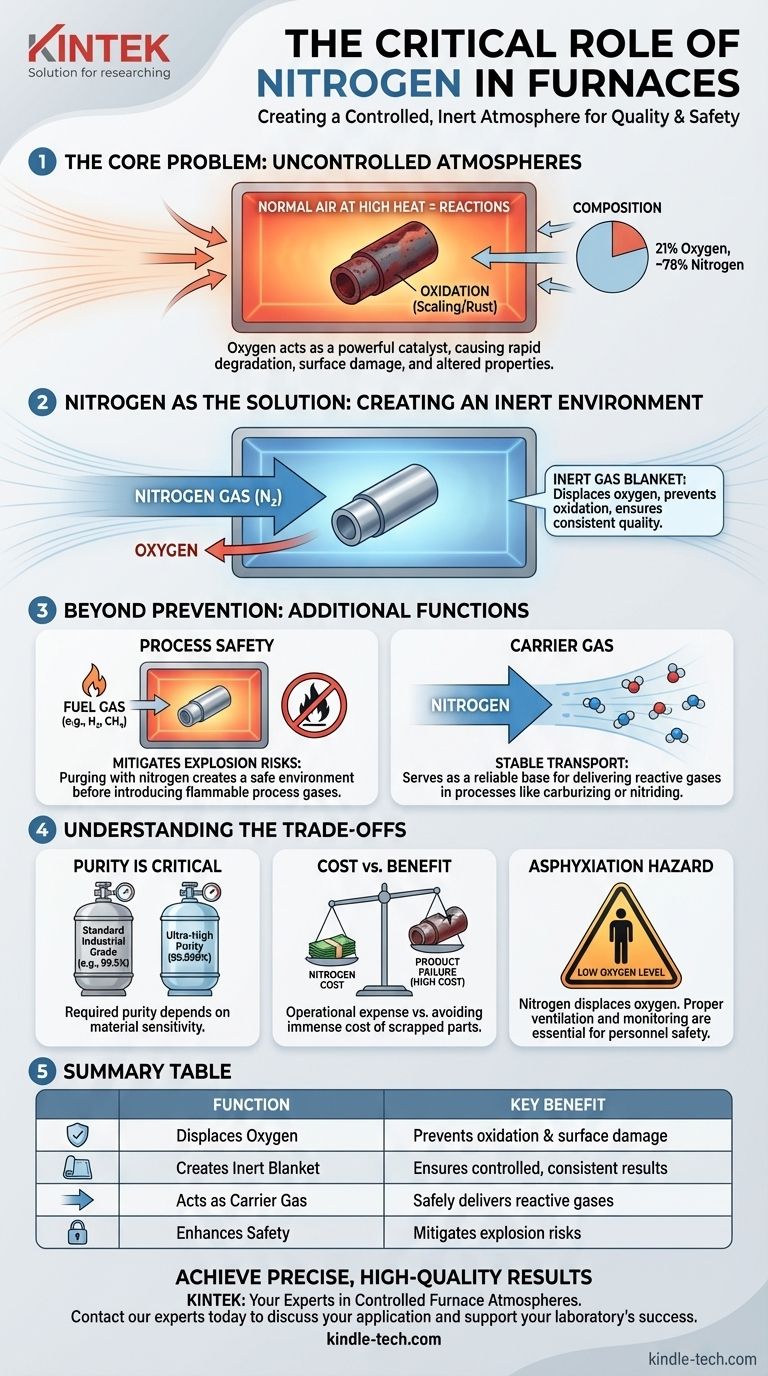
The air we breathe is approximately 21% oxygen. When a metal part is heated in the presence of this oxygen, the reaction is aggressive and rapid.

The Consequences of Oxidation

This high-temperature reaction with oxygen is called oxidation. On steel, it forms a dark, flaky layer known as mill scale. On other metals, it can cause severe discoloration and surface damage.

These effects are almost always undesirable. Oxidation can alter the dimensions of a precision part, ruin its surface finish, and in some cases, negatively impact the material's structural properties.

Nitrogen as the Solution: Creating an Inert Environment

Displacing Oxygen to Prevent Reactions

Nitrogen gas (N₂) is valued for being largely inert, meaning it does not readily react with other elements, even at high temperatures.

By continuously feeding nitrogen into a sealed furnace chamber, you can purge, or push out, the ambient air. This process, known as creating a nitrogen blanket or purge, effectively removes the oxygen from the equation. Without oxygen, the destructive oxidation reaction cannot occur.

Ensuring Process Safety

Many heat-treating processes introduce other flammable gases (like hydrogen or methane) to achieve specific results. An uncontrolled mixture of fuel gas and oxygen at high temperatures is the definition of an explosion hazard.

Nitrogen mitigates this risk. By first purging the chamber of oxygen, you create a safe environment into which flammable process gases can be introduced without the risk of combustion. Flowmeters and interlocks, as mentioned in control systems, are critical for managing this safety procedure.

Serving as a Carrier Gas

In more advanced processes, nitrogen is not just a passive blanket. It can also be used as a stable carrier gas.

For processes like carburizing (adding carbon) or nitriding (adding nitrogen in a reactive form), a precise atmosphere is required. Nitrogen can form the bulk of the atmosphere, carrying a small, controlled percentage of the "active" gas to the workpiece in a predictable way.

Understanding the Trade-offs

Purity is Critical

Not all nitrogen is the same. The required purity level depends entirely on the sensitivity of the material being heated.

For general-purpose annealing of a common steel, a standard industrial-grade nitrogen might suffice. For processing highly reactive metals like titanium or certain medical-grade stainless steels, an ultra-high purity (99.999%) nitrogen may be required, as even a few parts per million of oxygen can cause damage.

Cost vs. Benefit

Using nitrogen is an operational expense. The gas must be supplied from liquid tanks, high-pressure cylinders, or an on-site nitrogen generator.

This cost must be weighed against the immense cost of product failure. For high-value components, the cost of a controlled nitrogen atmosphere is negligible compared to the cost of scrapping a batch of parts due to oxidation.

The Asphyxiation Hazard

Safety for personnel is paramount. Nitrogen is not toxic, but it displaces oxygen. A leak from a furnace or supply line into an enclosed room can lower the oxygen level to a point that is immediately dangerous to human life, causing asphyxiation without warning. Proper ventilation and oxygen monitoring are non-negotiable safety requirements.

Making the Right Choice for Your Goal

Your approach to using nitrogen will depend entirely on your specific process and material.

  • If your primary focus is simple annealing or stress-relieving common steels: A basic nitrogen purge to prevent heavy scaling and ensure a clean surface is often sufficient.
  • If your primary focus is processing highly sensitive or reactive metals: You will require high-purity nitrogen and precise flow control to prevent even minor surface contamination.
  • If your primary focus is a reactive process like carburizing or nitriding: Nitrogen serves as the safe, inert base gas that carries smaller, controlled amounts of active gases to the workpiece.

Ultimately, using nitrogen is about taking deliberate control over the furnace environment to achieve a predictable, high-quality result.

Summary Table:

Function Key Benefit
Displaces Oxygen Prevents oxidation, scaling, and surface damage on materials.
Creates Inert Blanket Ensures a controlled, predictable environment for consistent results.
Acts as Carrier Gas Safely delivers reactive gases for processes like carburizing.
Enhances Safety Mitigates explosion risks by removing oxygen before introducing flammable gases.

Achieve precise, high-quality results with every heat treatment.

Whether you are annealing common steels or processing highly sensitive metals, controlling your furnace atmosphere is critical. KINTEK specializes in lab equipment and consumables, providing the solutions and expertise to help you implement safe, effective nitrogen atmospheres that protect your materials and ensure process reliability.

Contact our experts today to discuss your specific furnace application and discover how we can support your laboratory's success.

Visual Guide
What does nitrogen do in a furnace? Control Your Atmosphere to Prevent Oxidation & Ensure Quality Visual Guide

Related Products

People Also Ask

Related Products

1700℃ Controlled Atmosphere Furnace Nitrogen Inert Atmosphere Furnace

1700℃ Controlled Atmosphere Furnace Nitrogen Inert Atmosphere Furnace

KT-17A Controlled atmosphere furnace: 1700℃ heating, vacuum sealing technology, PID temperature control, and versatile TFT smart touch screen controller for laboratory and industrial use.

1200℃ Controlled Atmosphere Furnace Nitrogen Inert Atmosphere Furnace

1200℃ Controlled Atmosphere Furnace Nitrogen Inert Atmosphere Furnace

Discover our KT-12A Pro Controlled atmosphere furnace - high precision, heavy duty vacuum chamber, versatile smart touch screen controller, and excellent temperature uniformity up to 1200C. Ideal for both laboratory and industrial application.

1400℃ Controlled Atmosphere Furnace with Nitrogen and Inert Atmosphere

1400℃ Controlled Atmosphere Furnace with Nitrogen and Inert Atmosphere

Achieve precise heat treatment with KT-14A controlled atmosphere furnace. Vacuum sealed with a smart controller, it's ideal for lab and industrial use up to 1400℃.

Controlled Nitrogen Inert Hydrogen Atmosphere Furnace

Controlled Nitrogen Inert Hydrogen Atmosphere Furnace

KT-AH Hydrogen atmosphere furnace - induction gas furnace for sintering/annealing with built-in safety features, dual housing design, and energy-saving efficiency. Ideal for lab and industrial use.

Mesh belt controlled atmosphere furnace

Mesh belt controlled atmosphere furnace

Discover our KT-MB mesh belt sintering furnace - perfect for high-temperature sintering of electronic components & glass insulators. Available for open air or controlled atmosphere environments.

High Temperature Muffle Oven Furnace for Laboratory Debinding and Pre Sintering

High Temperature Muffle Oven Furnace for Laboratory Debinding and Pre Sintering

KT-MD High temperature debinding and pre-sintering furnace for ceramic materials with various molding processes. Ideal for electronic components such as MLCC and NFC.

Vertical High Temperature Graphite Vacuum Graphitization Furnace

Vertical High Temperature Graphite Vacuum Graphitization Furnace

Vertical high temperature graphitization furnace for carbonization and graphitization of carbon materials up to 3100℃.Suitable for shaped graphitization of carbon fiber filaments and other materials sintered in a carbon environment.Applications in metallurgy, electronics, and aerospace for producing high-quality graphite products like electrodes and crucibles.

Graphite Vacuum Furnace High Thermal Conductivity Film Graphitization Furnace

Graphite Vacuum Furnace High Thermal Conductivity Film Graphitization Furnace

The high thermal conductivity film graphitization furnace has uniform temperature, low energy consumption and can operate continuously.

Ultra-High Temperature Graphite Vacuum Graphitization Furnace

Ultra-High Temperature Graphite Vacuum Graphitization Furnace

The ultra-high temperature graphitization furnace utilizes medium frequency induction heating in a vacuum or inert gas environment. The induction coil generates an alternating magnetic field, inducing eddy currents in the graphite crucible, which heats up and radiates heat to the workpiece, bringing it to the desired temperature. This furnace is primarily used for graphitization and sintering of carbon materials, carbon fiber materials, and other composite materials.

Horizontal High Temperature Graphite Vacuum Graphitization Furnace

Horizontal High Temperature Graphite Vacuum Graphitization Furnace

Horizontal Graphitization Furnace: This type of furnace is designed with the heating elements placed horizontally, allowing for uniform heating of the sample. It's well-suited for graphitizing large or bulky samples that require precise temperature control and uniformity.

Laboratory Muffle Oven Furnace Bottom Lifting Muffle Furnace

Laboratory Muffle Oven Furnace Bottom Lifting Muffle Furnace

Efficiently produce batches with excellent temperature uniformity using our Bottom Lifting Furnace. Features two electric lifting stages and advanced temperature control up to 1600℃.

Rotary Tube Furnace Split Multi Heating Zone Rotating Tube Furnace

Rotary Tube Furnace Split Multi Heating Zone Rotating Tube Furnace

Multi zone rotary furnace for high-precision temperature control with 2-8 independent heating zones. Ideal for lithium ion battery electrode materials and high-temperature reactions. Can work under vacuum and controlled atmosphere.

Graphite Vacuum Furnace Bottom Discharge Graphitization Furnace for Carbon Materials

Graphite Vacuum Furnace Bottom Discharge Graphitization Furnace for Carbon Materials

Bottom-out graphitization furnace for carbon materials, ultra-high temperature furnace up to 3100°C, suitable for graphitization and sintering of carbon rods and carbon blocks. Vertical design, bottom discharging, convenient feeding and discharging, high temperature uniformity, low energy consumption, good stability, hydraulic lifting system, convenient loading and unloading.

Large Vertical Graphite Vacuum Graphitization Furnace

Large Vertical Graphite Vacuum Graphitization Furnace

A large vertical high-temperature graphitization furnace is a type of industrial furnace used for the graphitization of carbon materials, such as carbon fiber and carbon black. It is a high-temperature furnace that can reach temperatures of up to 3100°C.

Multi Heating Zones CVD Tube Furnace Machine Chemical Vapor Deposition Chamber System Equipment

Multi Heating Zones CVD Tube Furnace Machine Chemical Vapor Deposition Chamber System Equipment

KT-CTF14 Multi Heating Zones CVD Furnace - Precise Temperature Control and Gas Flow for Advanced Applications. Max temp up to 1200℃, 4 channels MFC mass flow meter, and 7" TFT touch screen controller.

Vacuum Heat Treat and Pressure Sintering Furnace for High Temperature Applications

Vacuum Heat Treat and Pressure Sintering Furnace for High Temperature Applications

Vacuum pressure sintering furnaces are designed for high temperature hot pressing applications in metal and ceramic sintering. Its advanced features ensure precise temperature control, reliable pressure maintenance, and a robust design for seamless operation.

1700℃ Muffle Oven Furnace for Laboratory

1700℃ Muffle Oven Furnace for Laboratory

Get superior heat control with our 1700℃ Muffle Furnace. Equipped with intelligent temperature microprocessor, TFT touch screen controller & advanced insulation materials for precise heating up to 1700C. Order now!

1200℃ Muffle Furnace Oven for Laboratory

1200℃ Muffle Furnace Oven for Laboratory

Upgrade your lab with our 1200℃ Muffle Furnace. Achieve fast, precise heating with Japan alumina fibers and Molybdenum coils. Features TFT touch screen controller for easy programming and data analysis. Order now!

Graphite Vacuum Continuous Graphitization Furnace

Graphite Vacuum Continuous Graphitization Furnace

High-temperature graphitization furnace is a professional equipment for graphitization treatment of carbon materials. It is a key equipment for the production of high-quality graphite products. It has high temperature, high efficiency and uniform heating. It is suitable for various high-temperature treatments and graphitization treatments. It is widely used in metallurgy, electronics, aerospace, etc. industry.

Multi-zone Laboratory Tube Furnace

Multi-zone Laboratory Tube Furnace

Experience precise, efficient thermal testing with our Multi Zone Tube Furnace. Independent heating zones and temperature sensors allow for controlled high-temperature gradient heating fields. Order now for advanced thermal analysis!


Leave Your Message



















