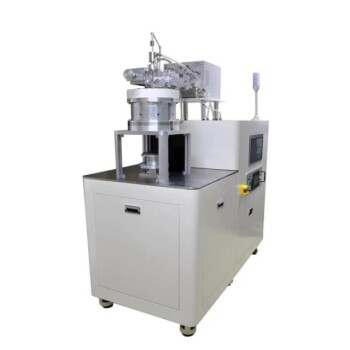
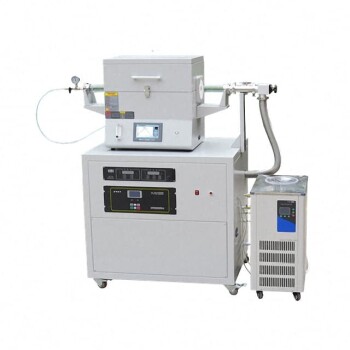
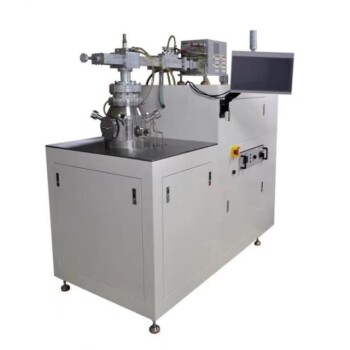
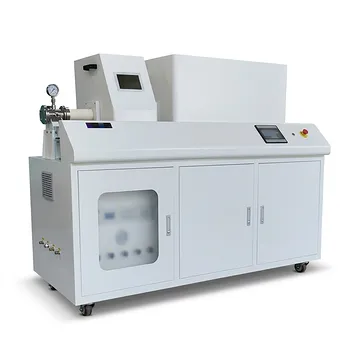
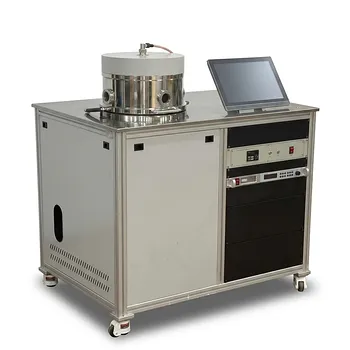
In the development of high-heat-resistant composites, a Chemical Vapor Deposition (CVD) system functions as a critical surface engineering tool used to apply protective coatings onto reinforcement fibers. Specifically, it deposits dense, chemically stable layers—such as Silicon Carbide (SiC)—onto materials like carbon fibers to shield them during manufacturing.
Core Takeaway: The primary value of CVD in this context is preservation and control. It creates a barrier that prevents the composite's matrix from chemically attacking the fibers during high-temperature processing, while simultaneously allowing engineers to optimize the bonding strength between the fiber and the matrix.
The Critical Role of Interfacial Control
The interface between the fiber and the matrix is the most vulnerable point in a composite material. CVD systems address this vulnerability through two specific mechanisms.
Preventing Fiber Degradation
During the manufacturing of high-heat composites, the processing temperatures can trigger aggressive chemical reactions. Without protection, the surrounding matrix material will react with the reinforcement fibers.
This reaction degrades the fibers, significantly reducing the structural integrity of the final composite. The CVD system deposits a dense protective layer (often Silicon Carbide) that acts as a physical and chemical shield, stopping this degradation before it begins.
Adjusting Bonding Strength
The performance of a composite depends heavily on how well the fibers "grip" the matrix. If the bond is too weak, the material falls apart; if it is too strong, the material becomes brittle.
A CVD system allows for the precise adjustment of interfacial bonding strength. By controlling the coating properties, engineers can tune this interaction to ensure the material transfers load effectively without failing prematurely.
How the Process Achieves Uniformity
Unlike liquid coating methods, CVD relies on gas-phase reactions to achieve superior coverage.
Vapor-Phase Penetration
The process begins by introducing volatile precursor gases into a reaction chamber, which is typically held under a vacuum. Because the coating material arrives as a gas, it can penetrate deep into complex fiber weaves that liquid coatings might miss.
Surface-Specific Reaction
The coating is not merely "painted" on; it is grown chemically. An energy source, such as heat or plasma, triggers the precursor gas to decompose or react specifically at the surface of the substrate.
Multidirectional Deposition
This chemical interaction results in a solid film that bonds directly to the part's surface. The deposition is multidirectional, meaning it builds up a uniform layer over all exposed surface areas of the fiber, ensuring no weak spots are left exposed to the matrix.
Understanding the Trade-offs
While CVD offers high-performance results, the process introduces specific complexities that must be managed.
Requirement for Controlled Environments
The process is not open-air; it requires a tightly controlled vacuum atmosphere to force chemicals to the surface and ensure purity. This necessitates specialized, sealed chambers and rigorous pressure management.
Energy and Thermal Demands
Initiating the chemical reaction requires significant energy. The substrate must typically be heated to a specific reaction temperature (or exposed to plasma) to successfully decompose the precursor gas and form the solid coating.
Precursor Limitations
You cannot simply use any material as a source. The source material must be compatible with a volatile precursor carrier that can be vaporized and then successfully decomposed to leave behind the desired solid layer.
Making the Right Choice for Your Goal
When integrating CVD into your materials development process, focus on the specific mechanical property you are trying to solve.
- If your primary focus is longevity and heat resistance: Prioritize the barrier function of the coating (like SiC) to ensure the fibers remain chemically isolated from the matrix during processing.
- If your primary focus is mechanical load transfer: Focus on the interfacial adjustment capabilities of the CVD process to tune how tightly the fiber bonds to the matrix.
By mastering the CVD interface, you convert a bundle of fibers and resin into a unified, high-performance structural material.
Summary Table:
| CVD Function | Mechanism | Benefit for Composites |
|---|---|---|
| Fiber Protection | Dense SiC coating deposition | Prevents chemical degradation during high-heat processing |
| Interfacial Control | Precise layer adjustment | Tunes bonding strength to optimize load transfer and toughness |
| Uniform Coverage | Vapor-phase penetration | Ensures multidirectional deposition on complex fiber weaves |
| Chemical Stability | Gas-surface reactions | Creates solid films that bond directly to the substrate surface |
Elevate Your Material Science with KINTEK CVD Solutions
Unlock the full potential of your high-performance composites with KINTEK’s industry-leading Chemical Vapor Deposition (CVD and PECVD) systems. Whether you are reinforcing carbon fibers with Silicon Carbide or engineering complex interfacial bonds, our advanced vacuum and high-temperature furnace technology provides the precision your lab demands.
Why choose KINTEK for your research?
- Comprehensive Range: From rotary and tube furnaces to specialized CVD/PECVD systems and high-pressure reactors.
- Total Lab Support: We provide the crushing systems, hydraulic presses, and essential consumables (PTFE, ceramics, crucibles) to support your entire workflow.
- Expert Engineering: Tailored solutions for battery research, aerospace materials, and advanced dental ceramics.
Ready to optimize your deposition process? Contact KINTEK experts today to find the perfect system for your material development goals!
References
- Fehim Fındık. Review of high temperature materials. DOI: 10.37868/hsd.v5i2.163
This article is also based on technical information from Kintek Solution Knowledge Base .
Related Products
- Chemical Vapor Deposition CVD Equipment System Chamber Slide PECVD Tube Furnace with Liquid Gasifier PECVD Machine
- Microwave Plasma Chemical Vapor Deposition MPCVD Machine System Reactor for Lab and Diamond Growth
- 915MHz MPCVD Diamond Machine Microwave Plasma Chemical Vapor Deposition System Reactor
- Customer Made Versatile CVD Tube Furnace Chemical Vapor Deposition Chamber System Equipment
- HFCVD Machine System Equipment for Drawing Die Nano-Diamond Coating
People Also Ask
- What are the advantages of chemical vapor deposition? Achieve Superior Thin Films for Your Lab
- What types of substrates are used in CVD to facilitate graphene films? Optimize Graphene Growth with the Right Catalyst
- What is the chemical vapor deposition growth process? Build Superior Thin Films from the Atom Up
- How expensive is chemical vapor deposition? Understanding the True Cost of High-Performance Coating
- Why is Chemical Vapor Deposition (CVD) equipment uniquely suited for constructing hierarchical superhydrophobic structures?