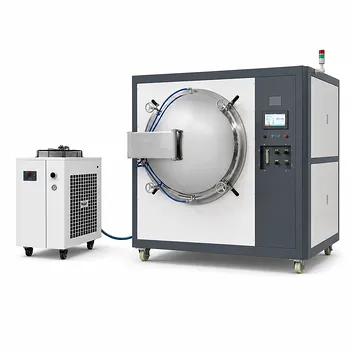
A vacuum hot press furnace serves as the central consolidation tool in the production of Al6061/B4C composite billets by simultaneously managing environment, temperature, and pressure. Specifically, it maintains a vacuum of approximately 0.1 Pa to ensure purity, heats the material to 600°C to activate bonding, and applies 100 MPa of pressure to drive physical densification.
By synchronizing high pressure and heat within a vacuum, the furnace transforms a loose powder mixture into a cohesive solid. This process is critical for achieving the specific relative density required for any subsequent secondary processing.
The Mechanics of Billet Formation
The production of Al6061/B4C composites requires precise control over three independent variables. The vacuum hot press furnace integrates these variables to ensure the material is chemically pure and mechanically sound.
Oxidation Prevention via Vacuum
Aluminum (the matrix in Al6061) has a high affinity for oxygen. If processed in air, oxide layers would form on the particle surfaces.
These oxide layers act as barriers, preventing the aluminum particles from bonding effectively with the boron carbide (B4C) reinforcement.
By maintaining a vacuum environment of approximately 0.1 Pa, the furnace removes oxygen from the chamber. This ensures the aluminum matrix remains pure and capable of strong interfacial bonding.
Thermal Activation at 600°C
The furnace raises the temperature to approximately 600°C. This temperature is carefully selected to sit just below the melting point of the Al6061 alloy.
At this thermal level, the metal matrix softens sufficiently to become malleable without turning into a liquid.
This "semi-solid" or softened state allows the material to deform plastically around the harder B4C particles, facilitating mechanical interlocking.
Densification through High Pressure
While heat softens the material, it is the application of mechanical pressure that creates a solid billet.
The furnace applies a load of approximately 100 MPa. This significant force crushes void spaces between particles that would otherwise remain in a standard sintering process.
This pressure drives the densification process, ensuring the final billet has high structural integrity and low porosity.
Critical Process Trade-offs
While vacuum hot pressing creates superior material properties compared to conventional sintering, it introduces specific operational constraints that must be managed.
Temperature Sensitivity
Operating at 600°C requires precise thermal regulation. This temperature is very close to the solidus line of aluminum alloys.
Exceeding this temperature can cause incipient melting, which distorts the billet shape and leads to segregation of alloying elements. conversely, falling below this temperature results in incomplete densification.
Production Throughput vs. Quality
The requirement for a high vacuum (0.1 Pa) significantly increases the cycle time compared to atmospheric processes.
Pumping down to this vacuum level takes time, limiting the volume of billets that can be produced per hour. This is a trade-off where production speed is sacrificed to guarantee material freedom from oxidation.
Optimizing the Consolidation Process
To ensure the highest quality Al6061/B4C billets, you must prioritize specific furnace parameters based on the desired outcome of the composite material.
- If your primary focus is Material Purity: Prioritize the integrity of the vacuum system to ensure it holds a steady 0.1 Pa, preventing oxide barriers that weaken the composite.
- If your primary focus is Structural Density: Ensure the hydraulic system can maintain a consistent 100 MPa pressure throughout the heating dwell time to eliminate microscopic voids.
Mastering the balance between thermal softening and mechanical compression is the key to producing billets ready for successful secondary processing.
Summary Table:
| Parameter | Process Role | Technical Requirement |
|---|---|---|
| Vacuum Environment | Prevents aluminum oxidation and ensures pure bonding | ~0.1 Pa |
| Temperature Control | Softens Al6061 matrix for plastic deformation | ~600°C |
| Mechanical Pressure | Eliminates porosity and drives physical densification | ~100 MPa |
| Atmosphere | Maintains chemical integrity of composite interface | High Vacuum |
Elevate Your Composite Materials with KINTEK Precision
Maximize the density and purity of your Al6061/B4C billets with KINTEK’s industry-leading vacuum hot press furnaces. Specialized in high-temperature and high-pressure applications, KINTEK provides researchers and manufacturers with the advanced tools needed for superior material consolidation.
Our extensive portfolio includes:
- Advanced Furnaces: Muffle, tube, vacuum, and specialized CVD/PECVD systems.
- Consolidation Tools: Hydraulic pellet presses, hot presses, and isostatic presses for maximum densification.
- Lab Essentials: Crushing and milling systems, high-pressure reactors, and high-purity ceramic crucibles.
Ready to optimize your sintering and densification workflow? Contact KINTEK today to consult with our experts on the perfect equipment solution for your laboratory or production line.
Related Products
- Vacuum Hot Press Furnace Heated Vacuum Press Machine Tube Furnace
- 600T Vacuum Induction Hot Press Furnace for Heat Treat and Sintering
- Vacuum Hot Press Furnace Machine Heated Vacuum Press
- Vacuum Hot Press Furnace Machine for Lamination and Heating
- Vacuum Heat Treat and Pressure Sintering Furnace for High Temperature Applications
People Also Ask
- What advantages does a vacuum hot press furnace provide for LSLBO ceramic electrolytes? Achieve 94% Relative Density
- What role does a Vacuum Hot Press (VHP) furnace play in the densification of austenitic stainless steel 316 composites?
- What are the advantages of using a vacuum hot pressing furnace? Superior Densification for 2024Al/Gr/SiC Composites
- What are the advantages of a vacuum hot press furnace for LTPO solid electrolytes? Boost Density and Conductivity
- What core processing conditions does a vacuum hot press furnace provide? Achieve High-Density Cu-SiC/Diamond Composites