Knowledge What is a brazing oven? A Controlled Environment for Superior Metal Joining
Author avatar

Tech Team · Kintek Solution

Updated 5 days ago

What is a brazing oven? A Controlled Environment for Superior Metal Joining


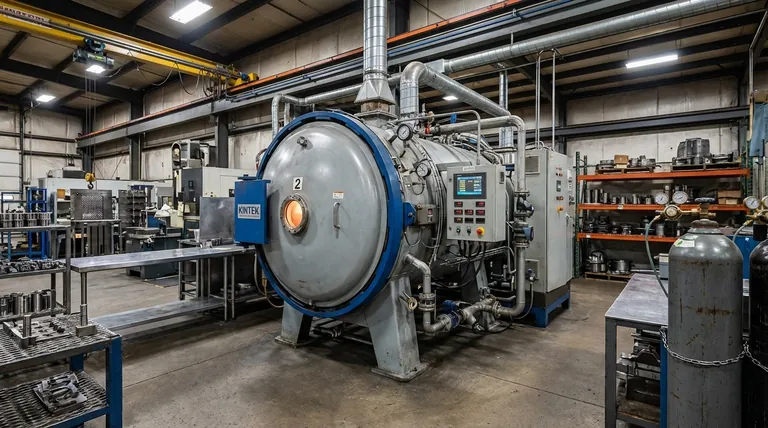
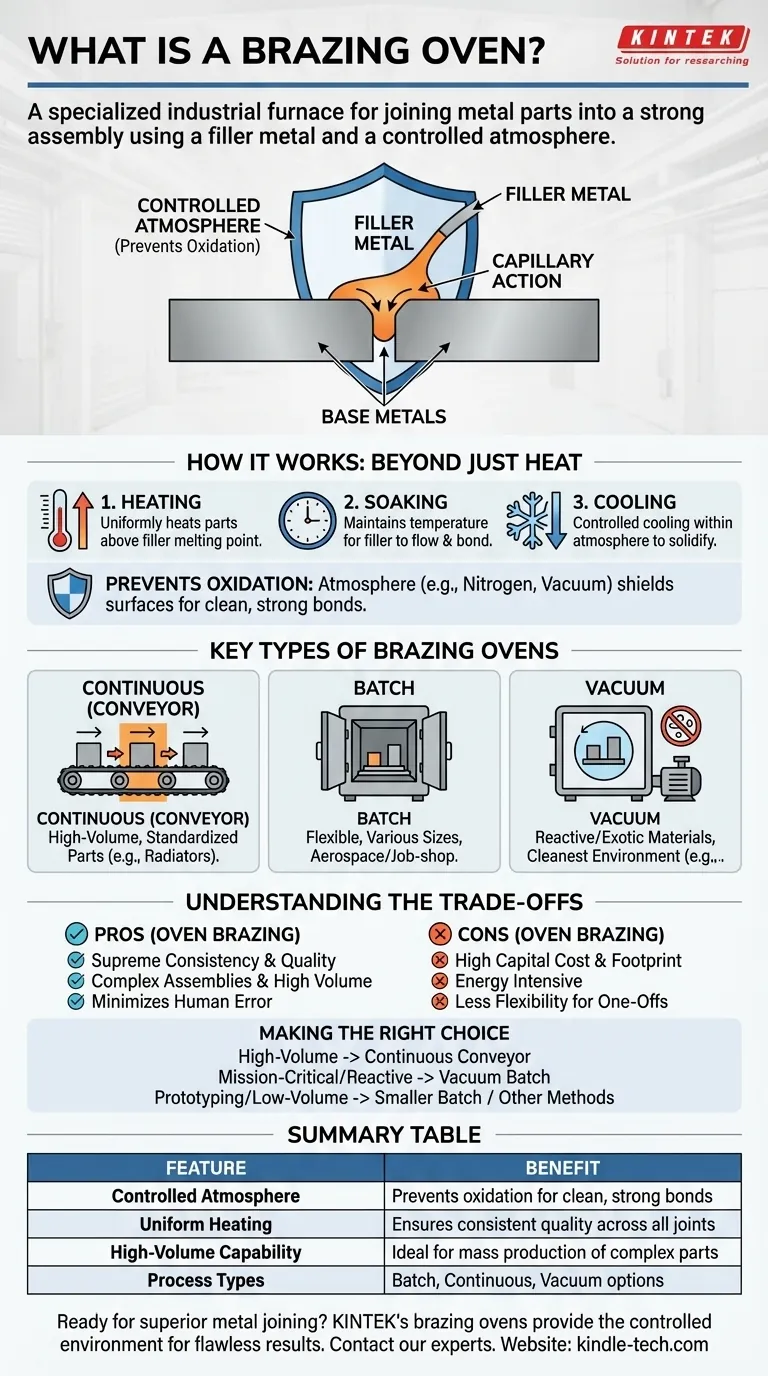
At its core, a brazing oven is a specialized industrial furnace used for joining multiple metal components into a single, robust assembly. It functions by precisely heating the parts in a controlled atmosphere to a temperature that melts a filler metal, but not the base metals themselves. This molten filler flows into the gaps between the parts via capillary action and, upon cooling, solidifies to form a strong, permanent metallurgical bond.

Brazing success is less about applying heat and more about controlling the environment where heat is applied. A brazing oven's primary function is not just to melt the filler metal, but to create a chemically controlled atmosphere that prevents oxidation, ensuring a clean, strong, and repeatable bond.
What is a brazing oven? A Controlled Environment for Superior Metal Joining

How a Brazing Oven Works: Beyond Just Heat

Understanding a brazing oven requires looking past the high temperatures and focusing on the carefully managed chemical environment it creates.

The Principle of Controlled Atmosphere Brazing

Brazing relies on a filler metal (the brazing alloy) with a lower melting point than the base metals being joined. The oven heats the entire assembly uniformly just above the filler's melting point.

This allows the molten alloy to be drawn into the tight-fitting joint, wetting the surfaces of the base metals. This process is known as capillary action.

Preventing Oxidation: The Critical Task

When metals are heated, they rapidly react with oxygen in the air to form oxides on their surface. This oxide layer acts as a barrier, preventing the molten filler metal from properly bonding with the base metal, resulting in a weak or failed joint.

A brazing oven's most important job is to displace the oxygen with a controlled atmosphere. This atmosphere acts as a protective shield, keeping the metal surfaces perfectly clean throughout the heating and cooling cycle. Common atmospheres include nitrogen, dissociated ammonia, or a vacuum.

The Brazing Cycle: Heat, Soak, Cool

A typical process involves three distinct phases:

  1. Heating: The parts are brought up to the target brazing temperature at a controlled rate.
  2. Soaking: The assembly is held at the brazing temperature for a specific duration to ensure complete melting of the filler and its flow throughout the joint.
  3. Cooling: The assembly is cooled in a controlled manner, still within the protective atmosphere, to solidify the joint without introducing thermal stress or oxidation.

Key Types of Brazing Ovens

The choice of oven depends heavily on production volume, part size, and material requirements.

Continuous (Conveyor) Ovens

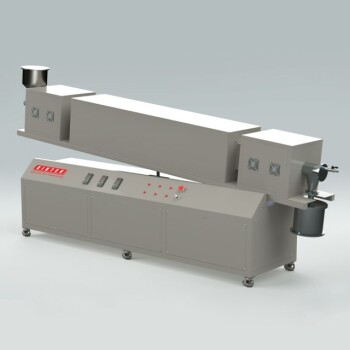
These ovens use a mesh belt conveyor to move parts through different temperature zones. They are the workhorses of high-volume manufacturing, ideal for producing thousands of identical parts like automotive radiators and air conditioning components.

Batch Ovens

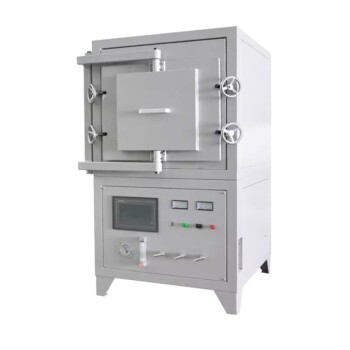
In a batch oven, a single load or "batch" of parts is placed inside, the door is sealed, and the entire brazing cycle is performed. They offer greater flexibility for handling parts of various sizes and complexities and are common in aerospace and job-shop environments.

Vacuum Ovens

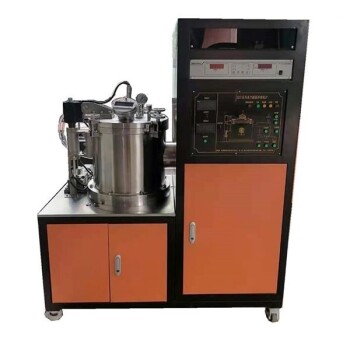
A vacuum oven is a type of batch oven where the "atmosphere" is the absence of gas. By pumping out the air, oxidation is virtually eliminated. This is the gold standard for brazing reactive or exotic materials like titanium, aluminum, and superalloys used in aerospace and medical implants.

Understanding the Trade-offs: Oven vs. Other Methods

Oven brazing is a powerful technique, but it's not always the right choice. It competes with other methods like manual torch brazing and induction brazing.

Advantage: Supreme Consistency and Quality

Because the entire part is heated uniformly in a controlled environment, oven brazing produces exceptionally consistent and high-quality joints across an entire production run. Human error is minimized.

Advantage: Complex Assemblies and High Volume

An oven can braze dozens or even hundreds of joints on a complex assembly in a single cycle. This makes it vastly more efficient for intricate parts or mass production compared to brazing one joint at a time with a torch.

Disadvantage: High Capital Cost and Footprint

Industrial brazing ovens are significant capital investments. They are large, require substantial factory floor space, and consume considerable energy, making them unsuitable for small-scale operations.

Disadvantage: Less Flexibility for One-Off Jobs

While batch ovens offer some flexibility, the setup and cycle time for oven brazing makes it impractical for quick, one-off repairs or simple prototypes. Torch or induction brazing is often faster and more cost-effective for these tasks.

Making the Right Choice for Your Goal

Selecting the correct brazing strategy requires matching the technology to your specific operational needs.

  • If your primary focus is high-volume production of standardized parts: A continuous conveyor oven offers the most efficient and cost-effective solution.
  • If your primary focus is mission-critical, complex components or reactive metals (like titanium): A vacuum batch oven provides the cleanest environment and the highest possible joint integrity.
  • If your primary focus is prototyping, repairs, or low-to-medium volume production: A smaller batch oven or alternative methods like torch or induction brazing will likely be more practical and economical.

Ultimately, viewing a brazing oven as an environmental control system, rather than just a heat source, is the key to understanding its value in modern manufacturing.

Summary Table:

Feature Benefit
Controlled Atmosphere Prevents oxidation for clean, strong bonds
Uniform Heating Ensures consistent quality across all joints
High-Volume Capability Ideal for mass production of complex parts
Process Types Batch, Continuous (Conveyor), and Vacuum ovens

Ready to achieve superior metal joining with precision and consistency?

Whether you are in high-volume manufacturing or working with mission-critical components, KINTEK's brazing ovens provide the controlled environment necessary for flawless results. Our expertise in lab and industrial equipment ensures you get a solution tailored to your specific materials and production goals.

Contact our experts today via our Contact Form to discuss how a KINTEK brazing oven can enhance your manufacturing process and deliver the strong, reliable bonds your products demand.

Visual Guide
What is a brazing oven? A Controlled Environment for Superior Metal Joining Visual Guide

Related Products

People Also Ask

Related Products

Vacuum Heat Treat Sintering Brazing Furnace

Vacuum Heat Treat Sintering Brazing Furnace

A vacuum brazing furnace is a type of industrial furnace used for brazing, a metalworking process that joins two pieces of metal using a filler metal that melts at a lower temperature than the base metals. Vacuum brazing furnaces are typically used for high-quality applications where a strong, clean joint is required.

1700℃ Controlled Atmosphere Furnace Nitrogen Inert Atmosphere Furnace

1700℃ Controlled Atmosphere Furnace Nitrogen Inert Atmosphere Furnace

KT-17A Controlled atmosphere furnace: 1700℃ heating, vacuum sealing technology, PID temperature control, and versatile TFT smart touch screen controller for laboratory and industrial use.

1200℃ Controlled Atmosphere Furnace Nitrogen Inert Atmosphere Furnace

1200℃ Controlled Atmosphere Furnace Nitrogen Inert Atmosphere Furnace

Discover our KT-12A Pro Controlled atmosphere furnace - high precision, heavy duty vacuum chamber, versatile smart touch screen controller, and excellent temperature uniformity up to 1200C. Ideal for both laboratory and industrial application.

1400℃ Controlled Atmosphere Furnace with Nitrogen and Inert Atmosphere

1400℃ Controlled Atmosphere Furnace with Nitrogen and Inert Atmosphere

Achieve precise heat treatment with KT-14A controlled atmosphere furnace. Vacuum sealed with a smart controller, it's ideal for lab and industrial use up to 1400℃.

Ultra-High Temperature Graphite Vacuum Graphitization Furnace

Ultra-High Temperature Graphite Vacuum Graphitization Furnace

The ultra-high temperature graphitization furnace utilizes medium frequency induction heating in a vacuum or inert gas environment. The induction coil generates an alternating magnetic field, inducing eddy currents in the graphite crucible, which heats up and radiates heat to the workpiece, bringing it to the desired temperature. This furnace is primarily used for graphitization and sintering of carbon materials, carbon fiber materials, and other composite materials.

Controlled Nitrogen Inert Hydrogen Atmosphere Furnace

Controlled Nitrogen Inert Hydrogen Atmosphere Furnace

KT-AH Hydrogen atmosphere furnace - induction gas furnace for sintering/annealing with built-in safety features, dual housing design, and energy-saving efficiency. Ideal for lab and industrial use.

Vacuum Heat Treat and Sintering Furnace with 9MPa Air Pressure

Vacuum Heat Treat and Sintering Furnace with 9MPa Air Pressure

The air pressure sintering furnace is a high-tech equipment commonly used for the sintering of advanced ceramic materials. It combines vacuum sintering and pressure sintering techniques to achieve high-density and high-strength ceramics.

Molybdenum Vacuum Heat Treat Furnace

Molybdenum Vacuum Heat Treat Furnace

Discover the benefits of a high-configuration molybdenum vacuum furnace with heat shield insulation. Ideal for high-purity, vacuum environments like sapphire crystal growth and heat treatment.

Vertical High Temperature Graphite Vacuum Graphitization Furnace

Vertical High Temperature Graphite Vacuum Graphitization Furnace

Vertical high temperature graphitization furnace for carbonization and graphitization of carbon materials up to 3100℃.Suitable for shaped graphitization of carbon fiber filaments and other materials sintered in a carbon environment.Applications in metallurgy, electronics, and aerospace for producing high-quality graphite products like electrodes and crucibles.

Vacuum Hot Press Furnace Heated Vacuum Press Machine Tube Furnace

Vacuum Hot Press Furnace Heated Vacuum Press Machine Tube Furnace

Reduce forming pressure & shorten sintering time with Vacuum Tube Hot Press Furnace for high-density, fine-grain materials. Ideal for refractory metals.

Vacuum Sealed Continuous Working Rotary Tube Furnace Rotating Tube Furnace

Vacuum Sealed Continuous Working Rotary Tube Furnace Rotating Tube Furnace

Experience efficient material processing with our vacuum-sealed rotary tube furnace. Perfect for experiments or industrial production, equipped with optional features for controlled feeding and optimized results. Order now.

1700℃ Laboratory Quartz Tube Furnace with Alumina Tube Tubular Furnace

1700℃ Laboratory Quartz Tube Furnace with Alumina Tube Tubular Furnace

Looking for a high-temperature tube furnace? Check out our 1700℃ Tube Furnace with Alumina Tube. Perfect for research and industrial applications up to 1700C.

Vacuum Heat Treat Furnace and Levitation Induction Melting Furnace

Vacuum Heat Treat Furnace and Levitation Induction Melting Furnace

Experience precise melting with our Vacuum Levitation Melting Furnace. Ideal for high melting point metals or alloys, with advanced technology for effective smelting. Order now for high-quality results.

Graphite Vacuum Continuous Graphitization Furnace

Graphite Vacuum Continuous Graphitization Furnace

High-temperature graphitization furnace is a professional equipment for graphitization treatment of carbon materials. It is a key equipment for the production of high-quality graphite products. It has high temperature, high efficiency and uniform heating. It is suitable for various high-temperature treatments and graphitization treatments. It is widely used in metallurgy, electronics, aerospace, etc. industry.

600T Vacuum Induction Hot Press Furnace for Heat Treat and Sintering

600T Vacuum Induction Hot Press Furnace for Heat Treat and Sintering

Discover the 600T Vacuum Induction Hot Press Furnace, designed for high-temperature sintering experiments in vacuum or protected atmospheres. Its precise temperature and pressure control, adjustable working pressure, and advanced safety features make it ideal for nonmetal materials, carbon composites, ceramics, and metal powders.

1800℃ Muffle Oven Furnace for Laboratory

1800℃ Muffle Oven Furnace for Laboratory

KT-18 muffle furnace with Japan Al2O3 polycrystalline fibe and Silicon Molybdenum heating element, up to 1900℃, PID temperature control and 7" smart touch screen. Compact design, low heat loss, and high energy efficiency. Safety interlock system and versatile functions.

Small Vacuum Heat Treat and Tungsten Wire Sintering Furnace

Small Vacuum Heat Treat and Tungsten Wire Sintering Furnace

The small vacuum tungsten wire sintering furnace is a compact experimental vacuum furnace specially designed for universities and scientific research institutes. The furnace features a CNC welded shell and vacuum piping to ensure leak-free operation. Quick-connect electrical connections facilitate relocation and debugging, and the standard electrical control cabinet is safe and convenient to operate.

High Temperature Muffle Oven Furnace for Laboratory Debinding and Pre Sintering

High Temperature Muffle Oven Furnace for Laboratory Debinding and Pre Sintering

KT-MD High temperature debinding and pre-sintering furnace for ceramic materials with various molding processes. Ideal for electronic components such as MLCC and NFC.

Laboratory Vacuum Tilt Rotary Tube Furnace Rotating Tube Furnace

Laboratory Vacuum Tilt Rotary Tube Furnace Rotating Tube Furnace

Discover the versatility of Laboratory Rotary Furnace: Ideal for calcination, drying, sintering, and high-temperature reactions. Adjustable rotating and tilting functions for optimal heating. Suitable for vacuum and controlled atmosphere environments. Learn more now!

Vertical Laboratory Quartz Tube Furnace Tubular Furnace

Vertical Laboratory Quartz Tube Furnace Tubular Furnace

Elevate your experiments with our Vertical Tube Furnace. Versatile design allows for operation under various environments and heat treatment applications. Order now for precise results!


Leave Your Message