Knowledge What is a calcination furnace? A Guide to High-Temperature Material Transformation
Author avatar

Tech Team · Kintek Solution

Updated 1 week ago

What is a calcination furnace? A Guide to High-Temperature Material Transformation


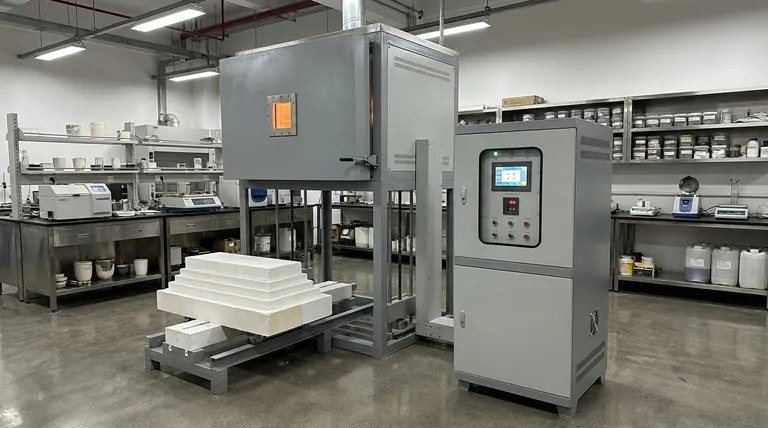
In essence, a calcination furnace is a high-temperature industrial oven designed to heat solid materials to induce a specific chemical reaction or physical change. Its primary purpose is not merely to heat something, but to transform it by removing volatile substances, driving off absorbed moisture, or deliberately causing oxidation.

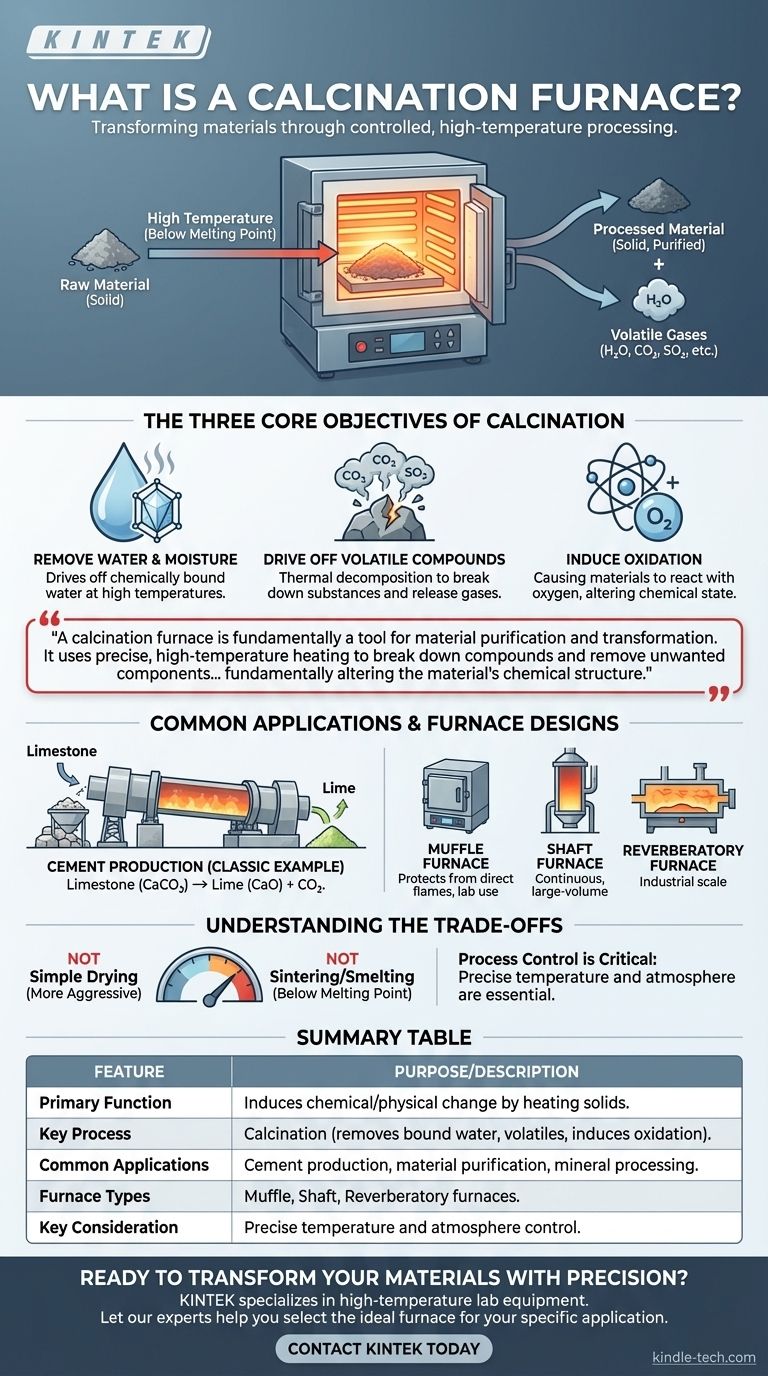
A calcination furnace is fundamentally a tool for material purification and transformation. It uses precise, high-temperature heating to break down compounds and remove unwanted components like water, carbon dioxide, or other gases, fundamentally altering the material's chemical structure.
What is a calcination furnace? A Guide to High-Temperature Material Transformation

The Three Core Objectives of Calcination

The process of calcination is defined by its outcome. A furnace is engineered to achieve one or more of these specific goals with a high degree of control.

Removing Water and Moisture

This goes beyond simple drying. Calcination is used to drive off water that is chemically bound within a material's crystal structure, which requires significantly higher temperatures than evaporation.

Driving Off Volatile Compounds

This is the most common objective, involving the thermal decomposition of a material. The heat causes the substance to break down, releasing gases and leaving a solid product behind.

A prime example is removing carbon dioxide (CO2) from limestone or sulfur dioxide (SO2) from certain minerals.

Inducing Oxidation

In some applications, the furnace is used to cause a material to react with oxygen in the air. This process, known as oxidation, can be used to convert a substance from one chemical state to another.

Common Applications and Furnace Designs

While the principles are straightforward, the applications and equipment can vary significantly depending on the industrial scale and desired outcome.

Cement Production: The Classic Example

The most widespread use of calcination is in producing cement. In massive kilns, calcium carbonate (limestone) is heated to decompose it into calcium oxide (lime) and carbon dioxide gas. The resulting lime is a primary ingredient in cement.

Common Furnace Configurations

Calcination furnaces are not one-size-fits-all. The design is chosen based on the material being processed and the required throughput.

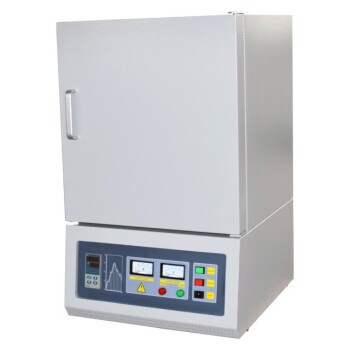
Common types include muffle furnaces, which protect the material from direct flames, and industrial-scale shaft furnaces or reverberatory furnaces, which are built for continuous, large-volume production.

Understanding the Trade-offs

It is crucial to distinguish calcination from other thermal processes. It is a more aggressive and transformative process than simple drying but is typically done at temperatures below the material's melting point, unlike sintering or smelting.

Process Control is Critical

The temperature and atmosphere inside the furnace must be precisely controlled. Insufficient heat will result in an incomplete reaction, while excessive heat could damage the material or cause unintended chemical changes.

Not a Universal Solution

Calcination is specifically for driving off volatile components or inducing oxidation. If the goal is simply to melt a material or fuse particles together without chemical change, a different type of furnace and process is required.

Applying This to Your Goal

Choosing the right thermal process depends entirely on the desired end-state of your material.

  • If your primary focus is simple moisture removal: A standard industrial drying oven may be sufficient and more energy-efficient.
  • If your primary focus is inducing a chemical breakdown: A calcination furnace is the correct instrument, with the specific design depending on your production scale.
  • If your primary focus is changing the material's crystal structure or purity: Calcination is the necessary step to remove volatile impurities and prepare the material for further processing.

Ultimately, a calcination furnace is a powerful instrument for fundamentally altering the chemical composition of solid materials through controlled heat.

Summary Table:

Feature Purpose/Description
Primary Function Induces chemical/physical change by heating solids to high temperatures.
Key Process Calcination (removes bound water, volatiles like CO2, or induces oxidation).
Common Applications Cement production (limestone to lime), material purification, mineral processing.
Common Furnace Types Muffle furnaces, shaft furnaces, reverberatory furnaces.
Key Consideration Requires precise temperature and atmosphere control for a complete reaction.

Ready to transform your materials with precision?

Whether your goal is material purification, driving off volatile compounds, or preparing samples for further analysis, the right calcination furnace is critical. KINTEK specializes in high-temperature lab equipment, including robust calcination furnaces designed for accuracy and reliability in research and quality control.

Let our experts help you select the ideal furnace for your specific application.

Contact KINTEL today to discuss your laboratory's calcination needs and discover how our solutions can enhance your processes.

Visual Guide
What is a calcination furnace? A Guide to High-Temperature Material Transformation Visual Guide

Related Products

People Also Ask

Related Products

Laboratory Muffle Oven Furnace Bottom Lifting Muffle Furnace

Laboratory Muffle Oven Furnace Bottom Lifting Muffle Furnace

Efficiently produce batches with excellent temperature uniformity using our Bottom Lifting Furnace. Features two electric lifting stages and advanced temperature control up to 1600℃.

1700℃ Laboratory Quartz Tube Furnace with Alumina Tube Tubular Furnace

1700℃ Laboratory Quartz Tube Furnace with Alumina Tube Tubular Furnace

Looking for a high-temperature tube furnace? Check out our 1700℃ Tube Furnace with Alumina Tube. Perfect for research and industrial applications up to 1700C.

1800℃ Muffle Oven Furnace for Laboratory

1800℃ Muffle Oven Furnace for Laboratory

KT-18 muffle furnace with Japan Al2O3 polycrystalline fibe and Silicon Molybdenum heating element, up to 1900℃, PID temperature control and 7" smart touch screen. Compact design, low heat loss, and high energy efficiency. Safety interlock system and versatile functions.

High Temperature Muffle Oven Furnace for Laboratory Debinding and Pre Sintering

High Temperature Muffle Oven Furnace for Laboratory Debinding and Pre Sintering

KT-MD High temperature debinding and pre-sintering furnace for ceramic materials with various molding processes. Ideal for electronic components such as MLCC and NFC.

1200℃ Split Tube Furnace with Quartz Tube Laboratory Tubular Furnace

1200℃ Split Tube Furnace with Quartz Tube Laboratory Tubular Furnace

KT-TF12 split tube furnace: high-purity insulation, embedded heating wire coils, and max. 1200C. Widely used for new materials and chemical vapour deposition.

1700℃ Muffle Oven Furnace for Laboratory

1700℃ Muffle Oven Furnace for Laboratory

Get superior heat control with our 1700℃ Muffle Furnace. Equipped with intelligent temperature microprocessor, TFT touch screen controller & advanced insulation materials for precise heating up to 1700C. Order now!

1400℃ Muffle Oven Furnace for Laboratory

1400℃ Muffle Oven Furnace for Laboratory

Get precise high-temperature control up to 1500℃ with KT-14M Muffle furnace. Equipped with a smart touch screen controller and advanced insulation materials.

High Pressure Laboratory Vacuum Tube Furnace Quartz Tubular Furnace

High Pressure Laboratory Vacuum Tube Furnace Quartz Tubular Furnace

KT-PTF High Pressure Tube Furnace: Compact split tube furnace with strong positive pressure resistance. Working temp up to 1100°C and pressure up to 15Mpa. Also works under controller atmosphere or high vacuum.

Ultra-High Temperature Graphite Vacuum Graphitization Furnace

Ultra-High Temperature Graphite Vacuum Graphitization Furnace

The ultra-high temperature graphitization furnace utilizes medium frequency induction heating in a vacuum or inert gas environment. The induction coil generates an alternating magnetic field, inducing eddy currents in the graphite crucible, which heats up and radiates heat to the workpiece, bringing it to the desired temperature. This furnace is primarily used for graphitization and sintering of carbon materials, carbon fiber materials, and other composite materials.

Vertical High Temperature Graphite Vacuum Graphitization Furnace

Vertical High Temperature Graphite Vacuum Graphitization Furnace

Vertical high temperature graphitization furnace for carbonization and graphitization of carbon materials up to 3100℃.Suitable for shaped graphitization of carbon fiber filaments and other materials sintered in a carbon environment.Applications in metallurgy, electronics, and aerospace for producing high-quality graphite products like electrodes and crucibles.

Graphite Vacuum Continuous Graphitization Furnace

Graphite Vacuum Continuous Graphitization Furnace

High-temperature graphitization furnace is a professional equipment for graphitization treatment of carbon materials. It is a key equipment for the production of high-quality graphite products. It has high temperature, high efficiency and uniform heating. It is suitable for various high-temperature treatments and graphitization treatments. It is widely used in metallurgy, electronics, aerospace, etc. industry.

Rotary Tube Furnace Split Multi Heating Zone Rotating Tube Furnace

Rotary Tube Furnace Split Multi Heating Zone Rotating Tube Furnace

Multi zone rotary furnace for high-precision temperature control with 2-8 independent heating zones. Ideal for lithium ion battery electrode materials and high-temperature reactions. Can work under vacuum and controlled atmosphere.

Electric Rotary Kiln Continuous Working Small Rotary Furnace Heating Pyrolysis Plant

Electric Rotary Kiln Continuous Working Small Rotary Furnace Heating Pyrolysis Plant

Efficiently calcine and dry bulk powder and lump fluid materials with an electric heating rotary furnace. Ideal for processing lithium ion battery materials and more.

Vacuum Hot Press Furnace Machine Heated Vacuum Press

Vacuum Hot Press Furnace Machine Heated Vacuum Press

Discover the advantages of Vacuum Hot Press Furnace! Manufacture dense refractory metals & compounds, ceramics, and composites under high temp and pressure.

Vacuum Sealed Continuous Working Rotary Tube Furnace Rotating Tube Furnace

Vacuum Sealed Continuous Working Rotary Tube Furnace Rotating Tube Furnace

Experience efficient material processing with our vacuum-sealed rotary tube furnace. Perfect for experiments or industrial production, equipped with optional features for controlled feeding and optimized results. Order now.

Graphite Vacuum Furnace IGBT Experimental Graphitization Furnace

Graphite Vacuum Furnace IGBT Experimental Graphitization Furnace

IGBT experimental graphitization furnace, a tailored solution for universities and research institutions, with high heating efficiency, user-friendliness, and precise temperature control.

Spark Plasma Sintering Furnace SPS Furnace

Spark Plasma Sintering Furnace SPS Furnace

Discover the benefits of Spark Plasma Sintering Furnaces for rapid, low-temperature material preparation. Uniform heating, low cost & eco-friendly.

Small Vacuum Heat Treat and Tungsten Wire Sintering Furnace

Small Vacuum Heat Treat and Tungsten Wire Sintering Furnace

The small vacuum tungsten wire sintering furnace is a compact experimental vacuum furnace specially designed for universities and scientific research institutes. The furnace features a CNC welded shell and vacuum piping to ensure leak-free operation. Quick-connect electrical connections facilitate relocation and debugging, and the standard electrical control cabinet is safe and convenient to operate.

Vacuum Hot Press Furnace Machine for Lamination and Heating

Vacuum Hot Press Furnace Machine for Lamination and Heating

Experience clean and precise lamination with Vacuum Lamination Press. Perfect for wafer bonding, thin-film transformations, and LCP lamination. Order now!

Rubber Vulcanizer Vulcanizing Machine Plate Vulcanizing Press for Lab

Rubber Vulcanizer Vulcanizing Machine Plate Vulcanizing Press for Lab

The Plate vulcanizing press is a kind of equipment used in the production of rubber products, mainly used for the vulcanization of rubber products. Vulcanization is a key step in rubber processing.


Leave Your Message