Knowledge What is a sintering machine? Transforming Powders into High-Performance Parts
Author avatar

Tech Team · Kintek Solution

Updated 1 week ago

What is a sintering machine? Transforming Powders into High-Performance Parts


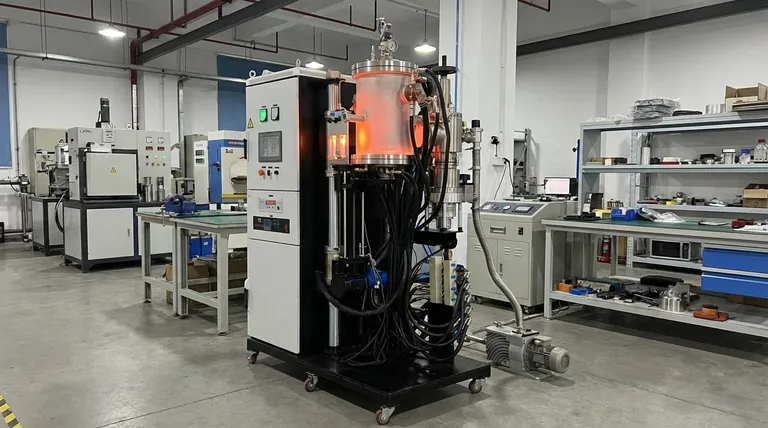
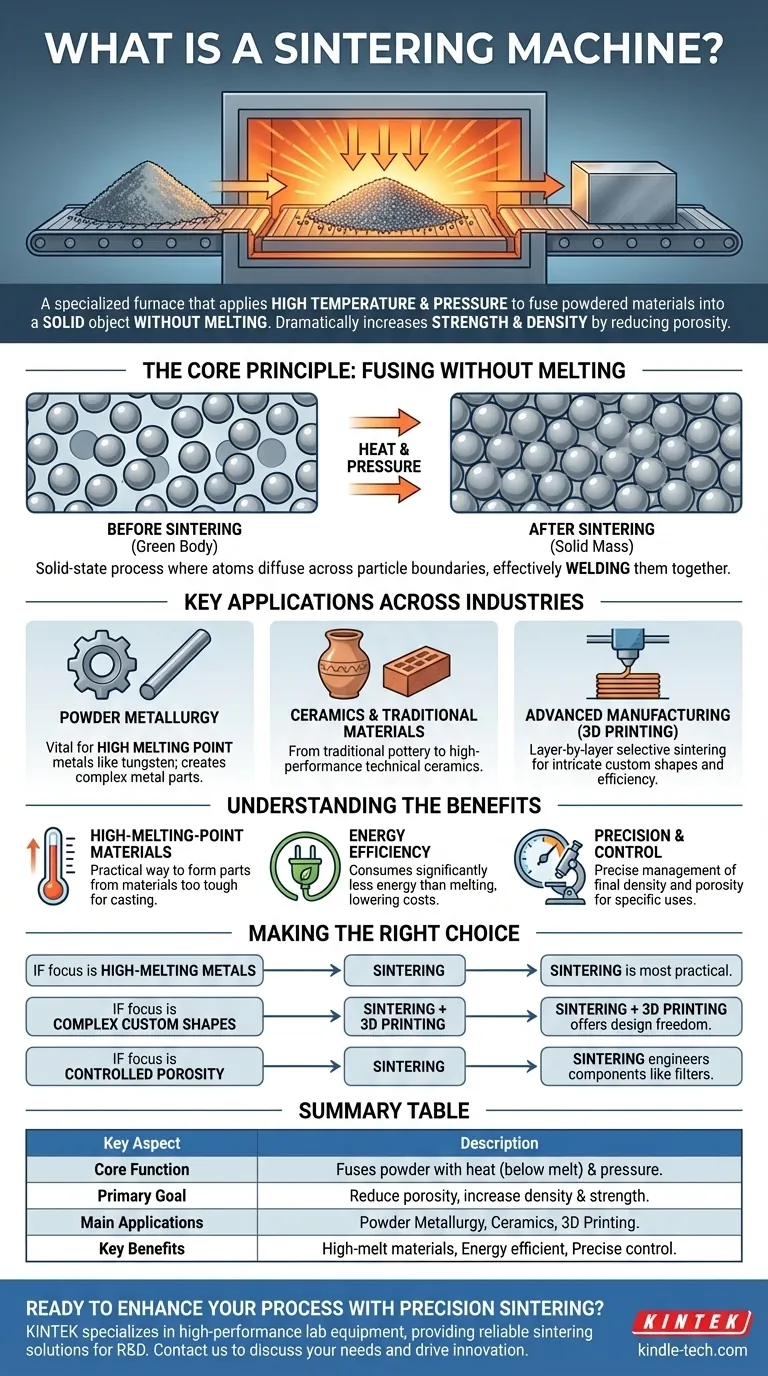
At its core, a sintering machine is a specialized furnace that applies high temperature and sometimes pressure to a powdered or loosely packed material. Its purpose is to fuse the individual particles together into a solid, coherent object without actually melting the material. This process, known as sintering, dramatically increases the material's strength and density by reducing the porous spaces between particles.

The crucial concept to grasp is that sintering is not melting. It's a solid-state process where a machine creates an environment hot enough to encourage atoms to diffuse across particle boundaries, effectively welding them together into a single, stronger piece.
What is a sintering machine? Transforming Powders into High-Performance Parts

The Core Principle: Fusing Without Melting

A sintering machine's entire function revolves around creating the precise conditions for atomic bonding. It manipulates temperature and pressure to fundamentally change a material's structure.

How It Works: Heat and Pressure

The machine heats a material to a temperature below its melting point. This thermal energy makes the atoms in the particles highly active, allowing them to migrate and bond with adjacent particles where they touch.

In some cases, pressure is also applied to physically compact the particles, increasing the points of contact and accelerating the fusion process.

The Goal: Reducing Porosity

The primary objective of sintering is to eliminate the empty voids between the individual grains of a loose powder. As particles fuse, these gaps shrink or close entirely.

This reduction in porosity is what gives the final product its density, strength, and improved material properties.

The Result: A Solid, Coherent Mass

The process transforms a "green body"—the initial, fragile shape made of loose particles—into a solid, durable component. The final object is a single, interconnected piece with significantly enhanced mechanical integrity.

Key Applications Across Industries

Sintering machines are foundational tools in numerous fields, particularly for materials that are difficult to work with using traditional melting and casting methods.

Powder Metallurgy

This is a primary application, used to create complex metal parts from powders. It's especially vital for metals with extremely high melting points, like tungsten, which are used for things like electrical wiring and cutting tools.

Other common sintered metal products include self-lubricating bearings, magnetic materials, and structural steel parts.

Ceramics and Traditional Materials

Sintering has been used for millennia to produce pottery, bricks, and other clay products. Modern applications extend this to high-performance ceramics, porcelain, and even glass production.

Advanced Manufacturing (3D Printing)

In modern additive manufacturing, sintering is used to create custom metal or ceramic parts layer by layer. A laser or other energy source selectively sinters powdered material, allowing for the creation of intricate shapes with remarkable energy efficiency and control.

Understanding the Benefits

Sintering is not just an alternative to melting; it offers unique advantages that make it the superior choice for many applications.

Benefit: Working with High-Melting-Point Materials

Sintering provides a practical way to form parts from materials whose melting points are too high for conventional casting, making it an indispensable industrial process.

Benefit: Energy Efficiency

Because the material is never fully melted, the sintering process consumes significantly less energy than traditional casting. This results in lower production costs, especially at scale.

Benefit: Precision and Control

The process allows for exceptional control over the final product's properties. By managing temperature, time, and pressure, manufacturers can precisely define the final density and porosity of a component, tailoring it for specific uses like filters or medical implants.

Making the Right Choice for Your Goal

The decision to use a sintering process is driven by the material you are working with and the desired properties of the final product.

  • If your primary focus is creating parts from high-melting-point metals: Sintering is often the most practical and energy-efficient manufacturing method available.
  • If your primary focus is manufacturing complex, custom metal shapes: Sintering, especially when combined with 3D printing, offers unparalleled design freedom and material control.
  • If your primary focus is producing materials with controlled porosity: The sintering process allows you to precisely engineer components like filters or self-lubricating bearings.

Ultimately, a sintering machine enables the transformation of simple powders into sophisticated, high-performance components.

Summary Table:

Key Aspect Description
Core Function Fuses powdered material particles into a solid mass using heat (below melting point) and sometimes pressure.
Primary Goal Reduce porosity to increase density, strength, and improve material properties.
Main Applications Powder Metallurgy, Ceramics, Advanced Manufacturing (3D Printing).
Key Benefits Works with high-melting-point materials, Energy efficient, Offers precision and control over final properties.

Ready to enhance your manufacturing process with precision sintering?

KINTEK specializes in high-performance lab equipment and consumables, providing reliable sintering solutions for laboratories and R&D departments. Whether you are developing new materials in powder metallurgy or advancing additive manufacturing techniques, our expertise can help you achieve superior part density and strength.

Contact us today to discuss how our sintering equipment can meet your specific laboratory needs and drive your innovations forward.

Visual Guide
What is a sintering machine? Transforming Powders into High-Performance Parts Visual Guide

Related Products

People Also Ask

Related Products

Small Vacuum Heat Treat and Tungsten Wire Sintering Furnace

Small Vacuum Heat Treat and Tungsten Wire Sintering Furnace

The small vacuum tungsten wire sintering furnace is a compact experimental vacuum furnace specially designed for universities and scientific research institutes. The furnace features a CNC welded shell and vacuum piping to ensure leak-free operation. Quick-connect electrical connections facilitate relocation and debugging, and the standard electrical control cabinet is safe and convenient to operate.

Vacuum Heat Treat and Molybdenum Wire Sintering Furnace for Vacuum Sintering

Vacuum Heat Treat and Molybdenum Wire Sintering Furnace for Vacuum Sintering

A vacuum molybdenum wire sintering furnace is a vertical or bedroom structure, which is suitable for withdrawal, brazing, sintering and degassing of metal materials under high vacuum and high temperature conditions. It is also suitable for dehydroxylation treatment of quartz materials.

1200℃ Split Tube Furnace with Quartz Tube Laboratory Tubular Furnace

1200℃ Split Tube Furnace with Quartz Tube Laboratory Tubular Furnace

KT-TF12 split tube furnace: high-purity insulation, embedded heating wire coils, and max. 1200C. Widely used for new materials and chemical vapour deposition.

Vacuum Hot Press Furnace Machine for Lamination and Heating

Vacuum Hot Press Furnace Machine for Lamination and Heating

Experience clean and precise lamination with Vacuum Lamination Press. Perfect for wafer bonding, thin-film transformations, and LCP lamination. Order now!

Vacuum Dental Porcelain Sintering Furnace

Vacuum Dental Porcelain Sintering Furnace

Get precise and reliable results with KinTek's Vacuum Porcelain Furnace. Suitable for all porcelain powders, it features hyperbolic ceramic furnace function, voice prompt, and automatic temperature calibration.

Laboratory Sterilizer Lab Autoclave Vertical Pressure Steam Sterilizer for Liquid Crystal Display Automatic Type

Laboratory Sterilizer Lab Autoclave Vertical Pressure Steam Sterilizer for Liquid Crystal Display Automatic Type

Liquid crystal display automatic vertical sterilizer is a safe, reliable and automatic control sterilization equipment, which is composed of heating system, microcomputer control system and overheating and overvoltage protection system.

Laboratory Test Sieves and Sieving Machines

Laboratory Test Sieves and Sieving Machines

Precision lab test sieves & sieving machines for accurate particle analysis. Stainless steel, ISO-compliant, 20μm-125mm range. Request specs now!

Laboratory Sterilizer Lab Autoclave Pulse Vacuum Lifting Sterilizer

Laboratory Sterilizer Lab Autoclave Pulse Vacuum Lifting Sterilizer

The pulse vacuum lifting sterilizer is a state-of-the-art equipment for efficient and precise sterilization. It uses pulsating vacuum technology, customizable cycles, and a user-friendly design for easy operation and safety.

HFCVD Machine System Equipment for Drawing Die Nano-Diamond Coating

HFCVD Machine System Equipment for Drawing Die Nano-Diamond Coating

The nano-diamond composite coating drawing die uses cemented carbide (WC-Co) as the substrate, and uses the chemical vapor phase method ( CVD method for short ) to coat the conventional diamond and nano-diamond composite coating on the surface of the inner hole of the mold.

Anti-Cracking Press Mold for Lab Use

Anti-Cracking Press Mold for Lab Use

The anti-cracking press mold is a specialized equipment designed for molding various shapes and sizes of film using high pressure and electric heating.

Benchtop Laboratory Vacuum Freeze Dryer

Benchtop Laboratory Vacuum Freeze Dryer

Benchtop laboratory freeze dryer for efficient lyophilization of biological, pharmaceutical, and food samples. Features intuitive touchscreen, high-performance refrigeration, and durable design. Preserve sample integrity—consult now!

High Energy Planetary Ball Mill Milling Machine for Laboratory

High Energy Planetary Ball Mill Milling Machine for Laboratory

Experience fast and effective sample processing with the F-P2000 high-energy planetary ball mill. This versatile equipment offers precise control and excellent grinding capabilities. Perfect for laboratories, it features multiple grinding bowls for simultaneous testing and high output. Achieve optimal results with its ergonomic design, compact structure, and advanced features. Ideal for a wide range of materials, it ensures consistent particle size reduction and low maintenance.

High Energy Vibratory Laboratory Ball Mill Grinding Mill Single Tank Type

High Energy Vibratory Laboratory Ball Mill Grinding Mill Single Tank Type

High-energy vibration ball mill is a small desktop laboratory grinding instrument.It can be ball-milled or mixed with different particle sizes and materials by dry and wet methods.

Benchtop Laboratory Freeze Dryer for Lab Use

Benchtop Laboratory Freeze Dryer for Lab Use

Premium benchtop laboratory freeze dryer for lyophilization, preserving samples with ≤ -60°C cooling. Ideal for pharmaceuticals & research.

Laboratory Vibratory Sieve Shaker Machine Slap Vibrating Sieve

Laboratory Vibratory Sieve Shaker Machine Slap Vibrating Sieve

KT-T200TAP is a slapping and oscillating sieving instrument for laboratory desktop use, with 300 rpm horizontal circular motion and 300 vertical slapping motions to simulate manual sieving to help sample particles pass through better.

High Energy Planetary Ball Mill Milling Machine for Laboratory

High Energy Planetary Ball Mill Milling Machine for Laboratory

The biggest feature is that the high energy planetary ball mill can not only perform fast and effective grinding, but also has good crushing ability

High-Energy Omnidirectional Planetary Ball Mill Milling Machine for Laboratory

High-Energy Omnidirectional Planetary Ball Mill Milling Machine for Laboratory

The KT-P4000E is a new product derived from the vertical high-energy planetary ball mill with a 360° swivel function. Experience faster, uniform, and smaller sample output results with 4 ≤1000ml ball mill jars.

High-Energy Omnidirectional Planetary Ball Mill Machine for Laboratory

High-Energy Omnidirectional Planetary Ball Mill Machine for Laboratory

The KT-P2000E is a new product derived from the vertical high-energy planetary ball mill with a 360°rotation function. The product not only has the characteristics of the vertical high-energy ball mill, but also has a unique 360°rotation function for the planetary body.

RRDE rotating disk (ring disk) electrode / compatible with PINE, Japanese ALS, Swiss Metrohm glassy carbon platinum

RRDE rotating disk (ring disk) electrode / compatible with PINE, Japanese ALS, Swiss Metrohm glassy carbon platinum

Elevate your electrochemical research with our Rotating Disk and Ring Electrodes. Corrosion resistant and customizable to your specific needs, with complete specifications.

915MHz MPCVD Diamond Machine Microwave Plasma Chemical Vapor Deposition System Reactor

915MHz MPCVD Diamond Machine Microwave Plasma Chemical Vapor Deposition System Reactor

915MHz MPCVD Diamond Machine and its multi-crystal effective growth, the maximum area can reach 8 inches, the maximum effective growth area of single crystal can reach 5 inches. This equipment is mainly used for the production of large-size polycrystalline diamond films, the growth of long single crystal diamonds, the low-temperature growth of high-quality graphene, and other materials that require energy provided by microwave plasma for growth.


Leave Your Message