Knowledge Graphitization furnace What is carbonization process? A Complete Guide to Converting Biomass to Charcoal
Author avatar

Tech Team · Kintek Solution

Updated 2 months ago

What is carbonization process? A Complete Guide to Converting Biomass to Charcoal


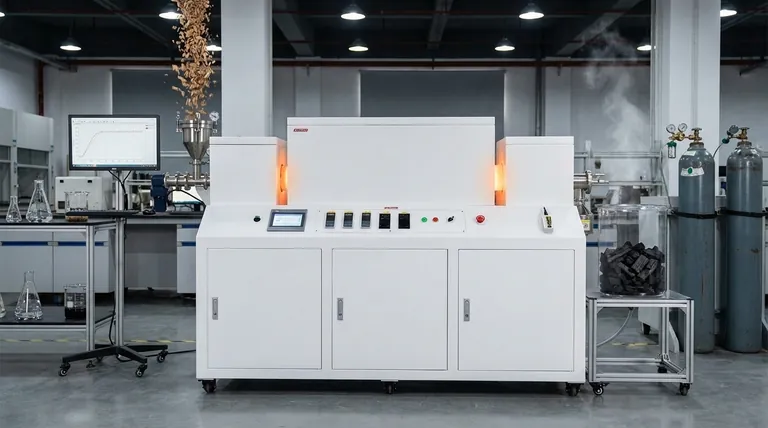
In essence, carbonization is a thermal decomposition process that transforms organic materials, like wood or agricultural waste, into a carbon-rich substance called charcoal. It works by heating the material in a low-oxygen environment, which drives off volatile compounds like water, methane, and hydrogen, leaving behind almost pure carbon.

The core principle of carbonization is not to burn the material, but to "cook" it without sufficient oxygen. This controlled heating breaks down complex organic matter, systematically removing everything that isn't carbon.
What is carbonization process? A Complete Guide to Converting Biomass to Charcoal

The Core Mechanism: Thermal Decomposition

To truly understand carbonization, you must first grasp the concept of thermal decomposition, also known as pyrolysis. This is the foundation of the entire process.

What is Thermal Decomposition?

Thermal decomposition is a chemical breakdown caused by heat. Instead of reacting with oxygen (burning), the material's own chemical bonds become unstable at high temperatures and break apart into simpler molecules.

The Role of an Oxygen-Free Environment

The key to successful carbonization is limiting oxygen. Sealing the material in a kiln or stove prevents combustion. If ample oxygen were present, the material would simply burn away into ash. By starving the process of oxygen, we ensure it decomposes into charcoal instead.

The Three Stages of Carbonization

The transformation from raw biomass to charcoal happens in distinct stages, dictated by rising temperatures inside the kiln.

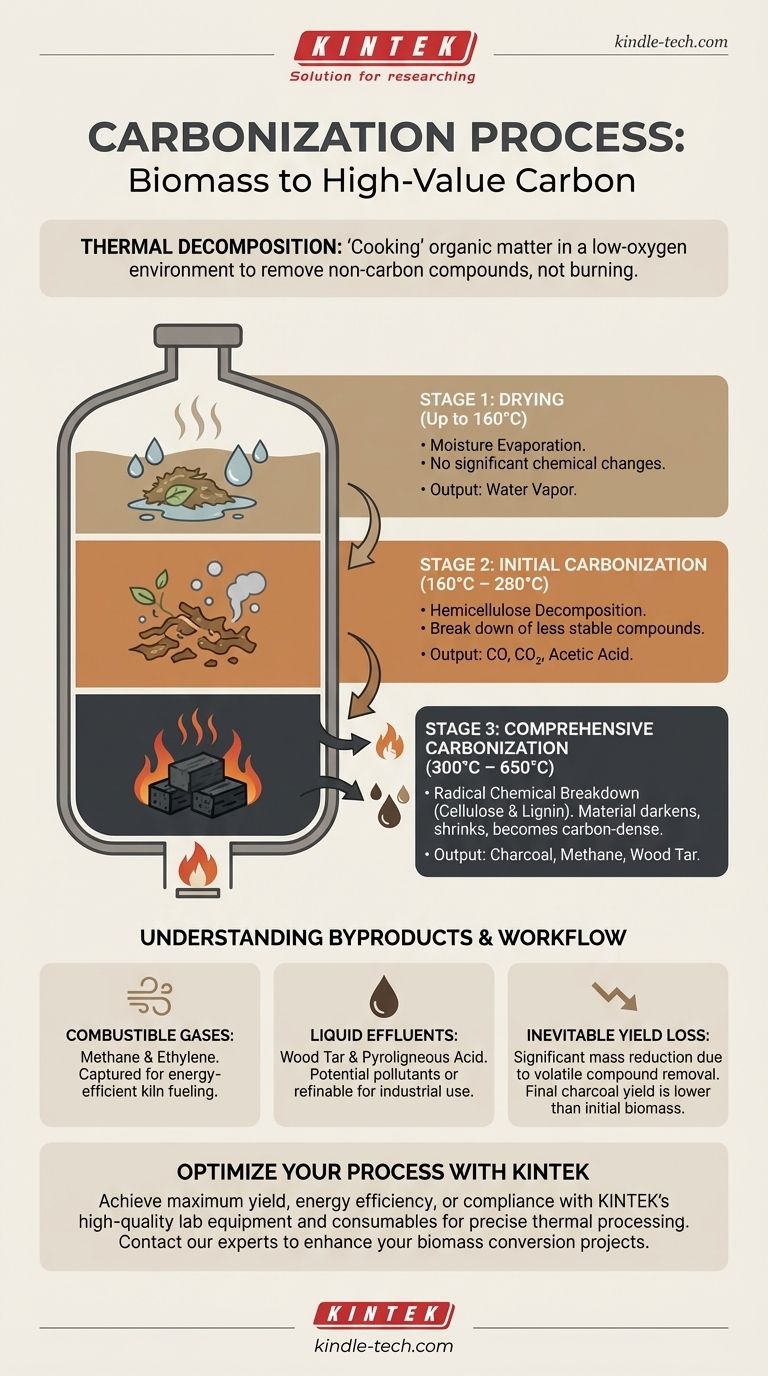
Stage 1: Drying (Up to 160°C)

The initial phase is focused entirely on removing moisture. As the temperature rises to 160°C, any water within the biomass evaporates.

At this stage, there are no significant chemical changes. The material is simply being prepared for the decomposition that follows.

Stage 2: Initial Carbonization (160°C – 280°C)

Once the material is dry, true decomposition begins. The least stable organic compounds start to break down.

Specifically, a component called hemicellulose decomposes, releasing gases like carbon dioxide (CO2), carbon monoxide (CO), and small amounts of acetic acid.

Stage 3: Comprehensive Carbonization (300°C – 650°C)

This is the main and most aggressive stage of the process. The temperature climbs significantly, causing a radical chemical breakdown of the remaining organic matter, primarily cellulose and lignin.

During this phase, a large volume of byproducts is released, including flammable gases like methane and ethylene, as well as liquids like wood tar and more acetic acid. The material darkens, shrinks, and becomes the carbon-dense product we know as charcoal.

Understanding the Byproducts and Trade-offs

The substances released during carbonization are not just waste; they are a critical part of the process with significant implications.

Combustible Gases

The methane and ethylene produced in Stage 3 are flammable. In modern carbonization systems, these gases are often captured and redirected to help fuel the kiln, creating a more energy-efficient, self-sustaining process.

Liquid Effluents

The process also creates liquids like wood tar (a complex mixture of organic compounds) and pyroligneous acid (primarily acetic acid and methanol). These byproducts can be environmental pollutants if not managed correctly, but they can also be collected and refined for various industrial uses.

The Inevitable Yield Loss

It is critical to understand that carbonization fundamentally reduces mass. A significant portion of the initial material's weight is lost as water vapor and volatile compounds. The final charcoal yield is always much lower than the starting weight of the biomass.

The Practical Workflow

While the chemistry is complex, the physical steps of the process are straightforward.

1. Loading and Sealing

The raw biomass (e.g., wood logs, briquettes) is loaded into a specialized oven or kiln. The container is then sealed to restrict airflow and create the necessary low-oxygen environment.

2. Heating and Decomposition

An external heat source initiates the process. As the internal temperature rises through the three stages, the biomass transforms into charcoal. In many systems, the process becomes self-sustaining once the flammable gases are released and ignited.

3. Cooling and Extraction

After the decomposition is complete, the charcoal must be allowed to cool down completely, still in a sealed, oxygen-free environment. Introducing oxygen while the charcoal is still hot would cause it to ignite. Once cool, it can be safely removed.

Applying This to Your Goal

Your approach to carbonization will depend on what you want to achieve.

  • If your primary focus is maximum charcoal yield: Prioritize precise temperature control and ensuring the kiln is perfectly sealed to prevent any loss of product to combustion.
  • If your primary focus is energy efficiency: Design a system to capture and reuse the combustible gases produced during Stage 3 to minimize external fuel consumption.
  • If your primary focus is environmental compliance: You must have a clear plan for safely managing or refining the liquid byproducts like wood tar and acidic liquids.

Ultimately, carbonization is a powerful and controlled method for refining organic matter into a stable, high-energy form of carbon.

Summary Table:

Stage Temperature Range Key Process Main Outputs
1. Drying Up to 160°C Moisture evaporation Water vapor
2. Initial Carbonization 160°C – 280°C Hemicellulose decomposition CO, CO2, acetic acid
3. Comprehensive Carbonization 300°C – 650°C Cellulose & lignin breakdown Charcoal, methane, wood tar

Ready to optimize your carbonization process?

KINTEK specializes in high-quality lab equipment and consumables for precise thermal processing. Whether your goal is maximum charcoal yield, energy efficiency, or environmental compliance, our solutions provide the control and reliability you need.

Contact our experts today to discuss how our kilns and laboratory systems can enhance your biomass conversion projects.

Visual Guide
What is carbonization process? A Complete Guide to Converting Biomass to Charcoal Visual Guide

Related Products

People Also Ask

Related Products

Graphite Vacuum Furnace Bottom Discharge Graphitization Furnace for Carbon Materials

Graphite Vacuum Furnace Bottom Discharge Graphitization Furnace for Carbon Materials

Bottom-out graphitization furnace for carbon materials, ultra-high temperature furnace up to 3100°C, suitable for graphitization and sintering of carbon rods and carbon blocks. Vertical design, bottom discharging, convenient feeding and discharging, high temperature uniformity, low energy consumption, good stability, hydraulic lifting system, convenient loading and unloading.

Large Vertical Graphite Vacuum Graphitization Furnace

Large Vertical Graphite Vacuum Graphitization Furnace

A large vertical high-temperature graphitization furnace is a type of industrial furnace used for the graphitization of carbon materials, such as carbon fiber and carbon black. It is a high-temperature furnace that can reach temperatures of up to 3100°C.

Graphite Vacuum Furnace Negative Material Graphitization Furnace

Graphite Vacuum Furnace Negative Material Graphitization Furnace

Graphitization furnace for battery production has uniform temperature and low energy consumption. Graphitization furnace for negative electrode materials: an efficient graphitization solution for battery production and advanced functions to enhance battery performance.

Electric Rotary Kiln Small Rotary Furnace for Activated Carbon Regeneration

Electric Rotary Kiln Small Rotary Furnace for Activated Carbon Regeneration

Revitalize your activated carbon with KinTek's Electric Regeneration Furnace. Achieve efficient and cost-effective regeneration with our highly automated rotary kiln and intelligent thermal controller.

Graphite Vacuum Continuous Graphitization Furnace

Graphite Vacuum Continuous Graphitization Furnace

High-temperature graphitization furnace is a professional equipment for graphitization treatment of carbon materials. It is a key equipment for the production of high-quality graphite products. It has high temperature, high efficiency and uniform heating. It is suitable for various high-temperature treatments and graphitization treatments. It is widely used in metallurgy, electronics, aerospace, etc. industry.

Ultra-High Temperature Graphite Vacuum Graphitization Furnace

Ultra-High Temperature Graphite Vacuum Graphitization Furnace

The ultra-high temperature graphitization furnace utilizes medium frequency induction heating in a vacuum or inert gas environment. The induction coil generates an alternating magnetic field, inducing eddy currents in the graphite crucible, which heats up and radiates heat to the workpiece, bringing it to the desired temperature. This furnace is primarily used for graphitization and sintering of carbon materials, carbon fiber materials, and other composite materials.

Vertical High Temperature Graphite Vacuum Graphitization Furnace

Vertical High Temperature Graphite Vacuum Graphitization Furnace

Vertical high temperature graphitization furnace for carbonization and graphitization of carbon materials up to 3100℃.Suitable for shaped graphitization of carbon fiber filaments and other materials sintered in a carbon environment.Applications in metallurgy, electronics, and aerospace for producing high-quality graphite products like electrodes and crucibles.

Graphite Vacuum Furnace High Thermal Conductivity Film Graphitization Furnace

Graphite Vacuum Furnace High Thermal Conductivity Film Graphitization Furnace

The high thermal conductivity film graphitization furnace has uniform temperature, low energy consumption and can operate continuously.

High Temperature Muffle Oven Furnace for Laboratory Debinding and Pre Sintering

High Temperature Muffle Oven Furnace for Laboratory Debinding and Pre Sintering

KT-MD High temperature debinding and pre-sintering furnace for ceramic materials with various molding processes. Ideal for electronic components such as MLCC and NFC.

Horizontal High Temperature Graphite Vacuum Graphitization Furnace

Horizontal High Temperature Graphite Vacuum Graphitization Furnace

Horizontal Graphitization Furnace: This type of furnace is designed with the heating elements placed horizontally, allowing for uniform heating of the sample. It's well-suited for graphitizing large or bulky samples that require precise temperature control and uniformity.

Graphite Vacuum Furnace IGBT Experimental Graphitization Furnace

Graphite Vacuum Furnace IGBT Experimental Graphitization Furnace

IGBT experimental graphitization furnace, a tailored solution for universities and research institutions, with high heating efficiency, user-friendliness, and precise temperature control.

1400℃ Controlled Atmosphere Furnace with Nitrogen and Inert Atmosphere

1400℃ Controlled Atmosphere Furnace with Nitrogen and Inert Atmosphere

Achieve precise heat treatment with KT-14A controlled atmosphere furnace. Vacuum sealed with a smart controller, it's ideal for lab and industrial use up to 1400℃.

1200℃ Controlled Atmosphere Furnace Nitrogen Inert Atmosphere Furnace

1200℃ Controlled Atmosphere Furnace Nitrogen Inert Atmosphere Furnace

Discover our KT-12A Pro Controlled atmosphere furnace - high precision, heavy duty vacuum chamber, versatile smart touch screen controller, and excellent temperature uniformity up to 1200C. Ideal for both laboratory and industrial application.

1700℃ Controlled Atmosphere Furnace Nitrogen Inert Atmosphere Furnace

1700℃ Controlled Atmosphere Furnace Nitrogen Inert Atmosphere Furnace

KT-17A Controlled atmosphere furnace: 1700℃ heating, vacuum sealing technology, PID temperature control, and versatile TFT smart touch screen controller for laboratory and industrial use.

Vacuum Heat Treat and Pressure Sintering Furnace for High Temperature Applications

Vacuum Heat Treat and Pressure Sintering Furnace for High Temperature Applications

Vacuum pressure sintering furnaces are designed for high temperature hot pressing applications in metal and ceramic sintering. Its advanced features ensure precise temperature control, reliable pressure maintenance, and a robust design for seamless operation.

Controlled Nitrogen Inert Hydrogen Atmosphere Furnace

Controlled Nitrogen Inert Hydrogen Atmosphere Furnace

KT-AH Hydrogen atmosphere furnace - induction gas furnace for sintering/annealing with built-in safety features, dual housing design, and energy-saving efficiency. Ideal for lab and industrial use.

2200 ℃ Tungsten Vacuum Heat Treat and Sintering Furnace

2200 ℃ Tungsten Vacuum Heat Treat and Sintering Furnace

Experience the ultimate refractory metal furnace with our Tungsten vacuum furnace. Capable of reaching 2200℃, perfect for sintering advanced ceramics and refractory metals. Order now for high-quality results.

Non Consumable Vacuum Arc Induction Melting Furnace

Non Consumable Vacuum Arc Induction Melting Furnace

Explore the benefits of Non-Consumable Vacuum Arc Furnace with high melting point electrodes. Small, easy to operate & eco-friendly. Ideal for laboratory research on refractory metals & carbides.

Electric Rotary Kiln Small Rotary Furnace Biomass Pyrolysis Plant

Electric Rotary Kiln Small Rotary Furnace Biomass Pyrolysis Plant

Learn about Rotary Biomass Pyrolysis Furnaces & how they decompose organic material at high temps without oxygen. Use for biofuels, waste processing, chemicals & more.

Dental Porcelain Zirconia Sintering Ceramic Furnace Chairside with Transformer

Dental Porcelain Zirconia Sintering Ceramic Furnace Chairside with Transformer

Experience top-notch sintering with Chairside Sintering Furnace with Transformer. Easy to operate, noise-free pallet, and automatic temperature calibration. Order now!


Leave Your Message