Knowledge What is Chemical Vapor Deposition (CVD)? Master High-Purity Thin Film and Semiconductor Fabrication
Author avatar

Tech Team · Kintek Solution

Updated 6 days ago

What is Chemical Vapor Deposition (CVD)? Master High-Purity Thin Film and Semiconductor Fabrication


Chemical Vapor Deposition (CVD) is a sophisticated materials science technique used to produce high-quality solid materials, specifically thin films and coatings. The process involves introducing gaseous chemical reagents, known as precursors, into a chamber where they undergo a chemical reaction to deposit a solid layer onto a target surface, or substrate.

Chemical Vapor Deposition is the fundamental bridge between gaseous chemicals and solid engineering materials. It allows for the precise creation of the microscopic structures that power modern electronics, particularly within semiconductor manufacturing.

The Mechanics of Deposition

Surface-Mediated Reactions

CVD is distinct from simple physical coating methods because it relies on chemical changes. It is defined as a process where a solid film forms through a heterogeneous reaction occurring specifically at the substrate surface.

The Transformation Process

The process begins with volatile precursors in a gaseous state. These gases are often carried by inert carrier gases into a reaction chamber.

Once inside, the precursors react either with each other or with the heated substrate surface. This reaction transitions the material from a gas to a non-volatile solid, which accumulates as a thin film.

Managing Byproducts

The chemical reaction that creates the film also produces volatile byproducts. These waste gases are not deposited; instead, they are pumped out of the reaction chamber to maintain the purity of the growing film.

Primary Industrial Applications

Semiconductor Fabrication

The primary reference highlights CVD as a cornerstone of the electronics industry. It is instrumental in manufacturing Complementary Metal-Oxide-Semiconductor (CMOS) technology.

This technology is the basis for the integrated circuits, microprocessors, and memory chips found in virtually all modern computing devices.

Advanced Coatings and Nanomaterials

Beyond electronics, CVD is used to synthesize advanced nanomaterials. It is also essential for applying various protective coatings that require high adhesion and uniformity, which physical application methods cannot achieve.

Understanding the Trade-offs

Thermal Requirements

Conventional CVD processes often require high temperatures to initiate the necessary chemical reactions. This can limit the types of substrates used, as the material must withstand the heat without degrading.

Process Environment

CVD typically requires a vacuum environment or a controlled reaction chamber. This adds complexity to the manufacturing setup compared to simpler coating methods that operate at atmospheric pressure.

Chemical Safety

Because the process relies on volatile gaseous precursors to create the reaction, the system must carefully manage hazardous or toxic input gases and safely vent the resulting chemical byproducts.

Making the Right Choice for Your Goal

To determine if CVD is the appropriate technique for your material needs, consider your specific performance requirements:

  • If your primary focus is semiconductor manufacturing: CVD is the standard requirement for creating the precise, high-purity thin films needed for CMOS logic and memory devices.
  • If your primary focus is surface durability: Use CVD to apply protective coatings that require a strong chemical bond to the substrate rather than a simple physical layer.
  • If your primary focus is substrate sensitivity: Be cautious of the high temperatures involved in standard CVD, which may damage heat-sensitive materials like certain polymers.

CVD remains the premier choice when material quality, purity, and precise structural control are more critical than process simplicity.

Summary Table:

Feature CVD Process Detail
Core Mechanism Heterogeneous chemical reactions at the substrate surface
Primary Output High-purity thin films, coatings, and nanomaterials
Key Applications CMOS technology, semiconductors, protective coatings
Key Requirements Controlled vacuum environment and high thermal stability
Waste Management Removal of volatile chemical byproducts via pumping systems

Elevate Your Material Science with KINTEK Precision

Unlock the full potential of Chemical Vapor Deposition for your research and production needs. At KINTEK, we specialize in providing the high-performance laboratory equipment required to achieve superior film purity and structural control.

Whether you are developing next-generation semiconductors or advanced protective coatings, our comprehensive range of CVD and PECVD systems, high-temperature furnaces, and vacuum solutions ensures your lab operates at the cutting edge of technology. From precision crushing and milling to reliable cooling solutions and consumables, KINTEK is your dedicated partner in excellence.

Ready to optimize your deposition process? Contact KINTEK today to discuss how our customized equipment can drive your innovation forward.

Related Products

People Also Ask

Related Products

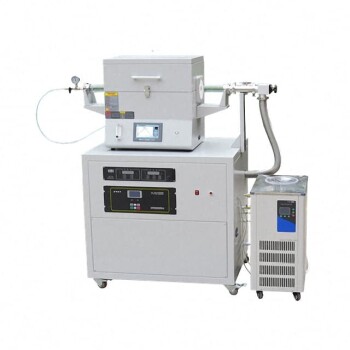
Multi Heating Zones CVD Tube Furnace Machine Chemical Vapor Deposition Chamber System Equipment

Multi Heating Zones CVD Tube Furnace Machine Chemical Vapor Deposition Chamber System Equipment

KT-CTF14 Multi Heating Zones CVD Furnace - Precise Temperature Control and Gas Flow for Advanced Applications. Max temp up to 1200℃, 4 channels MFC mass flow meter, and 7" TFT touch screen controller.

Graphite Vacuum Furnace High Thermal Conductivity Film Graphitization Furnace

Graphite Vacuum Furnace High Thermal Conductivity Film Graphitization Furnace

The high thermal conductivity film graphitization furnace has uniform temperature, low energy consumption and can operate continuously.

Vacuum Hot Press Furnace Heated Vacuum Press Machine Tube Furnace

Vacuum Hot Press Furnace Heated Vacuum Press Machine Tube Furnace

Reduce forming pressure & shorten sintering time with Vacuum Tube Hot Press Furnace for high-density, fine-grain materials. Ideal for refractory metals.

Ultra-High Temperature Graphite Vacuum Graphitization Furnace

Ultra-High Temperature Graphite Vacuum Graphitization Furnace

The ultra-high temperature graphitization furnace utilizes medium frequency induction heating in a vacuum or inert gas environment. The induction coil generates an alternating magnetic field, inducing eddy currents in the graphite crucible, which heats up and radiates heat to the workpiece, bringing it to the desired temperature. This furnace is primarily used for graphitization and sintering of carbon materials, carbon fiber materials, and other composite materials.

1200℃ Split Tube Furnace with Quartz Tube Laboratory Tubular Furnace

1200℃ Split Tube Furnace with Quartz Tube Laboratory Tubular Furnace

KT-TF12 split tube furnace: high-purity insulation, embedded heating wire coils, and max. 1200C. Widely used for new materials and chemical vapour deposition.

600T Vacuum Induction Hot Press Furnace for Heat Treat and Sintering

600T Vacuum Induction Hot Press Furnace for Heat Treat and Sintering

Discover the 600T Vacuum Induction Hot Press Furnace, designed for high-temperature sintering experiments in vacuum or protected atmospheres. Its precise temperature and pressure control, adjustable working pressure, and advanced safety features make it ideal for nonmetal materials, carbon composites, ceramics, and metal powders.

High Pressure Laboratory Vacuum Tube Furnace Quartz Tubular Furnace

High Pressure Laboratory Vacuum Tube Furnace Quartz Tubular Furnace

KT-PTF High Pressure Tube Furnace: Compact split tube furnace with strong positive pressure resistance. Working temp up to 1100°C and pressure up to 15Mpa. Also works under controller atmosphere or high vacuum.

Vacuum Heat Treat Sintering Brazing Furnace

Vacuum Heat Treat Sintering Brazing Furnace

A vacuum brazing furnace is a type of industrial furnace used for brazing, a metalworking process that joins two pieces of metal using a filler metal that melts at a lower temperature than the base metals. Vacuum brazing furnaces are typically used for high-quality applications where a strong, clean joint is required.

Vacuum Hot Press Furnace Machine Heated Vacuum Press

Vacuum Hot Press Furnace Machine Heated Vacuum Press

Discover the advantages of Vacuum Hot Press Furnace! Manufacture dense refractory metals & compounds, ceramics, and composites under high temp and pressure.

Vacuum Heat Treat and Sintering Furnace with 9MPa Air Pressure

Vacuum Heat Treat and Sintering Furnace with 9MPa Air Pressure

The air pressure sintering furnace is a high-tech equipment commonly used for the sintering of advanced ceramic materials. It combines vacuum sintering and pressure sintering techniques to achieve high-density and high-strength ceramics.

1200℃ Controlled Atmosphere Furnace Nitrogen Inert Atmosphere Furnace

1200℃ Controlled Atmosphere Furnace Nitrogen Inert Atmosphere Furnace

Discover our KT-12A Pro Controlled atmosphere furnace - high precision, heavy duty vacuum chamber, versatile smart touch screen controller, and excellent temperature uniformity up to 1200C. Ideal for both laboratory and industrial application.

Laboratory Rapid Thermal Processing (RTP) Quartz Tube Furnace

Laboratory Rapid Thermal Processing (RTP) Quartz Tube Furnace

Get lightning-fast heating with our RTP Rapid Heating Tube Furnace. Designed for precise, high-speed heating and cooling with convenient sliding rail and TFT touch screen controller. Order now for ideal thermal processing!

Vacuum Dental Porcelain Sintering Furnace

Vacuum Dental Porcelain Sintering Furnace

Get precise and reliable results with KinTek's Vacuum Porcelain Furnace. Suitable for all porcelain powders, it features hyperbolic ceramic furnace function, voice prompt, and automatic temperature calibration.

Vacuum Heat Treat and Molybdenum Wire Sintering Furnace for Vacuum Sintering

Vacuum Heat Treat and Molybdenum Wire Sintering Furnace for Vacuum Sintering

A vacuum molybdenum wire sintering furnace is a vertical or bedroom structure, which is suitable for withdrawal, brazing, sintering and degassing of metal materials under high vacuum and high temperature conditions. It is also suitable for dehydroxylation treatment of quartz materials.

Mesh belt controlled atmosphere furnace

Mesh belt controlled atmosphere furnace

Discover our KT-MB mesh belt sintering furnace - perfect for high-temperature sintering of electronic components & glass insulators. Available for open air or controlled atmosphere environments.

Graphite Vacuum Furnace IGBT Experimental Graphitization Furnace

Graphite Vacuum Furnace IGBT Experimental Graphitization Furnace

IGBT experimental graphitization furnace, a tailored solution for universities and research institutions, with high heating efficiency, user-friendliness, and precise temperature control.

Laboratory Vacuum Tilt Rotary Tube Furnace Rotating Tube Furnace

Laboratory Vacuum Tilt Rotary Tube Furnace Rotating Tube Furnace

Discover the versatility of Laboratory Rotary Furnace: Ideal for calcination, drying, sintering, and high-temperature reactions. Adjustable rotating and tilting functions for optimal heating. Suitable for vacuum and controlled atmosphere environments. Learn more now!

Multi-zone Laboratory Tube Furnace

Multi-zone Laboratory Tube Furnace

Experience precise, efficient thermal testing with our Multi Zone Tube Furnace. Independent heating zones and temperature sensors allow for controlled high-temperature gradient heating fields. Order now for advanced thermal analysis!

Vertical High Temperature Graphite Vacuum Graphitization Furnace

Vertical High Temperature Graphite Vacuum Graphitization Furnace

Vertical high temperature graphitization furnace for carbonization and graphitization of carbon materials up to 3100℃.Suitable for shaped graphitization of carbon fiber filaments and other materials sintered in a carbon environment.Applications in metallurgy, electronics, and aerospace for producing high-quality graphite products like electrodes and crucibles.

2200 ℃ Tungsten Vacuum Heat Treat and Sintering Furnace

2200 ℃ Tungsten Vacuum Heat Treat and Sintering Furnace

Experience the ultimate refractory metal furnace with our Tungsten vacuum furnace. Capable of reaching 2200℃, perfect for sintering advanced ceramics and refractory metals. Order now for high-quality results.


Leave Your Message