Knowledge cvd machine What is diode sputtering? A Guide to the Fundamental Thin-Film Deposition Process
Author avatar

Tech Team · Kintek Solution

Updated 2 months ago

What is diode sputtering? A Guide to the Fundamental Thin-Film Deposition Process


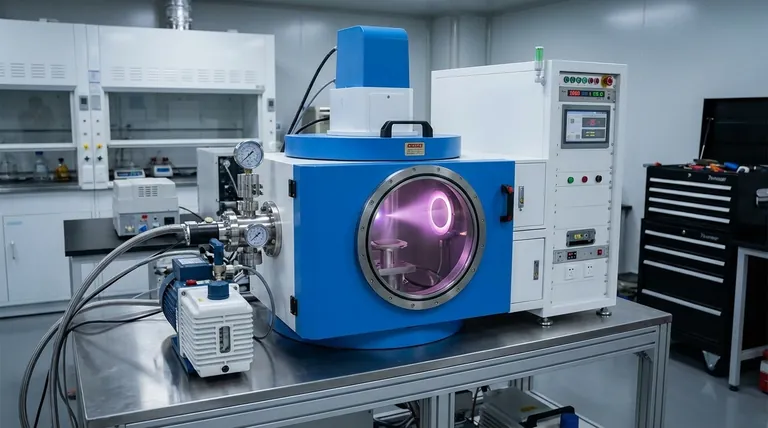
At its core, diode sputtering is a foundational method for creating ultra-thin films of material on a surface. It is a type of physical vapor deposition (PVD) that operates in a vacuum, using a simple two-electrode (diode) system to generate a plasma. This plasma bombards a source material, dislodging atoms that then coat a separate object, known as the substrate.

While the term may sound complex, diode sputtering is simply the most fundamental version of a process that underpins much of modern technology. It works by using high-energy ion bombardment to meticulously transfer atoms from a source to a substrate, offering atomic-level control over the creation of new surfaces.
What is diode sputtering? A Guide to the Fundamental Thin-Film Deposition Process

The Core Mechanism of Sputtering

To truly understand diode sputtering, we must break down the process into its essential stages. Each step occurs within a sealed vacuum chamber to ensure the purity and integrity of the final film.

The Vacuum Environment

First, both the source material (target) and the object to be coated (substrate) are placed in a vacuum chamber. All air is pumped out, creating a near-vacuum.

This vacuum is critical. It prevents atoms from the sputtering target from colliding with air molecules and ensures the resulting film is not contaminated by oxygen, nitrogen, or other atmospheric gases.

Creating the Plasma

An inert gas, most commonly Argon (Ar), is then introduced into the chamber at very low pressure. A strong DC voltage is applied between two electrodes.

The target material is made the cathode (negative electrode), while the substrate holder and chamber walls act as the anode (positive electrode). This simple two-electrode configuration is why the process is called "diode" sputtering. The powerful electric field energizes the free electrons in the chamber, initiating a self-sustaining plasma glow.

The Bombardment Process

The energized electrons collide with the neutral Argon gas atoms, knocking electrons loose from them. This process, called ionization, turns the Argon atoms into positively charged Argon ions (Ar+).

These new, positively charged ions are now aggressively accelerated by the electric field toward the negatively charged target. They strike the target surface with tremendous kinetic energy, physically dislodging, or "sputtering," individual atoms of the target material.

Deposition onto the Substrate

The ejected atoms from the target travel in a straight line through the vacuum. They eventually strike the surface of the substrate, which is strategically placed to intercept this vapor stream.

As these atoms land on the substrate, they condense and bond to its surface, gradually building a thin, uniform film. The process allows for precise control over film thickness, from just a few nanometers to several micrometers.

Understanding the Trade-offs

Diode sputtering is the simplest form of sputtering, but this simplicity comes with significant trade-offs compared to more advanced techniques.

Pro: Simplicity and Cost

The primary advantage of a diode system is its simplicity. The setup is straightforward and relatively inexpensive, making it an excellent tool for research, process development, and demonstrating the fundamental principles of physical vapor deposition.

Con: Low Deposition Rates

Diode sputtering is notoriously slow. The plasma it creates is not very dense, meaning the rate of ion bombardment and subsequent deposition is low. This makes it unsuitable for most high-volume manufacturing where throughput is critical.

Con: Substrate Heating

The process is inefficient. Many of the electrons accelerated from the cathode miss the Argon atoms and instead bombard the substrate, depositing significant heat. This can damage heat-sensitive substrates like plastics or delicate electronic components.

Con: Limited to Conductive Targets

The basic DC diode setup relies on the target being electrically conductive to function as a cathode. To sputter insulating or non-conductive materials (like ceramics), a more complex technique like RF (Radio Frequency) Sputtering is required, which uses an alternating AC field.

Making the Right Choice for Your Goal

While rarely used in modern mass production, understanding diode sputtering is essential for grasping the principles behind the more advanced methods that have replaced it, such as magnetron sputtering.

  • If your primary focus is fundamental research or teaching: Diode sputtering is an excellent, low-cost tool for demonstrating the core principles of PVD.
  • If your primary focus is high-volume manufacturing: You will almost certainly use a more advanced method like magnetron sputtering, which adds magnets to increase speed and efficiency dramatically.
  • If your primary focus is depositing insulating materials: You must use a technique like RF sputtering instead of a DC diode system.

Understanding the principles of diode sputtering provides the essential foundation for mastering all modern thin-film deposition technologies.

Summary Table:

Aspect Description
Process Type Physical Vapor Deposition (PVD)
Key Components Cathode (Target), Anode (Substrate), Inert Gas (Argon)
Primary Advantage Simple setup, low cost, excellent for R&D
Main Limitation Low deposition rates, significant substrate heating
Best For Conductive targets, fundamental research, process development

Ready to Elevate Your Thin-Film Research or Production?

Understanding the fundamentals is the first step. KINTEK specializes in advanced lab equipment and consumables for all your deposition needs. Whether you are moving from basic diode principles to high-throughput magnetron sputtering or require solutions for insulating materials, our expertise can help you achieve precise, high-quality results.

Contact our experts today to discuss how our solutions can optimize your laboratory's efficiency and capabilities.

Visual Guide

What is diode sputtering? A Guide to the Fundamental Thin-Film Deposition Process Visual Guide

Related Products

People Also Ask

Related Products

Laboratory CVD Boron Doped Diamond Materials

Laboratory CVD Boron Doped Diamond Materials

CVD boron-doped diamond: A versatile material enabling tailored electrical conductivity, optical transparency, and exceptional thermal properties for applications in electronics, optics, sensing, and quantum technologies.

Reference Electrode Calomel Silver Chloride Mercury Sulfate for Laboratory Use

Reference Electrode Calomel Silver Chloride Mercury Sulfate for Laboratory Use

Find high-quality reference electrodes for electrochemical experiments with complete specifications. Our models offer resistance to acid and alkali, durability, and safety, with customization options available to meet your specific needs.

RF PECVD System Radio Frequency Plasma-Enhanced Chemical Vapor Deposition RF PECVD

RF PECVD System Radio Frequency Plasma-Enhanced Chemical Vapor Deposition RF PECVD

RF-PECVD is an acronym for "Radio Frequency Plasma-Enhanced Chemical Vapor Deposition." It deposits DLC (Diamond-like carbon film) on germanium and silicon substrates. It is utilized in the 3-12um infrared wavelength range.

Custom CVD Diamond Coating for Lab Applications

Custom CVD Diamond Coating for Lab Applications

CVD Diamond Coating: Superior Thermal Conductivity, Crystal Quality, and Adhesion for Cutting Tools, Friction, and Acoustic Applications

CVD Diamond for Thermal Management Applications

CVD Diamond for Thermal Management Applications

CVD diamond for thermal management: High-quality diamond with thermal conductivity up to 2000 W/mK, ideal for heat spreaders, laser diodes, and GaN on Diamond (GOD) applications.

Inclined Rotary Plasma Enhanced Chemical Vapor Deposition PECVD Equipment Tube Furnace Machine

Inclined Rotary Plasma Enhanced Chemical Vapor Deposition PECVD Equipment Tube Furnace Machine

Upgrade your coating process with PECVD coating equipment. Ideal for LED, power semiconductors, MEMS and more. Deposits high-quality solid films at low temps.

Chemical Vapor Deposition CVD Equipment System Chamber Slide PECVD Tube Furnace with Liquid Gasifier PECVD Machine

Chemical Vapor Deposition CVD Equipment System Chamber Slide PECVD Tube Furnace with Liquid Gasifier PECVD Machine

KT-PE12 Slide PECVD System: Wide power range, programmable temp control, fast heating/cooling with sliding system, MFC mass flow control & vacuum pump.

Microwave Plasma Chemical Vapor Deposition MPCVD Machine System Reactor for Lab and Diamond Growth

Microwave Plasma Chemical Vapor Deposition MPCVD Machine System Reactor for Lab and Diamond Growth

Get high-quality diamond films with our Bell-jar Resonator MPCVD machine designed for lab and diamond growth. Discover how Microwave Plasma Chemical Vapor Deposition works for growing diamonds using carbon gas and plasma.

Battery Lab Equipment 304 Stainless Steel Strip Foil 20um Thick for Battery Test

Battery Lab Equipment 304 Stainless Steel Strip Foil 20um Thick for Battery Test

304 is a versatile stainless steel, which is widely used in the production of equipment and parts that require good overall performance (corrosion resistance and formability).

Silicon Carbide (SIC) Ceramic Sheet Wear-Resistant Engineering Advanced Fine Ceramics

Silicon Carbide (SIC) Ceramic Sheet Wear-Resistant Engineering Advanced Fine Ceramics

Silicon carbide (sic) ceramic sheet is composed of high-purity silicon carbide and ultra-fine powder, which is formed by vibration molding and high-temperature sintering.

HFCVD Machine System Equipment for Drawing Die Nano-Diamond Coating

HFCVD Machine System Equipment for Drawing Die Nano-Diamond Coating

The nano-diamond composite coating drawing die uses cemented carbide (WC-Co) as the substrate, and uses the chemical vapor phase method ( CVD method for short ) to coat the conventional diamond and nano-diamond composite coating on the surface of the inner hole of the mold.

Boron Nitride (BN) Ceramic Plate

Boron Nitride (BN) Ceramic Plate

Boron nitride (BN) ceramic plates do not use aluminum water to wet, and can provide comprehensive protection for the surface of materials that directly contact molten aluminum, magnesium, zinc alloys and their slag.

Inclined Rotary Plasma Enhanced Chemical Vapor Deposition PECVD Equipment Tube Furnace Machine

Inclined Rotary Plasma Enhanced Chemical Vapor Deposition PECVD Equipment Tube Furnace Machine

Introducing our inclined rotary PECVD furnace for precise thin film deposition. Enjoy automatic matching source, PID programmable temperature control, and high accuracy MFC mass flowmeter control. Built-in safety features for peace of mind.

Customer Made Versatile CVD Tube Furnace Chemical Vapor Deposition Chamber System Equipment

Customer Made Versatile CVD Tube Furnace Chemical Vapor Deposition Chamber System Equipment

Get your exclusive CVD furnace with KT-CTF16 Customer Made Versatile Furnace. Customizable sliding, rotating, and tilting functions for precise reactions. Order now!

Silicon Carbide (SIC) Ceramic Sheet Flat Corrugated Heat Sink for Engineering Advanced Fine Ceramics

Silicon Carbide (SIC) Ceramic Sheet Flat Corrugated Heat Sink for Engineering Advanced Fine Ceramics

Silicon carbide (sic) ceramic heat sink not only does not generate electromagnetic waves, but also can isolate electromagnetic waves and absorb part of electromagnetic waves.

CVD Diamond Dressing Tools for Precision Applications

CVD Diamond Dressing Tools for Precision Applications

Experience the Unbeatable Performance of CVD Diamond Dresser Blanks: High Thermal Conductivity, Exceptional Wear Resistance, and Orientation Independence.

Hemispherical Bottom Tungsten Molybdenum Evaporation Boat

Hemispherical Bottom Tungsten Molybdenum Evaporation Boat

Used for gold plating, silver plating, platinum, palladium, suitable for a small amount of thin film materials. Reduce the waste of film materials and reduce heat dissipation.

915MHz MPCVD Diamond Machine Microwave Plasma Chemical Vapor Deposition System Reactor

915MHz MPCVD Diamond Machine Microwave Plasma Chemical Vapor Deposition System Reactor

915MHz MPCVD Diamond Machine and its multi-crystal effective growth, the maximum area can reach 8 inches, the maximum effective growth area of single crystal can reach 5 inches. This equipment is mainly used for the production of large-size polycrystalline diamond films, the growth of long single crystal diamonds, the low-temperature growth of high-quality graphene, and other materials that require energy provided by microwave plasma for growth.

Float Soda-Lime Optical Glass for Laboratory Use

Float Soda-Lime Optical Glass for Laboratory Use

Soda-lime glass, widely favored as an insulating substrate for thin/thick film deposition, is created by floating molten glass on molten tin. This method ensures uniform thickness and exceptionally flat surfaces.

Multifunctional Electrolytic Electrochemical Cell Water Bath Single Layer Double Layer

Multifunctional Electrolytic Electrochemical Cell Water Bath Single Layer Double Layer

Discover our high-quality Multifunctional Electrolytic Cell Water Baths. Choose from single or double-layer options with superior corrosion resistance. Available in 30ml to 1000ml sizes.


Leave Your Message