Knowledge What is IP plated mean? Discover the Superior Durability of Ion Plating
Author avatar

Tech Team · Kintek Solution

Updated 6 days ago

What is IP plated mean? Discover the Superior Durability of Ion Plating


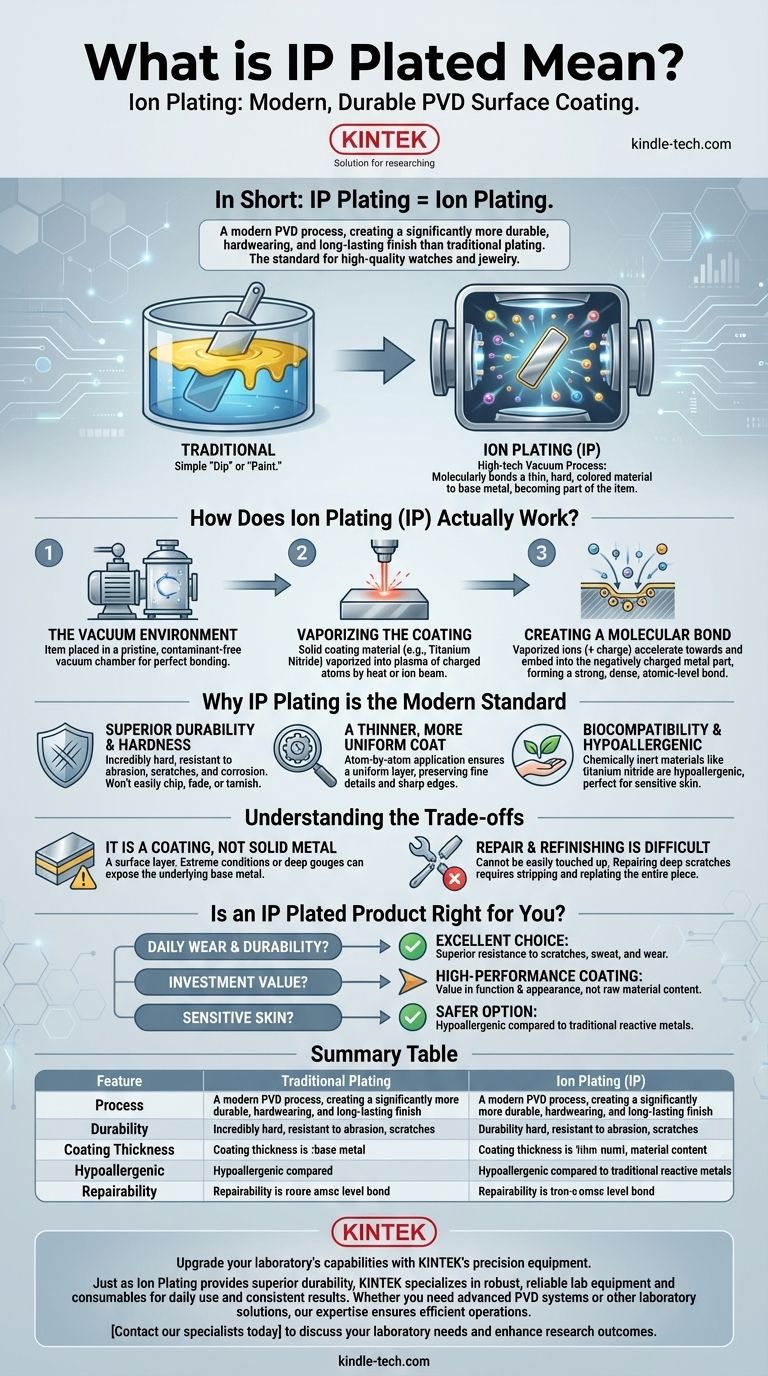
In short, IP Plating stands for Ion Plating. It is a modern surface coating process that uses Physical Vapor Deposition (PVD) to create a finish that is significantly more durable, hardwearing, and long-lasting than traditional plating methods. This technique is now the standard for high-quality watches and jewelry.

The crucial difference to understand is that Ion Plating is not a simple "dip" or "paint." It's a high-tech vacuum process that molecularly bonds a thin layer of hard, colored material to the base metal, resulting in a finish that becomes part of the original item rather than just sitting on top of it.
What is IP plated mean? Discover the Superior Durability of Ion Plating

How Does Ion Plating (IP) Actually Work?

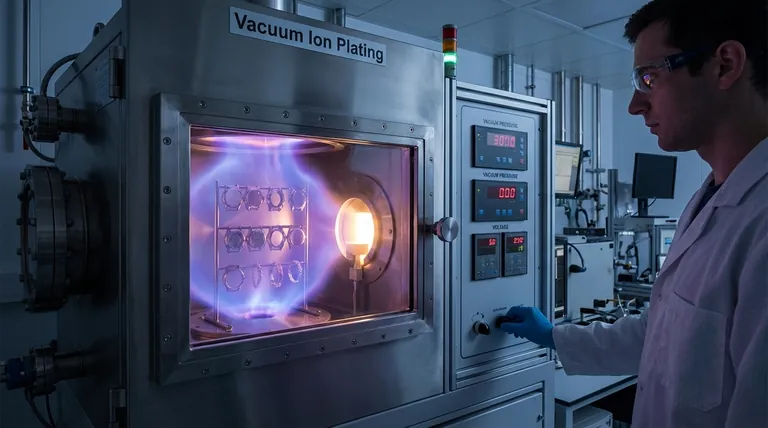
To understand why IP plating is superior, you need to understand the process. It's a sophisticated technique that takes place inside a specialized vacuum chamber.

The Vacuum Environment

First, the item to be plated (such as a stainless steel watch case) is placed in a vacuum chamber. All the air is removed to create a pristine, contaminant-free environment, which is critical for a perfect molecular bond.

Vaporizing the Coating Material

A solid piece of the coating material—often a super-hard ceramic like Titanium Nitride—is vaporized by either intense heat or a high-powered ion beam. This turns the solid material into a plasma of charged atoms.

Creating a Molecular Bond

The metal part being coated is given a strong negative electrical charge. The vaporized coating particles, which are positively charged ions, are then powerfully attracted to the negatively charged part. They accelerate towards it and embed themselves into the surface, creating an extremely strong, dense, and uniform bond at the atomic level.

Why IP Plating is the Modern Standard

This complex process yields several distinct advantages over older methods like traditional electroplating, making it the preferred choice for products designed for daily wear.

Superior Durability and Hardness

The primary benefit of IP plating is its exceptional durability. The resulting coating is incredibly hard and resistant to abrasion, scratches, and corrosion. An IP-plated finish won't easily chip, fade, or tarnish like older, softer plating methods.

A Thinner, More Uniform Coat

Because the coating is applied atom by atom in a vacuum, the resulting layer is extremely thin and perfectly uniform. This preserves the fine details and sharp edges of intricate watch or jewelry designs that thicker, less even plating can obscure.

Biocompatibility and Hypoallergenic Properties

The materials commonly used for IP plating, such as titanium nitride (used for gold tones) or titanium carbide (for black), are chemically inert. This makes them hypoallergenic and an excellent choice for individuals with skin sensitivities to metals like nickel.

Understanding the Trade-offs

While IP plating is a superior technology, it's essential to maintain an objective perspective. It has characteristics that you must be aware of.

It Is a Coating, Not Solid Metal

Despite its incredible durability, an IP finish is still a surface layer. Under extreme and prolonged abrasive conditions or after a very deep gouge that penetrates the coating, the underlying base metal (usually stainless steel) can become exposed.

Repair and Refinishing is Difficult

Unlike a solid gold watch that can be polished to remove scratches, an IP plated surface cannot be easily "touched up." Repairing a deep scratch would require the entire piece to be stripped and replated, which is often not feasible.

Is an IP Plated Product Right for You?

Making the right choice depends on balancing your expectations for appearance, longevity, and value.

  • If your primary focus is daily wear and durability: IP plating is an excellent choice, offering superior resistance to the scratches, sweat, and wear of everyday life.
  • If your primary focus is investment value: Recognize that it is a high-performance coating, not solid precious metal. Its value is in its function and appearance, not its raw material content.
  • If you have sensitive skin: IP plated jewelry is often a safer, hypoallergenic option compared to items with reactive metals used in traditional plating.

Ultimately, choosing an IP plated item means prioritizing modern, high-performance durability for your accessories.

Summary Table:

Feature Traditional Plating Ion Plating (IP)
Process Electrochemical dip Vacuum PVD, molecular bonding
Durability Prone to scratches/fading Extremely hard, abrasion-resistant
Coating Thickness Thicker, less uniform Thin, uniform, preserves details
Hypoallergenic Varies (may contain nickel) Excellent (uses inert ceramics)
Repairability Can be replated Difficult to refinish

Upgrade your laboratory's capabilities with KINTEK's precision equipment.

Just as Ion Plating provides superior durability for high-end accessories, KINTEK specializes in robust, reliable lab equipment and consumables designed to withstand daily use and deliver consistent results. Whether you need advanced PVD systems for surface coating research or other laboratory solutions, our expertise ensures your operations run efficiently and effectively.

Contact our specialists today to discuss how KINTEK can meet your specific laboratory needs and enhance your research outcomes.

Visual Guide
What is IP plated mean? Discover the Superior Durability of Ion Plating Visual Guide

Related Products

People Also Ask

Related Products

Chemical Vapor Deposition CVD Equipment System Chamber Slide PECVD Tube Furnace with Liquid Gasifier PECVD Machine

Chemical Vapor Deposition CVD Equipment System Chamber Slide PECVD Tube Furnace with Liquid Gasifier PECVD Machine

KT-PE12 Slide PECVD System: Wide power range, programmable temp control, fast heating/cooling with sliding system, MFC mass flow control & vacuum pump.

RF PECVD System Radio Frequency Plasma-Enhanced Chemical Vapor Deposition RF PECVD

RF PECVD System Radio Frequency Plasma-Enhanced Chemical Vapor Deposition RF PECVD

RF-PECVD is an acronym for "Radio Frequency Plasma-Enhanced Chemical Vapor Deposition." It deposits DLC (Diamond-like carbon film) on germanium and silicon substrates. It is utilized in the 3-12um infrared wavelength range.

Split Chamber CVD Tube Furnace with Vacuum Station Chemical Vapor Deposition System Equipment Machine

Split Chamber CVD Tube Furnace with Vacuum Station Chemical Vapor Deposition System Equipment Machine

Efficient split chamber CVD furnace with vacuum station for intuitive sample checking and quick cooling. Up to 1200℃ max temperature with accurate MFC mass flowmeter control.

30T 40T Split Automatic Heated Hydraulic Press Machine with Heated Plates for Laboratory Hot Press

30T 40T Split Automatic Heated Hydraulic Press Machine with Heated Plates for Laboratory Hot Press

Discover our split automatic heated lab press 30T/40T for precise sample preparation in material research, pharmacy, ceramics, and electronics industries. With a small footprint and heating up to 300°C, it's perfect for processing under vacuum environment.

Vacuum Heat Treat and Molybdenum Wire Sintering Furnace for Vacuum Sintering

Vacuum Heat Treat and Molybdenum Wire Sintering Furnace for Vacuum Sintering

A vacuum molybdenum wire sintering furnace is a vertical or bedroom structure, which is suitable for withdrawal, brazing, sintering and degassing of metal materials under high vacuum and high temperature conditions. It is also suitable for dehydroxylation treatment of quartz materials.

Molybdenum Vacuum Heat Treat Furnace

Molybdenum Vacuum Heat Treat Furnace

Discover the benefits of a high-configuration molybdenum vacuum furnace with heat shield insulation. Ideal for high-purity, vacuum environments like sapphire crystal growth and heat treatment.

Vertical High Temperature Graphite Vacuum Graphitization Furnace

Vertical High Temperature Graphite Vacuum Graphitization Furnace

Vertical high temperature graphitization furnace for carbonization and graphitization of carbon materials up to 3100℃.Suitable for shaped graphitization of carbon fiber filaments and other materials sintered in a carbon environment.Applications in metallurgy, electronics, and aerospace for producing high-quality graphite products like electrodes and crucibles.

Oil Free Diaphragm Vacuum Pump for Laboratory and Industrial Use

Oil Free Diaphragm Vacuum Pump for Laboratory and Industrial Use

Oil-free diaphragm vacuum pump for labs: clean, reliable, chemical-resistant. Ideal for filtration, SPE, and rotary evaporation. Maintenance-free operation.

Vacuum Hot Press Furnace Heated Vacuum Press Machine Tube Furnace

Vacuum Hot Press Furnace Heated Vacuum Press Machine Tube Furnace

Reduce forming pressure & shorten sintering time with Vacuum Tube Hot Press Furnace for high-density, fine-grain materials. Ideal for refractory metals.

Small Vacuum Heat Treat and Tungsten Wire Sintering Furnace

Small Vacuum Heat Treat and Tungsten Wire Sintering Furnace

The small vacuum tungsten wire sintering furnace is a compact experimental vacuum furnace specially designed for universities and scientific research institutes. The furnace features a CNC welded shell and vacuum piping to ensure leak-free operation. Quick-connect electrical connections facilitate relocation and debugging, and the standard electrical control cabinet is safe and convenient to operate.

Non Consumable Vacuum Arc Induction Melting Furnace

Non Consumable Vacuum Arc Induction Melting Furnace

Explore the benefits of Non-Consumable Vacuum Arc Furnace with high melting point electrodes. Small, easy to operate & eco-friendly. Ideal for laboratory research on refractory metals & carbides.

Ultra-High Temperature Graphite Vacuum Graphitization Furnace

Ultra-High Temperature Graphite Vacuum Graphitization Furnace

The ultra-high temperature graphitization furnace utilizes medium frequency induction heating in a vacuum or inert gas environment. The induction coil generates an alternating magnetic field, inducing eddy currents in the graphite crucible, which heats up and radiates heat to the workpiece, bringing it to the desired temperature. This furnace is primarily used for graphitization and sintering of carbon materials, carbon fiber materials, and other composite materials.

Vacuum Heat Treat Furnace with Ceramic Fiber Liner

Vacuum Heat Treat Furnace with Ceramic Fiber Liner

Vacuum furnace with polycrystalline ceramic fiber insulation liner for excellent heat insulation and uniform temperature field. Choose from 1200℃ or 1700℃ max. working temperature with high vacuum performance and precise temperature control.

Vacuum Heat Treat and Sintering Furnace with 9MPa Air Pressure

Vacuum Heat Treat and Sintering Furnace with 9MPa Air Pressure

The air pressure sintering furnace is a high-tech equipment commonly used for the sintering of advanced ceramic materials. It combines vacuum sintering and pressure sintering techniques to achieve high-density and high-strength ceramics.

1200℃ Controlled Atmosphere Furnace Nitrogen Inert Atmosphere Furnace

1200℃ Controlled Atmosphere Furnace Nitrogen Inert Atmosphere Furnace

Discover our KT-12A Pro Controlled atmosphere furnace - high precision, heavy duty vacuum chamber, versatile smart touch screen controller, and excellent temperature uniformity up to 1200C. Ideal for both laboratory and industrial application.

1400℃ Controlled Atmosphere Furnace with Nitrogen and Inert Atmosphere

1400℃ Controlled Atmosphere Furnace with Nitrogen and Inert Atmosphere

Achieve precise heat treatment with KT-14A controlled atmosphere furnace. Vacuum sealed with a smart controller, it's ideal for lab and industrial use up to 1400℃.

600T Vacuum Induction Hot Press Furnace for Heat Treat and Sintering

600T Vacuum Induction Hot Press Furnace for Heat Treat and Sintering

Discover the 600T Vacuum Induction Hot Press Furnace, designed for high-temperature sintering experiments in vacuum or protected atmospheres. Its precise temperature and pressure control, adjustable working pressure, and advanced safety features make it ideal for nonmetal materials, carbon composites, ceramics, and metal powders.

High Pressure Laboratory Vacuum Tube Furnace Quartz Tubular Furnace

High Pressure Laboratory Vacuum Tube Furnace Quartz Tubular Furnace

KT-PTF High Pressure Tube Furnace: Compact split tube furnace with strong positive pressure resistance. Working temp up to 1100°C and pressure up to 15Mpa. Also works under controller atmosphere or high vacuum.

Circulating Water Vacuum Pump for Laboratory and Industrial Use

Circulating Water Vacuum Pump for Laboratory and Industrial Use

Efficient circulating water vacuum pump for labs - oil-free, corrosion-resistant, quiet operation. Multiple models available. Get yours now!

2200 ℃ Tungsten Vacuum Heat Treat and Sintering Furnace

2200 ℃ Tungsten Vacuum Heat Treat and Sintering Furnace

Experience the ultimate refractory metal furnace with our Tungsten vacuum furnace. Capable of reaching 2200℃, perfect for sintering advanced ceramics and refractory metals. Order now for high-quality results.


Leave Your Message