Knowledge cvd machine What is physical Vapour deposition process? A Guide to High-Performance Thin Film Coatings
Author avatar

Tech Team · Kintek Solution

Updated 2 months ago

What is physical Vapour deposition process? A Guide to High-Performance Thin Film Coatings


In essence, Physical Vapor Deposition (PVD) is a vacuum-based coating process where a thin, high-performance film is applied to a surface. The technique works by converting a solid source material into a vapor, which then travels through the vacuum and condenses onto the target object, building the coating one atom at a time.

PVD is not a simple painting or plating process; it is a sophisticated technique that fundamentally changes a material's surface properties by depositing a highly adherent, atom-by-atom thin film in a controlled high-vacuum environment.
What is physical Vapour deposition process? A Guide to High-Performance Thin Film Coatings

How the PVD Process Fundamentally Works

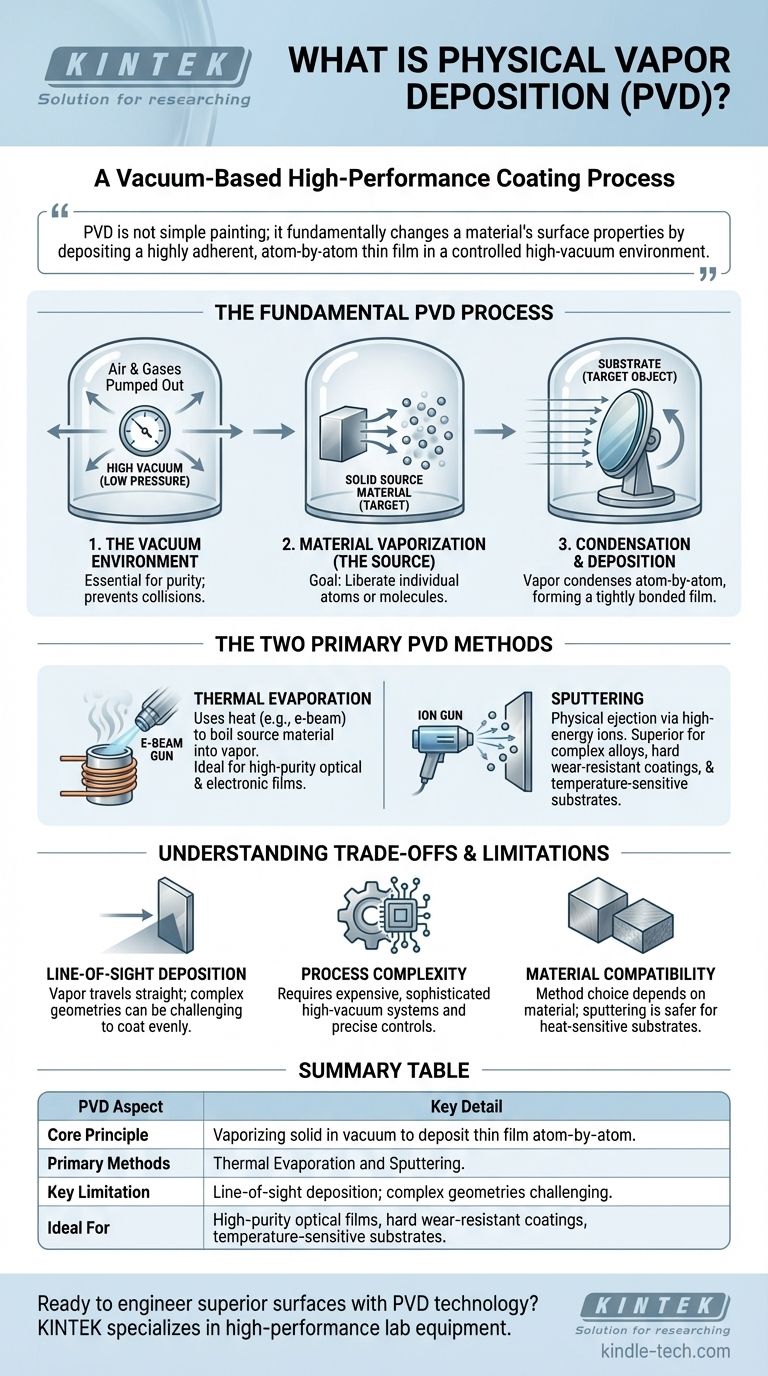
The PVD process, regardless of the specific method used, follows three critical steps conducted inside a vacuum chamber. This environment is essential for the purity and quality of the final coating.

The Vacuum Environment

First, all the air and other gases are pumped out of the deposition chamber to create a high vacuum. This extremely low-pressure environment is critical because it prevents vaporized coating atoms from colliding with air molecules on their way to the substrate.

Material Vaporization (The Source)

A solid source material, known as the target, is converted into a vapor. This is the core step that defines the different types of PVD. The goal is to liberate individual atoms or molecules from the solid material so they can be transported.

Condensation and Deposition

The vaporized atoms travel in a straight line through the vacuum chamber and strike the surface of the component to be coated, which is called the substrate. Upon contact with the cooler substrate, the vapor condenses back into a solid state, forming a thin, dense, and tightly bonded film. Fixtures often rotate the parts to ensure an even coating on complex 3D surfaces.

The Two Primary PVD Methods

While the principle is the same, how the material is vaporized creates two distinct and common PVD categories.

Thermal Evaporation

This method uses heat to turn the source material into a vapor. The solid material is heated in a crucible until it literally boils and evaporates.

A common and precise form of this is e-beam evaporation, where a high-energy electron beam is focused on the target material, causing it to vaporize at a controlled rate. This is often used for creating highly pure optical and electronic films.

Sputtering

Sputtering does not rely on heat to vaporize the material. Instead, it is a physical ejection process.

High-energy ions (typically from an inert gas like argon) are accelerated and smashed into the target material. The impact has enough energy to physically knock atoms off the target's surface, launching them toward the substrate where they form the coating.

Understanding the Trade-offs and Limitations

PVD is a powerful technology, but it is essential to understand its operational constraints to apply it correctly.

Line-of-Sight Deposition

The vaporized atoms travel in a straight line from the source to the substrate. This means PVD is a "line-of-sight" process. Any surface not directly exposed to the vapor source will not get coated, which can be a challenge for components with complex geometries, holes, or deep recesses.

Process Complexity

PVD systems require high-vacuum chambers, sophisticated power supplies, and precise controls. This makes the equipment expensive and the process more complex to run compared to conventional coating methods like painting or electroplating.

Material Compatibility

The choice of PVD method is often dictated by the material being deposited. Some alloys or compounds can decompose at the high temperatures required for thermal evaporation, making sputtering the only viable option.

Making the Right Choice for Your Application

Selecting the correct PVD method depends entirely on the desired properties of the final coating and the nature of the substrate material.

  • If your primary focus is high-purity optical or electronic films: Thermal evaporation often provides the cleanest and most controlled deposition for these sensitive applications.
  • If your primary focus is a hard, dense, and wear-resistant coating: Sputtering is generally superior for depositing complex alloys and compounds used for tools and aerospace components.
  • If your primary focus is coating a temperature-sensitive material: Sputtering can be performed at lower temperatures than thermal evaporation, making it a safer choice for plastics or other sensitive substrates.

By understanding these core principles, you can effectively leverage PVD to engineer high-performance surfaces tailored to your specific technical needs.

Summary Table:

PVD Aspect Key Detail
Core Principle Vaporizing a solid material in a vacuum to deposit a thin film atom-by-atom.
Primary Methods Thermal Evaporation and Sputtering.
Key Limitation Line-of-sight deposition; complex geometries can be challenging.
Ideal For High-purity optical films, hard wear-resistant coatings, and temperature-sensitive substrates.

Ready to engineer superior surfaces with PVD technology? KINTEK specializes in providing high-performance lab equipment and consumables, including solutions for advanced coating processes. Our expertise can help you select the right PVD method for your specific application, ensuring durability and precision. Contact our experts today to discuss how we can support your laboratory's coating and material science needs!

Visual Guide
What is physical Vapour deposition process? A Guide to High-Performance Thin Film Coatings Visual Guide

Related Products

People Also Ask

Related Products

Chemical Vapor Deposition CVD Equipment System Chamber Slide PECVD Tube Furnace with Liquid Gasifier PECVD Machine

Chemical Vapor Deposition CVD Equipment System Chamber Slide PECVD Tube Furnace with Liquid Gasifier PECVD Machine

KT-PE12 Slide PECVD System: Wide power range, programmable temp control, fast heating/cooling with sliding system, MFC mass flow control & vacuum pump.

RF PECVD System Radio Frequency Plasma-Enhanced Chemical Vapor Deposition RF PECVD

RF PECVD System Radio Frequency Plasma-Enhanced Chemical Vapor Deposition RF PECVD

RF-PECVD is an acronym for "Radio Frequency Plasma-Enhanced Chemical Vapor Deposition." It deposits DLC (Diamond-like carbon film) on germanium and silicon substrates. It is utilized in the 3-12um infrared wavelength range.

915MHz MPCVD Diamond Machine Microwave Plasma Chemical Vapor Deposition System Reactor

915MHz MPCVD Diamond Machine Microwave Plasma Chemical Vapor Deposition System Reactor

915MHz MPCVD Diamond Machine and its multi-crystal effective growth, the maximum area can reach 8 inches, the maximum effective growth area of single crystal can reach 5 inches. This equipment is mainly used for the production of large-size polycrystalline diamond films, the growth of long single crystal diamonds, the low-temperature growth of high-quality graphene, and other materials that require energy provided by microwave plasma for growth.

HFCVD Machine System Equipment for Drawing Die Nano-Diamond Coating

HFCVD Machine System Equipment for Drawing Die Nano-Diamond Coating

The nano-diamond composite coating drawing die uses cemented carbide (WC-Co) as the substrate, and uses the chemical vapor phase method ( CVD method for short ) to coat the conventional diamond and nano-diamond composite coating on the surface of the inner hole of the mold.

Split Chamber CVD Tube Furnace with Vacuum Station Chemical Vapor Deposition System Equipment Machine

Split Chamber CVD Tube Furnace with Vacuum Station Chemical Vapor Deposition System Equipment Machine

Efficient split chamber CVD furnace with vacuum station for intuitive sample checking and quick cooling. Up to 1200℃ max temperature with accurate MFC mass flowmeter control.

Microwave Plasma Chemical Vapor Deposition MPCVD Machine System Reactor for Lab and Diamond Growth

Microwave Plasma Chemical Vapor Deposition MPCVD Machine System Reactor for Lab and Diamond Growth

Get high-quality diamond films with our Bell-jar Resonator MPCVD machine designed for lab and diamond growth. Discover how Microwave Plasma Chemical Vapor Deposition works for growing diamonds using carbon gas and plasma.

Customer Made Versatile CVD Tube Furnace Chemical Vapor Deposition Chamber System Equipment

Customer Made Versatile CVD Tube Furnace Chemical Vapor Deposition Chamber System Equipment

Get your exclusive CVD furnace with KT-CTF16 Customer Made Versatile Furnace. Customizable sliding, rotating, and tilting functions for precise reactions. Order now!

Inclined Rotary Plasma Enhanced Chemical Vapor Deposition PECVD Equipment Tube Furnace Machine

Inclined Rotary Plasma Enhanced Chemical Vapor Deposition PECVD Equipment Tube Furnace Machine

Introducing our inclined rotary PECVD furnace for precise thin film deposition. Enjoy automatic matching source, PID programmable temperature control, and high accuracy MFC mass flowmeter control. Built-in safety features for peace of mind.

Cylindrical Resonator MPCVD Machine System Reactor for Microwave Plasma Chemical Vapor Deposition and Lab Diamond Growth

Cylindrical Resonator MPCVD Machine System Reactor for Microwave Plasma Chemical Vapor Deposition and Lab Diamond Growth

Learn about Cylindrical Resonator MPCVD Machine, the microwave plasma chemical vapor deposition method used for growing diamond gemstones and films in the jewelry and semi-conductor industries. Discover its cost-effective advantages over traditional HPHT methods.

Multi Heating Zones CVD Tube Furnace Machine Chemical Vapor Deposition Chamber System Equipment

Multi Heating Zones CVD Tube Furnace Machine Chemical Vapor Deposition Chamber System Equipment

KT-CTF14 Multi Heating Zones CVD Furnace - Precise Temperature Control and Gas Flow for Advanced Applications. Max temp up to 1200℃, 4 channels MFC mass flow meter, and 7" TFT touch screen controller.

Inclined Rotary Plasma Enhanced Chemical Vapor Deposition PECVD Equipment Tube Furnace Machine

Inclined Rotary Plasma Enhanced Chemical Vapor Deposition PECVD Equipment Tube Furnace Machine

Upgrade your coating process with PECVD coating equipment. Ideal for LED, power semiconductors, MEMS and more. Deposits high-quality solid films at low temps.

CVD Diamond for Thermal Management Applications

CVD Diamond for Thermal Management Applications

CVD diamond for thermal management: High-quality diamond with thermal conductivity up to 2000 W/mK, ideal for heat spreaders, laser diodes, and GaN on Diamond (GOD) applications.

Custom CVD Diamond Coating for Lab Applications

Custom CVD Diamond Coating for Lab Applications

CVD Diamond Coating: Superior Thermal Conductivity, Crystal Quality, and Adhesion for Cutting Tools, Friction, and Acoustic Applications

CVD Diamond Dressing Tools for Precision Applications

CVD Diamond Dressing Tools for Precision Applications

Experience the Unbeatable Performance of CVD Diamond Dresser Blanks: High Thermal Conductivity, Exceptional Wear Resistance, and Orientation Independence.

Molybdenum Tungsten Tantalum Evaporation Boat for High Temperature Applications

Molybdenum Tungsten Tantalum Evaporation Boat for High Temperature Applications

Evaporation boat sources are used in thermal evaporation systems and are suitable for depositing various metals, alloys and materials. Evaporation boat sources are available in different thicknesses of tungsten, tantalum and molybdenum to ensure compatibility with a variety of power sources. As a container, it is used for vacuum evaporation of materials. They can be used for thin film deposition of various materials, or designed to be compatible with techniques such as electron beam fabrication.

Electron Beam Evaporation Coating Oxygen-Free Copper Crucible and Evaporation Boat

Electron Beam Evaporation Coating Oxygen-Free Copper Crucible and Evaporation Boat

Electron Beam Evaporation Coating Oxygen-Free Copper Crucible enables precise co-deposition of various materials. Its controlled temperature and water-cooled design ensure pure and efficient thin film deposition.

Hemispherical Bottom Tungsten Molybdenum Evaporation Boat

Hemispherical Bottom Tungsten Molybdenum Evaporation Boat

Used for gold plating, silver plating, platinum, palladium, suitable for a small amount of thin film materials. Reduce the waste of film materials and reduce heat dissipation.

Tungsten Evaporation Boat for Thin Film Deposition

Tungsten Evaporation Boat for Thin Film Deposition

Learn about tungsten boats, also known as evaporated or coated tungsten boats. With a high tungsten content of 99.95%, these boats are ideal for high-temperature environments and widely used in various industries. Discover their properties and applications here.

Evaporation Boat for Organic Matter

Evaporation Boat for Organic Matter

The evaporation boat for organic matter is an important tool for precise and uniform heating during the deposition of organic materials.

Vacuum Induction Melting Spinning System Arc Melting Furnace

Vacuum Induction Melting Spinning System Arc Melting Furnace

Develop metastable materials with ease using our Vacuum Melt Spinning System. Ideal for research and experimental work with amorphous and microcrystalline materials. Order now for effective results.


Leave Your Message