Knowledge What is plasma nitriding? Achieve Superior Wear Resistance and Component Durability
Author avatar

Tech Team · Kintek Solution

Updated 5 days ago

What is plasma nitriding? Achieve Superior Wear Resistance and Component Durability


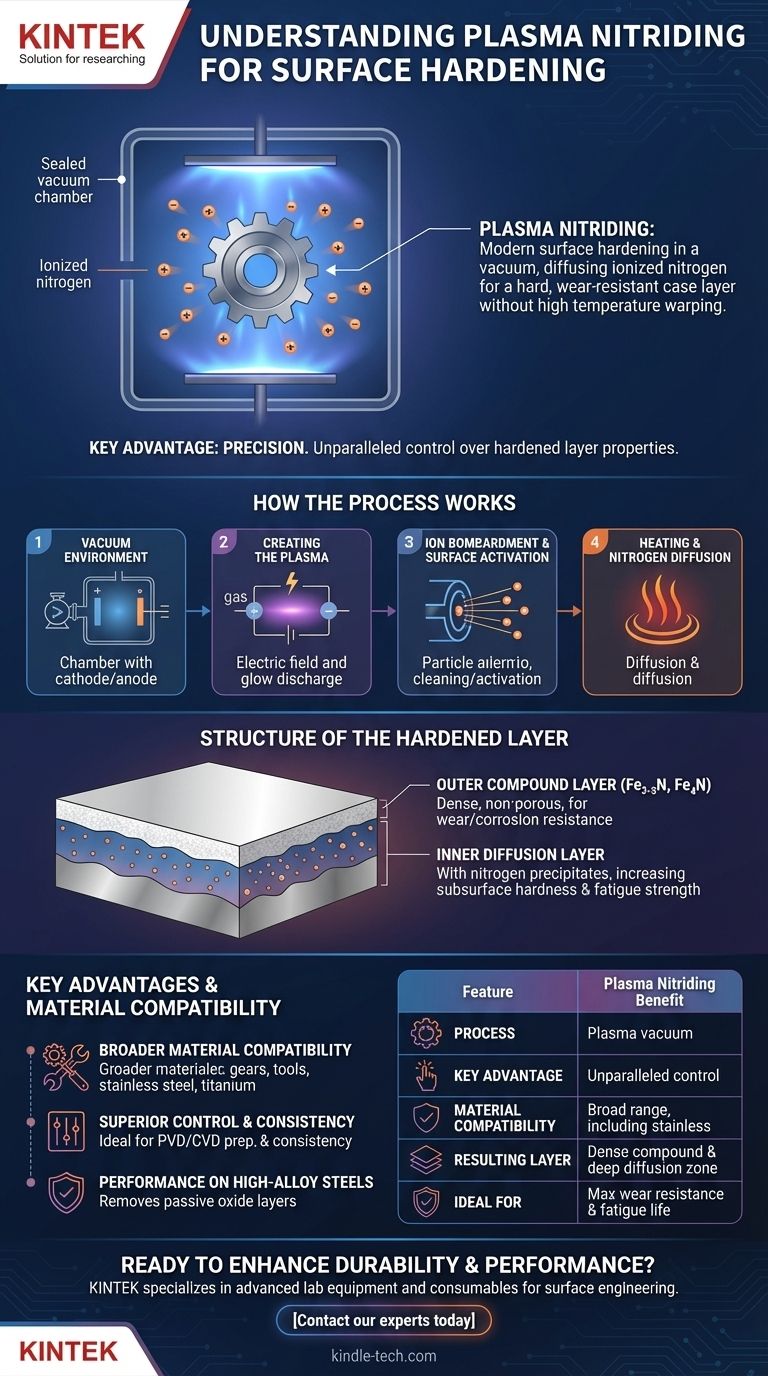
In short, plasma nitriding is a modern surface hardening method that uses ionized nitrogen gas in a vacuum to diffuse nitrogen into a metal's surface. This creates an extremely hard and wear-resistant case layer without the high temperatures or quenching that can cause parts to warp.

The crucial advantage of plasma nitriding lies in its precision. By using an electric field to control the process, engineers gain unparalleled control over the hardened layer's properties, making it superior to traditional methods for high-performance and sensitive components.
What is plasma nitriding? Achieve Superior Wear Resistance and Component Durability

How the Plasma Nitriding Process Works

Plasma nitriding, also known as ion nitriding, is a thermochemical heat treatment that fundamentally alters the surface of a material. The process takes place entirely within a sealed vacuum chamber.

The Vacuum Environment

The workpiece to be treated is placed inside the chamber and becomes the cathode (negative charge). The furnace wall itself acts as the anode (positive charge). The chamber is then evacuated to remove any contaminants.

Creating the Plasma

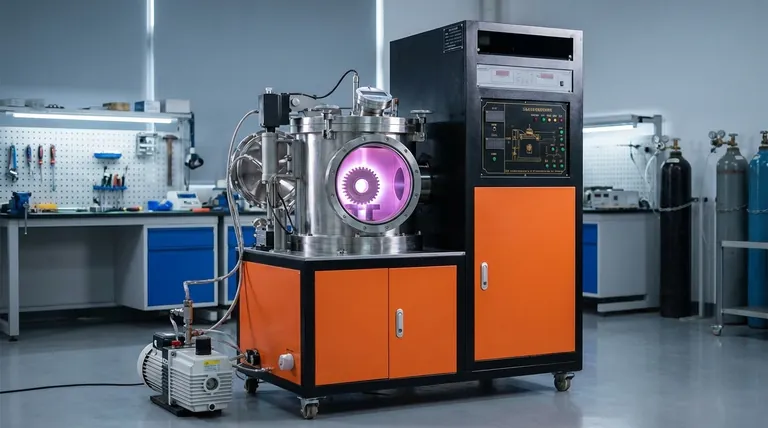
A specific nitrogen-based gas mixture is introduced into the chamber. A high-voltage electric field is applied between the workpiece and the furnace wall, causing the gas to ionize and form a low-pressure, conductive gas known as plasma. This is visually recognized as a characteristic glow discharge surrounding the part.

Ion Bombardment and Surface Activation

The positively charged nitrogen ions within the plasma are accelerated with high energy toward the negatively charged workpiece. This ion bombardment has several simultaneous effects.

First, it sputters the surface at a microscopic level, cleaning it of any impurities and dissolving passive oxide layers, which is especially critical for stainless steels. This activates the surface, making it highly receptive to nitrogen.

Heating and Nitrogen Diffusion

The constant energy transfer from the ion bombardment also heats the workpiece to the required nitriding temperature. Once at temperature, the activated surface readily allows nitrogen atoms to diffuse into the material, beginning the hardening process.

The Structure of the Hardened Layer

The nitriding process creates a distinct, two-part hardened case on the material's surface, each with a specific function.

The Outer Compound Layer

This is the outermost layer, often called the "white layer." It is composed of hard iron nitride compounds (ε-nitride Fe2-3N and γ'-nitride Fe4N). In plasma nitriding, this layer is uniquely dense and non-porous, providing exceptional resistance to wear, abrasion, and corrosion.

The Inner Diffusion Layer

Beneath the compound layer lies the diffusion layer. Here, nitrogen has penetrated deeper into the base material. It forms fine precipitates with nitride-forming elements in the alloy (like chromium, molybdenum, and aluminum), significantly increasing the subsurface hardness and fatigue strength of the component.

Understanding the Key Advantages

Plasma nitriding offers significant benefits over older methods like gas or salt bath nitriding, particularly for demanding applications.

Broader Material Compatibility

The process is effective on a vast range of materials. This includes all ferrous metals, high-alloy tool steels, cast iron, and even materials that are difficult to nitride otherwise, such as stainless steels, nickel-based alloys, and titanium alloys.

Superior Control and Consistency

The electrical parameters of the plasma can be precisely controlled. This allows for fine-tuning the structure of the nitrided layers, such as creating a specific compound layer thickness or even a layer with no compound zone at all, which is ideal for subsequent PVD or CVD coatings.

Performance on High-Alloy Steels

For high-alloy and stainless steels, the sputtering effect of the plasma is critical. It effectively removes the tough, passive oxide layers that would otherwise prevent nitrogen diffusion, resulting in a much harder and more consistent case than is possible with gas nitriding.

Making the Right Choice for Your Goal

Understanding these principles allows you to select the right surface treatment for your specific engineering challenge.

  • If your primary focus is maximum wear and galling resistance: The dense, non-porous compound layer created by plasma nitriding offers superior performance for components like gears, extruder screws, and forging dies.
  • If your primary focus is improving the fatigue life of a component: The deep diffusion layer significantly enhances subsurface strength, making it ideal for crankshafts, camshafts, and axles.
  • If your primary focus is treating stainless or high-alloy tool steel: Plasma nitriding is the definitive choice, as its surface activation mechanism overcomes the passive layers inherent to these materials.
  • If your primary focus is preparing a surface for a thin-film coating: The ability to precisely control or eliminate the compound layer makes plasma nitriding an ideal preparatory step for PVD and CVD processes.

Ultimately, leveraging plasma nitriding allows for a level of material surface engineering that empowers the design of more durable, efficient, and reliable components.

Summary Table:

Feature Plasma Nitriding Benefit
Process Uses ionized gas (plasma) in a vacuum chamber
Key Advantage Unparalleled control over the hardened layer's properties
Material Compatibility Broad range, including stainless steels & high-alloy tool steels
Resulting Layer Dense, non-porous compound layer and a deep diffusion zone
Ideal For Components requiring maximum wear resistance and fatigue life

Ready to enhance the durability and performance of your components?

KINTEK specializes in advanced lab equipment and consumables for surface engineering. Our expertise in plasma nitriding technology can help you achieve superior wear resistance, corrosion protection, and extended fatigue life for your high-performance parts.

Contact our experts today to discuss how plasma nitriding can solve your specific material challenges and improve your product reliability.

Visual Guide
What is plasma nitriding? Achieve Superior Wear Resistance and Component Durability Visual Guide

Related Products

People Also Ask

Related Products

Vacuum Heat Treat Furnace and Levitation Induction Melting Furnace

Vacuum Heat Treat Furnace and Levitation Induction Melting Furnace

Experience precise melting with our Vacuum Levitation Melting Furnace. Ideal for high melting point metals or alloys, with advanced technology for effective smelting. Order now for high-quality results.

Vacuum Heat Treat and Sintering Furnace with 9MPa Air Pressure

Vacuum Heat Treat and Sintering Furnace with 9MPa Air Pressure

The air pressure sintering furnace is a high-tech equipment commonly used for the sintering of advanced ceramic materials. It combines vacuum sintering and pressure sintering techniques to achieve high-density and high-strength ceramics.

Vacuum Heat Treat Sintering Brazing Furnace

Vacuum Heat Treat Sintering Brazing Furnace

A vacuum brazing furnace is a type of industrial furnace used for brazing, a metalworking process that joins two pieces of metal using a filler metal that melts at a lower temperature than the base metals. Vacuum brazing furnaces are typically used for high-quality applications where a strong, clean joint is required.

Vacuum Heat Treat Furnace with Ceramic Fiber Liner

Vacuum Heat Treat Furnace with Ceramic Fiber Liner

Vacuum furnace with polycrystalline ceramic fiber insulation liner for excellent heat insulation and uniform temperature field. Choose from 1200℃ or 1700℃ max. working temperature with high vacuum performance and precise temperature control.

Vacuum Sealed Continuous Working Rotary Tube Furnace Rotating Tube Furnace

Vacuum Sealed Continuous Working Rotary Tube Furnace Rotating Tube Furnace

Experience efficient material processing with our vacuum-sealed rotary tube furnace. Perfect for experiments or industrial production, equipped with optional features for controlled feeding and optimized results. Order now.

Vertical Laboratory Quartz Tube Furnace Tubular Furnace

Vertical Laboratory Quartz Tube Furnace Tubular Furnace

Elevate your experiments with our Vertical Tube Furnace. Versatile design allows for operation under various environments and heat treatment applications. Order now for precise results!

High Pressure Laboratory Vacuum Tube Furnace Quartz Tubular Furnace

High Pressure Laboratory Vacuum Tube Furnace Quartz Tubular Furnace

KT-PTF High Pressure Tube Furnace: Compact split tube furnace with strong positive pressure resistance. Working temp up to 1100°C and pressure up to 15Mpa. Also works under controller atmosphere or high vacuum.

600T Vacuum Induction Hot Press Furnace for Heat Treat and Sintering

600T Vacuum Induction Hot Press Furnace for Heat Treat and Sintering

Discover the 600T Vacuum Induction Hot Press Furnace, designed for high-temperature sintering experiments in vacuum or protected atmospheres. Its precise temperature and pressure control, adjustable working pressure, and advanced safety features make it ideal for nonmetal materials, carbon composites, ceramics, and metal powders.

1700℃ Controlled Atmosphere Furnace Nitrogen Inert Atmosphere Furnace

1700℃ Controlled Atmosphere Furnace Nitrogen Inert Atmosphere Furnace

KT-17A Controlled atmosphere furnace: 1700℃ heating, vacuum sealing technology, PID temperature control, and versatile TFT smart touch screen controller for laboratory and industrial use.

Ultra-High Temperature Graphite Vacuum Graphitization Furnace

Ultra-High Temperature Graphite Vacuum Graphitization Furnace

The ultra-high temperature graphitization furnace utilizes medium frequency induction heating in a vacuum or inert gas environment. The induction coil generates an alternating magnetic field, inducing eddy currents in the graphite crucible, which heats up and radiates heat to the workpiece, bringing it to the desired temperature. This furnace is primarily used for graphitization and sintering of carbon materials, carbon fiber materials, and other composite materials.

Laboratory Vacuum Tilt Rotary Tube Furnace Rotating Tube Furnace

Laboratory Vacuum Tilt Rotary Tube Furnace Rotating Tube Furnace

Discover the versatility of Laboratory Rotary Furnace: Ideal for calcination, drying, sintering, and high-temperature reactions. Adjustable rotating and tilting functions for optimal heating. Suitable for vacuum and controlled atmosphere environments. Learn more now!

Spark Plasma Sintering Furnace SPS Furnace

Spark Plasma Sintering Furnace SPS Furnace

Discover the benefits of Spark Plasma Sintering Furnaces for rapid, low-temperature material preparation. Uniform heating, low cost & eco-friendly.

Vacuum Hot Press Furnace Heated Vacuum Press Machine Tube Furnace

Vacuum Hot Press Furnace Heated Vacuum Press Machine Tube Furnace

Reduce forming pressure & shorten sintering time with Vacuum Tube Hot Press Furnace for high-density, fine-grain materials. Ideal for refractory metals.

1200℃ Controlled Atmosphere Furnace Nitrogen Inert Atmosphere Furnace

1200℃ Controlled Atmosphere Furnace Nitrogen Inert Atmosphere Furnace

Discover our KT-12A Pro Controlled atmosphere furnace - high precision, heavy duty vacuum chamber, versatile smart touch screen controller, and excellent temperature uniformity up to 1200C. Ideal for both laboratory and industrial application.

1400℃ Controlled Atmosphere Furnace with Nitrogen and Inert Atmosphere

1400℃ Controlled Atmosphere Furnace with Nitrogen and Inert Atmosphere

Achieve precise heat treatment with KT-14A controlled atmosphere furnace. Vacuum sealed with a smart controller, it's ideal for lab and industrial use up to 1400℃.

Vacuum Induction Melting Spinning System Arc Melting Furnace

Vacuum Induction Melting Spinning System Arc Melting Furnace

Develop metastable materials with ease using our Vacuum Melt Spinning System. Ideal for research and experimental work with amorphous and microcrystalline materials. Order now for effective results.

Vacuum Heat Treat and Molybdenum Wire Sintering Furnace for Vacuum Sintering

Vacuum Heat Treat and Molybdenum Wire Sintering Furnace for Vacuum Sintering

A vacuum molybdenum wire sintering furnace is a vertical or bedroom structure, which is suitable for withdrawal, brazing, sintering and degassing of metal materials under high vacuum and high temperature conditions. It is also suitable for dehydroxylation treatment of quartz materials.

High Temperature Muffle Oven Furnace for Laboratory Debinding and Pre Sintering

High Temperature Muffle Oven Furnace for Laboratory Debinding and Pre Sintering

KT-MD High temperature debinding and pre-sintering furnace for ceramic materials with various molding processes. Ideal for electronic components such as MLCC and NFC.

2200 ℃ Tungsten Vacuum Heat Treat and Sintering Furnace

2200 ℃ Tungsten Vacuum Heat Treat and Sintering Furnace

Experience the ultimate refractory metal furnace with our Tungsten vacuum furnace. Capable of reaching 2200℃, perfect for sintering advanced ceramics and refractory metals. Order now for high-quality results.

1800℃ Muffle Oven Furnace for Laboratory

1800℃ Muffle Oven Furnace for Laboratory

KT-18 muffle furnace with Japan Al2O3 polycrystalline fibe and Silicon Molybdenum heating element, up to 1900℃, PID temperature control and 7" smart touch screen. Compact design, low heat loss, and high energy efficiency. Safety interlock system and versatile functions.


Leave Your Message