Knowledge What is sintering cycle? A Guide to the Thermal Process for Dense, Strong Parts
Author avatar

Tech Team · Kintek Solution

Updated 1 week ago

What is sintering cycle? A Guide to the Thermal Process for Dense, Strong Parts


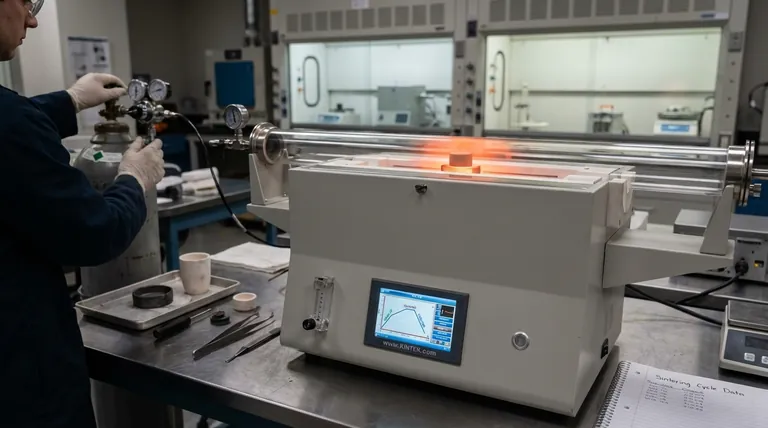
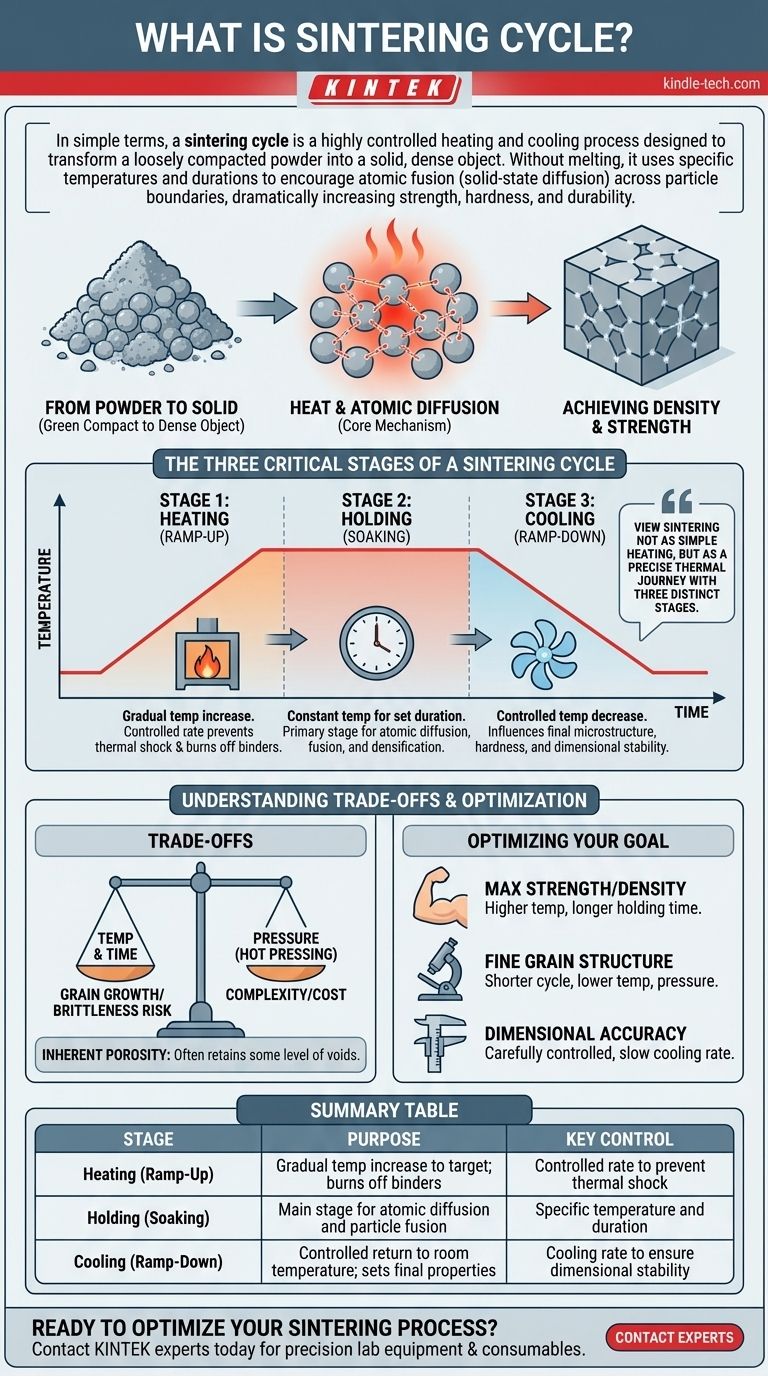
In simple terms, a sintering cycle is a highly controlled heating and cooling process designed to transform a loosely compacted powder into a solid, dense object. Without melting the core material, the cycle uses specific temperatures and durations to encourage atoms to fuse across particle boundaries. This solid-state diffusion welds the particles together, dramatically increasing the material's strength, hardness, and durability.

The critical insight is to view sintering not as simple heating, but as a precise thermal journey with three distinct stages: a controlled ramp-up, a specific hold at temperature, and a carefully managed cool-down. Each stage plays a vital role in fusing the particles and achieving the final, desired material properties.
What is sintering cycle? A Guide to the Thermal Process for Dense, Strong Parts

The Core Mechanism: How Sintering Works

From Powder to Solid

The process begins with a mass of fine particles—typically metal, ceramic, or plastic—that has often been pressed into a desired shape. This initial object is known as a "green compact" and is fragile, with significant empty space, or porosity, between the particles.

The Role of Heat

The sintering cycle introduces thermal energy. This energy doesn't melt the material but excites the atoms, giving them the mobility to move.

Atomic Diffusion

At the high temperatures of the sintering cycle, atoms migrate across the boundaries where individual particles touch. This process, called solid-state diffusion, builds "necks" or bridges between adjacent particles.

Achieving Density and Strength

As these necks grow, they pull the particles closer together, shrinking the voids between them. The entire mass densifies and fuses into a single, coherent piece with mechanical properties vastly superior to the original powder.

The Three Critical Stages of a Sintering Cycle

A successful outcome depends on meticulously controlling each phase of the thermal cycle.

Stage 1: Heating (Ramp-Up)

The furnace temperature is gradually increased to the target sintering temperature. This must be done at a controlled rate to prevent thermal shock, which could crack the part. This stage also serves to cleanly burn off any lubricants or binders used during the initial compaction phase.

Stage 2: Holding (Soaking)

The material is held at a constant, specific sintering temperature for a set duration. During this "soaking" period, the majority of atomic diffusion occurs. This is the primary stage where the particles fuse, porosity decreases, and the part gains its strength and density.

Stage 3: Cooling (Ramp-Down)

Finally, the temperature is slowly and deliberately lowered back to room temperature. The cooling rate is just as critical as the heating rate, as it influences the final microstructure, hardness, and dimensional stability of the finished component.

Understanding the Trade-offs

The effectiveness of a sintering cycle is determined by a balance of competing factors.

Temperature vs. Time

A higher sintering temperature can accelerate diffusion and shorten the required holding time. However, it also increases energy costs and the risk of undesirable grain growth, which can sometimes make a material more brittle.

The Impact of Pressure

Some sintering cycles apply external pressure during heating (a process known as hot pressing). This can achieve higher final densities at lower temperatures but adds significant complexity and cost to the equipment and process.

Inherent Porosity

While sintering dramatically increases density, it rarely eliminates all voids. Most sintered parts retain some level of residual porosity, which must be accounted for in engineering applications. The process is ideal for materials with extremely high melting points, like tungsten and molybdenum, where traditional casting is impractical.

Optimizing the Cycle for Your Goal

The ideal sintering cycle is always tailored to the material and the desired outcome for the final part.

  • If your primary focus is maximum strength and density: You will need a cycle with a higher sintering temperature and a longer holding time to maximize atomic diffusion.
  • If your primary focus is preserving a fine grain structure: A shorter cycle at a lower temperature, sometimes with applied pressure, is the preferred approach.
  • If your primary focus is dimensional accuracy: A carefully controlled, slower cooling rate is paramount to prevent warping and minimize internal stresses.

Mastering the sintering cycle is about precisely balancing time, temperature, and pressure to engineer a material's final properties from the particle level up.

Summary Table:

Stage Purpose Key Control
Heating (Ramp-Up) Gradual temperature increase to target; burns off binders Controlled rate to prevent thermal shock
Holding (Soaking) Main stage for atomic diffusion and particle fusion Specific temperature and duration
Cooling (Ramp-Down) Controlled return to room temperature; sets final properties Cooling rate to ensure dimensional stability

Ready to optimize your sintering process for stronger, more durable parts?

At KINTEK, we specialize in precision lab equipment for sintering applications. Our furnaces and consumables are designed to deliver the exact temperature control and uniformity your materials require. Whether you are working with metals, ceramics, or other powders, we can help you achieve maximum density, strength, and dimensional accuracy.

Contact our experts today to discuss your specific needs and discover how KINTEK solutions can enhance your laboratory's capabilities.

Visual Guide
What is sintering cycle? A Guide to the Thermal Process for Dense, Strong Parts Visual Guide

Related Products

People Also Ask

Related Products

1400℃ Laboratory Quartz Tube Furnace with Alumina Tube Tubular Furnace

1400℃ Laboratory Quartz Tube Furnace with Alumina Tube Tubular Furnace

Looking for a tube furnace for high-temperature applications? Our 1400℃ Tube Furnace with Alumina Tube is perfect for research and industrial use.

1700℃ Laboratory Quartz Tube Furnace with Alumina Tube Tubular Furnace

1700℃ Laboratory Quartz Tube Furnace with Alumina Tube Tubular Furnace

Looking for a high-temperature tube furnace? Check out our 1700℃ Tube Furnace with Alumina Tube. Perfect for research and industrial applications up to 1700C.

Vacuum Heat Treat and Sintering Furnace with 9MPa Air Pressure

Vacuum Heat Treat and Sintering Furnace with 9MPa Air Pressure

The air pressure sintering furnace is a high-tech equipment commonly used for the sintering of advanced ceramic materials. It combines vacuum sintering and pressure sintering techniques to achieve high-density and high-strength ceramics.

Laboratory Muffle Oven Furnace Bottom Lifting Muffle Furnace

Laboratory Muffle Oven Furnace Bottom Lifting Muffle Furnace

Efficiently produce batches with excellent temperature uniformity using our Bottom Lifting Furnace. Features two electric lifting stages and advanced temperature control up to 1600℃.

Molybdenum Vacuum Heat Treat Furnace

Molybdenum Vacuum Heat Treat Furnace

Discover the benefits of a high-configuration molybdenum vacuum furnace with heat shield insulation. Ideal for high-purity, vacuum environments like sapphire crystal growth and heat treatment.

1800℃ Muffle Oven Furnace for Laboratory

1800℃ Muffle Oven Furnace for Laboratory

KT-18 muffle furnace with Japan Al2O3 polycrystalline fibe and Silicon Molybdenum heating element, up to 1900℃, PID temperature control and 7" smart touch screen. Compact design, low heat loss, and high energy efficiency. Safety interlock system and versatile functions.

High Pressure Laboratory Vacuum Tube Furnace Quartz Tubular Furnace

High Pressure Laboratory Vacuum Tube Furnace Quartz Tubular Furnace

KT-PTF High Pressure Tube Furnace: Compact split tube furnace with strong positive pressure resistance. Working temp up to 1100°C and pressure up to 15Mpa. Also works under controller atmosphere or high vacuum.

1700℃ Muffle Oven Furnace for Laboratory

1700℃ Muffle Oven Furnace for Laboratory

Get superior heat control with our 1700℃ Muffle Furnace. Equipped with intelligent temperature microprocessor, TFT touch screen controller & advanced insulation materials for precise heating up to 1700C. Order now!

Spark Plasma Sintering Furnace SPS Furnace

Spark Plasma Sintering Furnace SPS Furnace

Discover the benefits of Spark Plasma Sintering Furnaces for rapid, low-temperature material preparation. Uniform heating, low cost & eco-friendly.

1400℃ Muffle Oven Furnace for Laboratory

1400℃ Muffle Oven Furnace for Laboratory

Get precise high-temperature control up to 1500℃ with KT-14M Muffle furnace. Equipped with a smart touch screen controller and advanced insulation materials.

Ultra-High Temperature Graphite Vacuum Graphitization Furnace

Ultra-High Temperature Graphite Vacuum Graphitization Furnace

The ultra-high temperature graphitization furnace utilizes medium frequency induction heating in a vacuum or inert gas environment. The induction coil generates an alternating magnetic field, inducing eddy currents in the graphite crucible, which heats up and radiates heat to the workpiece, bringing it to the desired temperature. This furnace is primarily used for graphitization and sintering of carbon materials, carbon fiber materials, and other composite materials.

1200℃ Split Tube Furnace with Quartz Tube Laboratory Tubular Furnace

1200℃ Split Tube Furnace with Quartz Tube Laboratory Tubular Furnace

KT-TF12 split tube furnace: high-purity insulation, embedded heating wire coils, and max. 1200C. Widely used for new materials and chemical vapour deposition.

High Temperature Muffle Oven Furnace for Laboratory Debinding and Pre Sintering

High Temperature Muffle Oven Furnace for Laboratory Debinding and Pre Sintering

KT-MD High temperature debinding and pre-sintering furnace for ceramic materials with various molding processes. Ideal for electronic components such as MLCC and NFC.

Vacuum Heat Treat and Molybdenum Wire Sintering Furnace for Vacuum Sintering

Vacuum Heat Treat and Molybdenum Wire Sintering Furnace for Vacuum Sintering

A vacuum molybdenum wire sintering furnace is a vertical or bedroom structure, which is suitable for withdrawal, brazing, sintering and degassing of metal materials under high vacuum and high temperature conditions. It is also suitable for dehydroxylation treatment of quartz materials.

600T Vacuum Induction Hot Press Furnace for Heat Treat and Sintering

600T Vacuum Induction Hot Press Furnace for Heat Treat and Sintering

Discover the 600T Vacuum Induction Hot Press Furnace, designed for high-temperature sintering experiments in vacuum or protected atmospheres. Its precise temperature and pressure control, adjustable working pressure, and advanced safety features make it ideal for nonmetal materials, carbon composites, ceramics, and metal powders.

Laboratory Quartz Tube Furnace Tubular RTP Heating Furnace

Laboratory Quartz Tube Furnace Tubular RTP Heating Furnace

Get lightning-fast heating with our RTP Rapid Heating Tube Furnace. Designed for precise, high-speed heating and cooling with convenient sliding rail and TFT touch screen controller. Order now for ideal thermal processing!

Vacuum Heat Treat Sintering Brazing Furnace

Vacuum Heat Treat Sintering Brazing Furnace

A vacuum brazing furnace is a type of industrial furnace used for brazing, a metalworking process that joins two pieces of metal using a filler metal that melts at a lower temperature than the base metals. Vacuum brazing furnaces are typically used for high-quality applications where a strong, clean joint is required.

1700℃ Controlled Atmosphere Furnace Nitrogen Inert Atmosphere Furnace

1700℃ Controlled Atmosphere Furnace Nitrogen Inert Atmosphere Furnace

KT-17A Controlled atmosphere furnace: 1700℃ heating, vacuum sealing technology, PID temperature control, and versatile TFT smart touch screen controller for laboratory and industrial use.

Vacuum Heat Treat Furnace with Ceramic Fiber Liner

Vacuum Heat Treat Furnace with Ceramic Fiber Liner

Vacuum furnace with polycrystalline ceramic fiber insulation liner for excellent heat insulation and uniform temperature field. Choose from 1200℃ or 1700℃ max. working temperature with high vacuum performance and precise temperature control.

Rotary Tube Furnace Split Multi Heating Zone Rotating Tube Furnace

Rotary Tube Furnace Split Multi Heating Zone Rotating Tube Furnace

Multi zone rotary furnace for high-precision temperature control with 2-8 independent heating zones. Ideal for lithium ion battery electrode materials and high-temperature reactions. Can work under vacuum and controlled atmosphere.


Leave Your Message