Knowledge Vacuum Furnace What is the arc melting method for alloy preparation? A Guide to High-Volume Metal Melting
Author avatar

Tech Team · Kintek Solution

Updated 2 months ago

What is the arc melting method for alloy preparation? A Guide to High-Volume Metal Melting


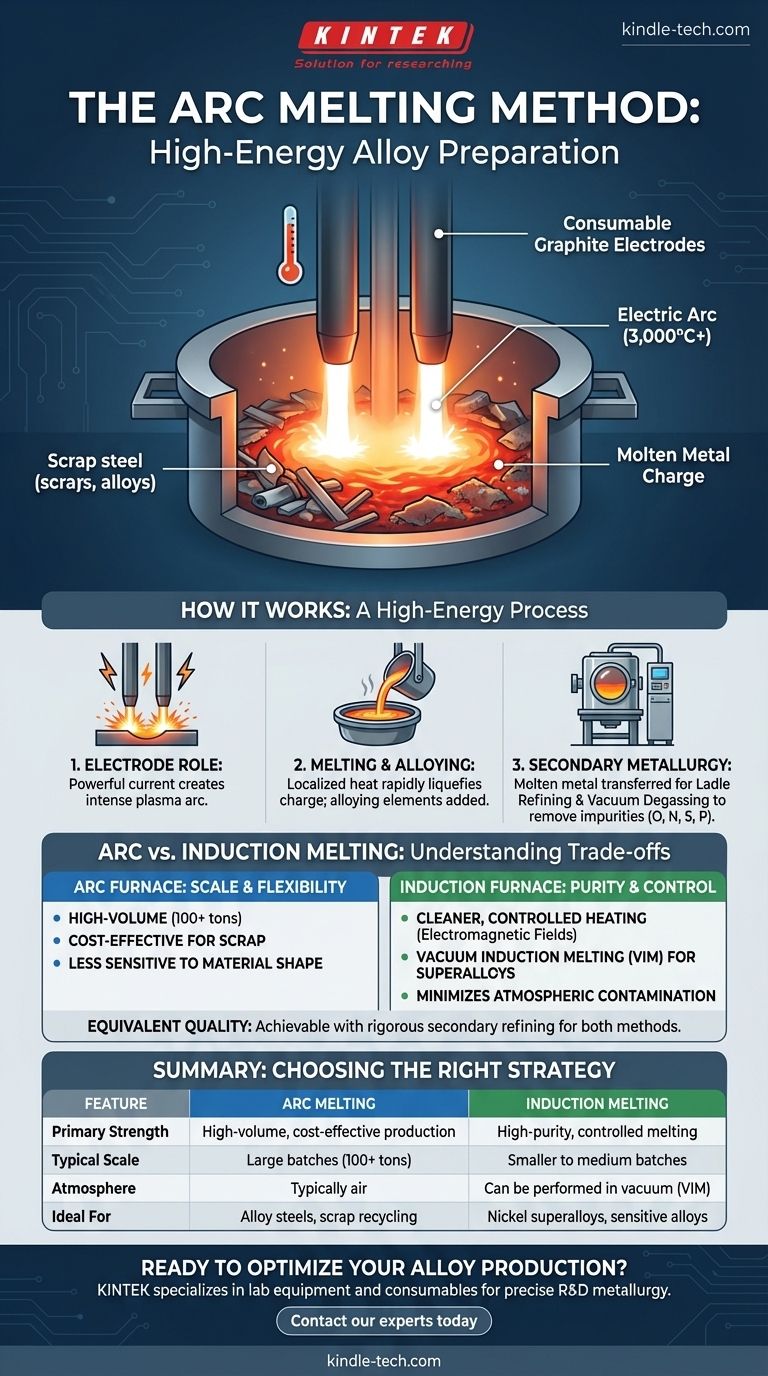
Arc melting is a process that uses a high-energy electric arc to melt metals and create alloys. An arc is generated between graphite or carbon electrodes and the metallic raw materials (the "charge"), producing intense heat that can exceed 3,000°C (5,400°F) and rapidly liquefy the charge. It is a foundational method for large-scale production, particularly for alloy steels.

The core principle to understand is that arc melting is an exceptionally powerful and efficient method for melting large quantities of metal, but it is often just the first step. Achieving high-purity, high-quality alloys typically requires subsequent refining and degassing stages to remove impurities introduced during the aggressive melting process.
What is the arc melting method for alloy preparation? A Guide to High-Volume Metal Melting

How the Arc Melting Process Works

The effectiveness of arc melting lies in its direct and intense application of energy. The process is straightforward but requires significant control to manage the extreme temperatures and molten metal chemistry.

The Role of Electrodes

The heart of the furnace is a set of consumable electrodes, typically made of graphite. A powerful electric current is passed through these electrodes.

When the electrodes are lowered close to the metal charge inside the furnace, a powerful electric arc is struck. This arc is essentially a continuous spark of plasma that transfers immense thermal energy directly to the metal.

Melting and Alloying

This intense, localized heat rapidly melts the raw materials, which can range from scrap steel to other pre-alloyed metals.

Once the primary charge is molten, alloying elements can be added directly to the liquid bath to achieve the desired chemical composition for the final product.

The Need for Secondary Metallurgy

Standard arc melting is a "raw" process often performed in air. This introduces oxygen and nitrogen into the molten metal and can fail to remove other impurities like sulfur and phosphorus from the raw materials.

To produce high-quality alloy steel, the molten metal is transferred from the arc furnace to a separate station for ladle refining and vacuum degassing. These secondary steps are critical for removing dissolved gases and unwanted elements, precisely tuning the final chemistry.

Understanding the Trade-offs: Arc vs. Induction Melting

The choice of melting technology is driven by the desired quality, production volume, and cost. Arc melting's main alternative is induction melting, and they serve different strategic purposes.

Advantage of Arc Furnaces: Scale and Flexibility

Arc furnaces excel at processing large volumes, often exceeding 100 tons per batch. They are highly effective at melting down scrap metal, making them a cost-effective choice for many types of steel production.

Their raw power makes them less sensitive to the quality and shape of the raw material charge compared to other methods.

Advantage of Induction Furnaces: Purity and Control

Induction furnaces use electromagnetic fields to heat the metal. This process is cleaner and more controlled, introducing fewer impurities.

For highly sensitive materials like nickel-based superalloys, vacuum induction melting (VIM) is often preferred. By performing the melt under a vacuum, it prevents contamination from the atmosphere, resulting in a much cleaner base metal.

Achieving Equivalent Quality

As the references note, the distinction in quality is not absolute. An induction furnace can produce a lower-quality steel if it skips the refining steps.

Conversely, if steel from an induction furnace undergoes the same rigorous ladle refining and vacuum degassing as steel from an arc furnace, the final quality can be identical. The key is the commitment to secondary refining, not just the initial melting method.

Making the Right Choice for Your Goal

The optimal melting strategy depends entirely on your operational priorities and the specifications of the final alloy.

  • If your primary focus is high-volume, cost-effective production of alloy steels: The arc furnace, followed by a robust secondary refining process, is the industry standard.
  • If your primary focus is producing smaller batches of extremely high-purity, specialized alloys (like superalloys): Vacuum induction melting is the superior choice for minimizing contamination from the start.

Ultimately, selecting the right melting technology is about matching the tool to the specific metallurgical objective you need to achieve.

Summary Table:

Feature Arc Melting Induction Melting
Primary Strength High-volume, cost-effective production High-purity, controlled melting
Typical Scale Large batches (often 100+ tons) Smaller to medium batches
Atmosphere Typically air Can be performed in vacuum (VIM) for purity
Ideal For Alloy steels, scrap metal recycling Nickel superalloys, sensitive alloys

Ready to optimize your alloy production process?

Whether you are scaling up production of alloy steels or require high-purity melting for specialized alloys, the right equipment is critical. KINTEK specializes in lab equipment and consumables, serving precise laboratory needs for research and development in metallurgy.

Contact our experts today to discuss how our solutions can help you achieve your specific metallurgical goals, from efficient melting to final quality control.

Visual Guide
What is the arc melting method for alloy preparation? A Guide to High-Volume Metal Melting Visual Guide

Related Products

People Also Ask

Related Products

Non Consumable Vacuum Arc Induction Melting Furnace

Non Consumable Vacuum Arc Induction Melting Furnace

Explore the benefits of Non-Consumable Vacuum Arc Furnace with high melting point electrodes. Small, easy to operate & eco-friendly. Ideal for laboratory research on refractory metals & carbides.

Vacuum Arc Induction Melting Furnace

Vacuum Arc Induction Melting Furnace

Discover the power of Vacuum Arc Furnace for melting active & refractory metals. High-speed, remarkable degassing effect, and free of contamination. Learn more now!

Vacuum Heat Treat Furnace and Levitation Induction Melting Furnace

Vacuum Heat Treat Furnace and Levitation Induction Melting Furnace

Experience precise melting with our Vacuum Levitation Melting Furnace. Ideal for high melting point metals or alloys, with advanced technology for effective smelting. Order now for high-quality results.

Lab-Scale Vacuum Induction Melting Furnace

Lab-Scale Vacuum Induction Melting Furnace

Get precise alloy composition with our Vacuum Induction Melting Furnace. Ideal for aerospace, nuclear energy, and electronic industries. Order now for effective smelting and casting of metals and alloys.

High Temperature Muffle Oven Furnace for Laboratory Debinding and Pre Sintering

High Temperature Muffle Oven Furnace for Laboratory Debinding and Pre Sintering

KT-MD High temperature debinding and pre-sintering furnace for ceramic materials with various molding processes. Ideal for electronic components such as MLCC and NFC.

Vertical High Temperature Graphite Vacuum Graphitization Furnace

Vertical High Temperature Graphite Vacuum Graphitization Furnace

Vertical high temperature graphitization furnace for carbonization and graphitization of carbon materials up to 3100℃.Suitable for shaped graphitization of carbon fiber filaments and other materials sintered in a carbon environment.Applications in metallurgy, electronics, and aerospace for producing high-quality graphite products like electrodes and crucibles.

Laboratory Muffle Oven Furnace Bottom Lifting Muffle Furnace

Laboratory Muffle Oven Furnace Bottom Lifting Muffle Furnace

Efficiently produce batches with excellent temperature uniformity using our Bottom Lifting Furnace. Features two electric lifting stages and advanced temperature control up to 1600℃.

Large Vertical Graphite Vacuum Graphitization Furnace

Large Vertical Graphite Vacuum Graphitization Furnace

A large vertical high-temperature graphitization furnace is a type of industrial furnace used for the graphitization of carbon materials, such as carbon fiber and carbon black. It is a high-temperature furnace that can reach temperatures of up to 3100°C.

Mesh belt controlled atmosphere furnace

Mesh belt controlled atmosphere furnace

Discover our KT-MB mesh belt sintering furnace - perfect for high-temperature sintering of electronic components & glass insulators. Available for open air or controlled atmosphere environments.

Vacuum Heat Treat and Pressure Sintering Furnace for High Temperature Applications

Vacuum Heat Treat and Pressure Sintering Furnace for High Temperature Applications

Vacuum pressure sintering furnaces are designed for high temperature hot pressing applications in metal and ceramic sintering. Its advanced features ensure precise temperature control, reliable pressure maintenance, and a robust design for seamless operation.

Horizontal High Temperature Graphite Vacuum Graphitization Furnace

Horizontal High Temperature Graphite Vacuum Graphitization Furnace

Horizontal Graphitization Furnace: This type of furnace is designed with the heating elements placed horizontally, allowing for uniform heating of the sample. It's well-suited for graphitizing large or bulky samples that require precise temperature control and uniformity.

Ultra-High Temperature Graphite Vacuum Graphitization Furnace

Ultra-High Temperature Graphite Vacuum Graphitization Furnace

The ultra-high temperature graphitization furnace utilizes medium frequency induction heating in a vacuum or inert gas environment. The induction coil generates an alternating magnetic field, inducing eddy currents in the graphite crucible, which heats up and radiates heat to the workpiece, bringing it to the desired temperature. This furnace is primarily used for graphitization and sintering of carbon materials, carbon fiber materials, and other composite materials.

600T Vacuum Induction Hot Press Furnace for Heat Treat and Sintering

600T Vacuum Induction Hot Press Furnace for Heat Treat and Sintering

Discover the 600T Vacuum Induction Hot Press Furnace, designed for high-temperature sintering experiments in vacuum or protected atmospheres. Its precise temperature and pressure control, adjustable working pressure, and advanced safety features make it ideal for nonmetal materials, carbon composites, ceramics, and metal powders.

1700℃ Controlled Atmosphere Furnace Nitrogen Inert Atmosphere Furnace

1700℃ Controlled Atmosphere Furnace Nitrogen Inert Atmosphere Furnace

KT-17A Controlled atmosphere furnace: 1700℃ heating, vacuum sealing technology, PID temperature control, and versatile TFT smart touch screen controller for laboratory and industrial use.

Vacuum Heat Treat and Molybdenum Wire Sintering Furnace for Vacuum Sintering

Vacuum Heat Treat and Molybdenum Wire Sintering Furnace for Vacuum Sintering

A vacuum molybdenum wire sintering furnace is a vertical or bedroom structure, which is suitable for withdrawal, brazing, sintering and degassing of metal materials under high vacuum and high temperature conditions. It is also suitable for dehydroxylation treatment of quartz materials.

2200 ℃ Graphite Vacuum Heat Treat Furnace

2200 ℃ Graphite Vacuum Heat Treat Furnace

Discover the power of the KT-VG Graphite Vacuum Furnace - with a maximum working temperature of 2200℃, it's perfect for vacuum sintering of various materials. Learn more now.

1700℃ Muffle Oven Furnace for Laboratory

1700℃ Muffle Oven Furnace for Laboratory

Get superior heat control with our 1700℃ Muffle Furnace. Equipped with intelligent temperature microprocessor, TFT touch screen controller & advanced insulation materials for precise heating up to 1700C. Order now!

Graphite Vacuum Furnace High Thermal Conductivity Film Graphitization Furnace

Graphite Vacuum Furnace High Thermal Conductivity Film Graphitization Furnace

The high thermal conductivity film graphitization furnace has uniform temperature, low energy consumption and can operate continuously.

Vacuum Heat Treat Furnace with Ceramic Fiber Liner

Vacuum Heat Treat Furnace with Ceramic Fiber Liner

Vacuum furnace with polycrystalline ceramic fiber insulation liner for excellent heat insulation and uniform temperature field. Choose from 1200℃ or 1700℃ max. working temperature with high vacuum performance and precise temperature control.

Graphite Vacuum Furnace Bottom Discharge Graphitization Furnace for Carbon Materials

Graphite Vacuum Furnace Bottom Discharge Graphitization Furnace for Carbon Materials

Bottom-out graphitization furnace for carbon materials, ultra-high temperature furnace up to 3100°C, suitable for graphitization and sintering of carbon rods and carbon blocks. Vertical design, bottom discharging, convenient feeding and discharging, high temperature uniformity, low energy consumption, good stability, hydraulic lifting system, convenient loading and unloading.


Leave Your Message