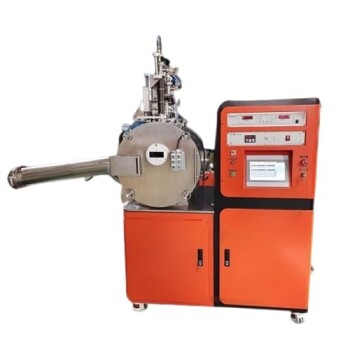
The primary function of a laboratory-scale vacuum arc melting furnace is to enable the rapid synthesis of high-purity alloy ingots in small, experimental batches.
For researchers developing aluminum-modified austenitic stainless steel, this equipment serves as a critical screening tool. It allows for the efficient creation of new material compositions—typically weighing less than 0.5 pounds—so that their properties can be evaluated before shifting to resource-intensive commercial pilot production.
By combining high-vacuum environments with small-batch flexibility, this furnace isolates the variables of microstructural evolution and oxidation resistance, allowing for low-risk iteration during the earliest phases of alloy development.
The Strategic Role in Early Research
Rapid Composition Screening
In the initial stages of discovery, speed is essential. This furnace allows researchers to produce a wide variety of alloy compositions in a short timeframe.
Because the batches are small (often under 0.5 lbs), you can iterate quickly. If a specific aluminum concentration fails to perform, the loss is negligible, and the next composition can be melted immediately.
Control of Microstructural Evolution
The vacuum arc melting process provides a baseline for understanding how the alloy solidifies.
Researchers use these small ingots to analyze the initial microstructural evolution of the steel. This step confirms whether the aluminum is dissolving correctly into the austenitic matrix or if it is forming unwanted intermetallic phases.
Preliminary Performance Testing
Before an alloy is deemed viable, it must pass basic performance thresholds.
The ingots produced are used to screen for preliminary oxidation resistance. This is particularly vital for aluminum-modified steels, where the goal is often to form a protective alumina scale.
The Importance of the Vacuum Environment
Preventing Oxide Formation
While the primary function is melting, the vacuum environment is the mechanism that ensures success.
Aluminum and chromium (a key component of stainless steel) have a high affinity for oxygen. As noted in vacuum processing principles, excluding oxygen prevents the formation of detrimental oxide films during the liquid phase.
Ensuring High Purity
A high vacuum creates an environment with extremely low oxygen partial pressure.
This ensures the final ingot is free from atmospheric contamination. High purity is essential for isolating the true effects of the alloying elements without the interference of impurities or inclusions.
Understanding the Trade-offs
Scale-Up Discrepancies
While excellent for screening, laboratory-scale furnaces do not perfectly mimic industrial conditions.
The cooling rates in a small button arc melter differ significantly from large-scale casting. Consequently, the microstructure observed in the lab may change when the process is scaled up to pilot production.
Homogeneity Challenges
In very small batches, achieving perfect chemical homogeneity can be difficult.
Researchers must often melt, flip, and re-melt the ingot multiple times to ensure the aluminum is evenly distributed throughout the stainless steel matrix.
Making the Right Choice for Your Goal
To maximize the utility of a laboratory-scale vacuum arc melting furnace, align your usage with your specific research phase:
- If your primary focus is Discovery: Use the furnace to rapidly cycle through a high volume of varying aluminum percentages to identify the "sweet spot" for stability.
- If your primary focus is Mechanism Analysis: Use the high-purity ingots to conduct deep-dive microscopy on how the microstructure evolves during solidification.
This equipment acts as the gatekeeper of alloy development, filtering out non-viable compositions so you only scale up the most promising candidates.
Summary Table:
| Feature | Strategic Benefit for Alloy Research |
|---|---|
| Small Batch Size (<0.5 lbs) | Enables low-cost, rapid iteration and screening of new material compositions. |
| High-Vacuum Environment | Prevents oxidation of sensitive elements like Aluminum and Chromium for high purity. |
| Rapid Solidification | Provides a controlled baseline for studying microstructural evolution and phase stability. |
| Compositional Flexibility | Allows researchers to quickly identify the 'sweet spot' for alumina scale formation. |
| Gatekeeper Role | Filters out non-viable alloys before committing to resource-intensive pilot production. |
Elevate Your Materials Research with KINTEK
Precision in the early stages of alloy development is the key to breakthroughs in aluminum-modified stainless steels. KINTEK specializes in high-performance laboratory equipment designed for rigorous research environments. Beyond our advanced vacuum arc melting systems, we offer a comprehensive range of high-temperature furnaces (muffle, tube, vacuum, and CVD), induction melting solutions, and high-pressure reactors to support every phase of your workflow.
Whether you need precision crushing and milling systems for sample preparation or high-purity ceramics and crucibles for melting, KINTEK provides the reliability and expertise your lab demands.
Ready to accelerate your material discovery? Contact us today to find the perfect equipment for your research goals!
References
- P.J. Maziasz. Development of Creep-Resistant and Oxidation-Resistant Austenitic Stainless Steels for High Temperature Applications. DOI: 10.1007/s11837-017-2642-x
This article is also based on technical information from Kintek Solution Knowledge Base .
Related Products
- Non Consumable Vacuum Arc Induction Melting Furnace
- Vacuum Induction Melting Spinning System Arc Melting Furnace
- Vacuum Arc Induction Melting Furnace
- Lab-Scale Vacuum Induction Melting Furnace
- Vacuum Heat Treat Furnace and Levitation Induction Melting Furnace
People Also Ask
- What is the temperature range of the induction melting furnace? Find the Right Heat for Your Metals
- What are the advantages of induction melting furnace? Achieve Purity, Efficiency, and Safety
- What is the use of induction melting furnace? Achieve Fast, Clean, and Precise Metal Melting
- How do specialized industrial-grade small melting furnaces address challenges in precision jewelry casting? Expert Guide
- How do vacuum induction or arc melting furnaces facilitate the synthesis of U-Al-C MAX phases? Precision Heat & Purity