Knowledge What is the composition of a CVD diamond? Discover the Pure Carbon Structure of Lab-Grown Gems
Author avatar

Tech Team · Kintek Solution

Updated 1 week ago

What is the composition of a CVD diamond? Discover the Pure Carbon Structure of Lab-Grown Gems


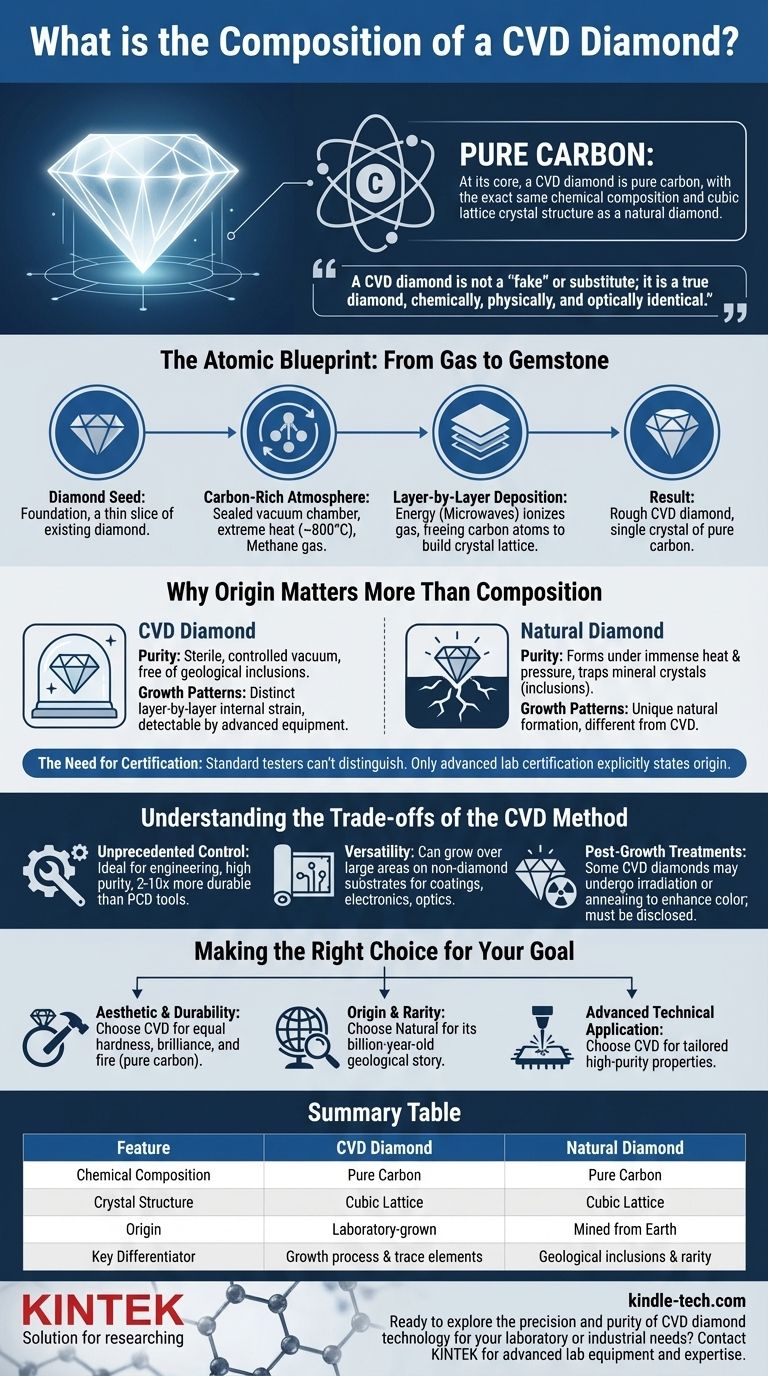
At its core, a CVD diamond is pure carbon. It possesses the exact same chemical composition and crystal structure as a diamond mined from the Earth. The distinction between a CVD (Chemical Vapor Deposition) diamond and a natural one is not a matter of substance, but of origin and process.

A CVD diamond is not a "fake" diamond or a substitute; it is a true diamond, composed of carbon atoms arranged in a cubic lattice. It is grown in a laboratory environment by depositing carbon atoms onto a seed crystal, resulting in a stone that is chemically, physically, and optically identical to its natural counterpart.
What is the composition of a CVD diamond? Discover the Pure Carbon Structure of Lab-Grown Gems

The Atomic Blueprint: From Gas to Gemstone

The composition of a CVD diamond is a direct result of its highly controlled manufacturing process, which mimics natural processes on an accelerated timeline.

The Diamond Seed Foundation

The process begins with a "seed," which is a very thin slice of a high-quality existing diamond. This seed acts as the foundational template upon which the new diamond will grow.

A Carbon-Rich Atmosphere

This seed is placed inside a sealed vacuum chamber. The chamber is then heated to extreme temperatures, typically around 800°C, and filled with a carbon-rich gas, such as methane.

Layer-by-Layer Carbon Deposition

Energy, often in the form of microwaves, is introduced into the chamber. This energy ionizes the gas, breaking down the molecular bonds and freeing the carbon atoms. These individual carbon atoms then attach themselves to the diamond seed, building up the crystal lattice layer by layer.

This meticulous process continues for several weeks until the rough diamond has reached the desired size. The result is a single crystal of pure carbon, identical in structure to a mined diamond.

Why Origin Matters More Than Composition

Since CVD diamonds are chemically pure carbon, the key differentiators lie in the microscopic traces left by their unique growth environment, which can only be identified by specialized gemological labs.

Purity and Inclusions

Natural diamonds form under immense heat and pressure deep within the Earth, a chaotic process that often traps tiny mineral crystals and other foreign materials, known as inclusions. CVD diamonds grow in a sterile, controlled vacuum, so they are free of these geological inclusions.

Growth Patterns

The layer-by-layer growth of a CVD diamond can sometimes create internal strain or graining patterns that are distinct from the growth patterns of natural diamonds. These are invisible to the naked eye but can be detected with advanced equipment.

The Need for Certification

Because they share the same physical properties, a standard jeweler's diamond tester cannot distinguish between a natural and a CVD diamond. The only definitive way to verify a diamond's origin is through a gemological certificate from a reputable lab, which will explicitly state if it is laboratory-grown.

Understanding the Trade-offs of the CVD Method

The CVD process was developed to overcome the limitations of other diamond synthesis techniques, offering distinct advantages but also presenting its own set of considerations.

Advantage: Unprecedented Control

The CVD method allows for exceptionally fine control over the diamond's purity and properties. This makes it ideal for engineering and industrial applications where specific characteristics are required, such as creating tools that are 2-10 times more durable than Polycrystalline Diamond (PCD) tools.

Advantage: Versatility

Unlike natural diamonds, CVD diamond films can be grown over large areas and deposited onto a wide variety of non-diamond materials (substrates). This versatility is critical for creating high-performance coatings, electronic components, and advanced optics.

Consideration: Post-Growth Treatments

Some CVD diamonds may undergo post-growth treatments, such as irradiation or annealing, to enhance their color. While perfectly stable, these treatments are a human intervention that must be disclosed on a grading report.

Making the Right Choice for Your Goal

Understanding that the composition is identical allows you to focus on the factors that truly matter for your specific needs.

  • If your primary focus is aesthetic beauty and durability: A CVD diamond offers the same hardness, brilliance, and fire as a natural diamond, as these properties are dictated by its pure carbon structure.
  • If your primary focus is verifiable origin and rarity: A natural diamond's value is intrinsically linked to its billion-year-old geological story and its finite supply.
  • If your primary focus is advanced technical application: CVD technology provides the unique ability to create high-purity diamond layers with specific properties tailored for cutting tools, semiconductors, or optics.

Ultimately, the choice is not about a "real" versus a "synthetic" chemical composition, but about the story, process, and application you value most.

Summary Table:

Feature CVD Diamond Natural Diamond
Chemical Composition Pure Carbon Pure Carbon
Crystal Structure Cubic Lattice Cubic Lattice
Origin Laboratory-grown Mined from Earth
Key Differentiator Growth process & trace elements Geological inclusions & rarity

Ready to explore the precision and purity of CVD diamond technology for your laboratory or industrial needs? KINTEK specializes in advanced lab equipment and consumables, providing the tools and expertise to support your research and development with high-performance materials. Whether you're working on cutting-edge electronics, durable coatings, or high-purity optics, our solutions are designed to meet the demands of modern science. Contact us today to learn how we can help you achieve your goals with reliable, cutting-edge technology!

Visual Guide
What is the composition of a CVD diamond? Discover the Pure Carbon Structure of Lab-Grown Gems Visual Guide

Related Products

People Also Ask

Related Products

Customer Made Versatile CVD Tube Furnace Chemical Vapor Deposition Chamber System Equipment

Customer Made Versatile CVD Tube Furnace Chemical Vapor Deposition Chamber System Equipment

Get your exclusive CVD furnace with KT-CTF16 Customer Made Versatile Furnace. Customizable sliding, rotating, and tilting functions for precise reactions. Order now!

Split Chamber CVD Tube Furnace with Vacuum Station Chemical Vapor Deposition System Equipment Machine

Split Chamber CVD Tube Furnace with Vacuum Station Chemical Vapor Deposition System Equipment Machine

Efficient split chamber CVD furnace with vacuum station for intuitive sample checking and quick cooling. Up to 1200℃ max temperature with accurate MFC mass flowmeter control.

1200℃ Split Tube Furnace with Quartz Tube Laboratory Tubular Furnace

1200℃ Split Tube Furnace with Quartz Tube Laboratory Tubular Furnace

KT-TF12 split tube furnace: high-purity insulation, embedded heating wire coils, and max. 1200C. Widely used for new materials and chemical vapour deposition.

1400℃ Laboratory Quartz Tube Furnace with Alumina Tube Tubular Furnace

1400℃ Laboratory Quartz Tube Furnace with Alumina Tube Tubular Furnace

Looking for a tube furnace for high-temperature applications? Our 1400℃ Tube Furnace with Alumina Tube is perfect for research and industrial use.

1700℃ Laboratory Quartz Tube Furnace with Alumina Tube Tubular Furnace

1700℃ Laboratory Quartz Tube Furnace with Alumina Tube Tubular Furnace

Looking for a high-temperature tube furnace? Check out our 1700℃ Tube Furnace with Alumina Tube. Perfect for research and industrial applications up to 1700C.

Rotary Tube Furnace Split Multi Heating Zone Rotating Tube Furnace

Rotary Tube Furnace Split Multi Heating Zone Rotating Tube Furnace

Multi zone rotary furnace for high-precision temperature control with 2-8 independent heating zones. Ideal for lithium ion battery electrode materials and high-temperature reactions. Can work under vacuum and controlled atmosphere.

Vertical Laboratory Quartz Tube Furnace Tubular Furnace

Vertical Laboratory Quartz Tube Furnace Tubular Furnace

Elevate your experiments with our Vertical Tube Furnace. Versatile design allows for operation under various environments and heat treatment applications. Order now for precise results!

Laboratory Muffle Oven Furnace Bottom Lifting Muffle Furnace

Laboratory Muffle Oven Furnace Bottom Lifting Muffle Furnace

Efficiently produce batches with excellent temperature uniformity using our Bottom Lifting Furnace. Features two electric lifting stages and advanced temperature control up to 1600℃.

High Temperature Muffle Oven Furnace for Laboratory Debinding and Pre Sintering

High Temperature Muffle Oven Furnace for Laboratory Debinding and Pre Sintering

KT-MD High temperature debinding and pre-sintering furnace for ceramic materials with various molding processes. Ideal for electronic components such as MLCC and NFC.

Laboratory Quartz Tube Furnace Tubular RTP Heating Furnace

Laboratory Quartz Tube Furnace Tubular RTP Heating Furnace

Get lightning-fast heating with our RTP Rapid Heating Tube Furnace. Designed for precise, high-speed heating and cooling with convenient sliding rail and TFT touch screen controller. Order now for ideal thermal processing!

Vacuum Sealed Continuous Working Rotary Tube Furnace Rotating Tube Furnace

Vacuum Sealed Continuous Working Rotary Tube Furnace Rotating Tube Furnace

Experience efficient material processing with our vacuum-sealed rotary tube furnace. Perfect for experiments or industrial production, equipped with optional features for controlled feeding and optimized results. Order now.

High Pressure Laboratory Vacuum Tube Furnace Quartz Tubular Furnace

High Pressure Laboratory Vacuum Tube Furnace Quartz Tubular Furnace

KT-PTF High Pressure Tube Furnace: Compact split tube furnace with strong positive pressure resistance. Working temp up to 1100°C and pressure up to 15Mpa. Also works under controller atmosphere or high vacuum.

1700℃ Muffle Oven Furnace for Laboratory

1700℃ Muffle Oven Furnace for Laboratory

Get superior heat control with our 1700℃ Muffle Furnace. Equipped with intelligent temperature microprocessor, TFT touch screen controller & advanced insulation materials for precise heating up to 1700C. Order now!

1800℃ Muffle Oven Furnace for Laboratory

1800℃ Muffle Oven Furnace for Laboratory

KT-18 muffle furnace with Japan Al2O3 polycrystalline fibe and Silicon Molybdenum heating element, up to 1900℃, PID temperature control and 7" smart touch screen. Compact design, low heat loss, and high energy efficiency. Safety interlock system and versatile functions.

600T Vacuum Induction Hot Press Furnace for Heat Treat and Sintering

600T Vacuum Induction Hot Press Furnace for Heat Treat and Sintering

Discover the 600T Vacuum Induction Hot Press Furnace, designed for high-temperature sintering experiments in vacuum or protected atmospheres. Its precise temperature and pressure control, adjustable working pressure, and advanced safety features make it ideal for nonmetal materials, carbon composites, ceramics, and metal powders.

Vacuum Heat Treat and Sintering Furnace with 9MPa Air Pressure

Vacuum Heat Treat and Sintering Furnace with 9MPa Air Pressure

The air pressure sintering furnace is a high-tech equipment commonly used for the sintering of advanced ceramic materials. It combines vacuum sintering and pressure sintering techniques to achieve high-density and high-strength ceramics.

Vacuum Heat Treat Sintering Brazing Furnace

Vacuum Heat Treat Sintering Brazing Furnace

A vacuum brazing furnace is a type of industrial furnace used for brazing, a metalworking process that joins two pieces of metal using a filler metal that melts at a lower temperature than the base metals. Vacuum brazing furnaces are typically used for high-quality applications where a strong, clean joint is required.

Graphite Vacuum Continuous Graphitization Furnace

Graphite Vacuum Continuous Graphitization Furnace

High-temperature graphitization furnace is a professional equipment for graphitization treatment of carbon materials. It is a key equipment for the production of high-quality graphite products. It has high temperature, high efficiency and uniform heating. It is suitable for various high-temperature treatments and graphitization treatments. It is widely used in metallurgy, electronics, aerospace, etc. industry.

Laboratory Vacuum Tilt Rotary Tube Furnace Rotating Tube Furnace

Laboratory Vacuum Tilt Rotary Tube Furnace Rotating Tube Furnace

Discover the versatility of Laboratory Rotary Furnace: Ideal for calcination, drying, sintering, and high-temperature reactions. Adjustable rotating and tilting functions for optimal heating. Suitable for vacuum and controlled atmosphere environments. Learn more now!

Dental Porcelain Zirconia Sintering Ceramic Furnace Chairside with Transformer

Dental Porcelain Zirconia Sintering Ceramic Furnace Chairside with Transformer

Experience top-notch sintering with Chairside Sintering Furnace with Transformer. Easy to operate, noise-free pallet, and automatic temperature calibration. Order now!


Leave Your Message