Knowledge What is the compression method of processing plastic? A Guide to Strong, Cost-Effective Molding
Author avatar

Tech Team · Kintek Solution

Updated 1 week ago

What is the compression method of processing plastic? A Guide to Strong, Cost-Effective Molding


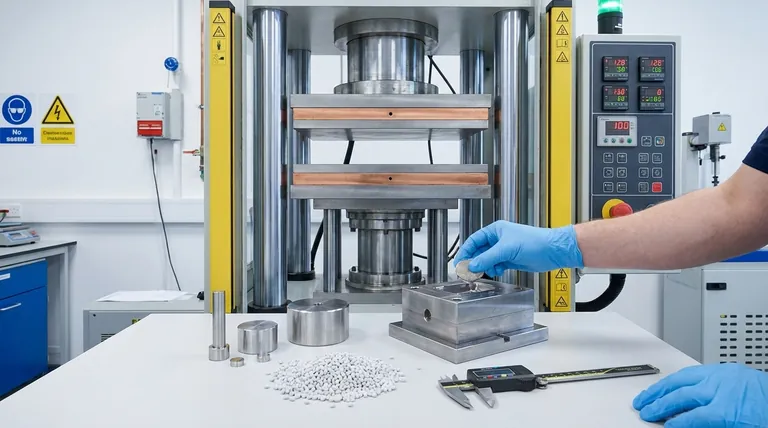
In essence, compression molding is a manufacturing process where a precise amount of plastic material is shaped using heat and pressure inside a heated mold. The material, often a pre-formed slug, is placed into the open mold cavity, the mold is closed, and pressure is applied, forcing the material to fill the cavity and conform to its shape as it cures.

The core principle of compression molding is its simplicity and effectiveness for creating strong, durable parts, particularly from thermoset plastics. While slower than other methods, it excels in producing components with excellent structural integrity and low internal stress.
What is the compression method of processing plastic? A Guide to Strong, Cost-Effective Molding

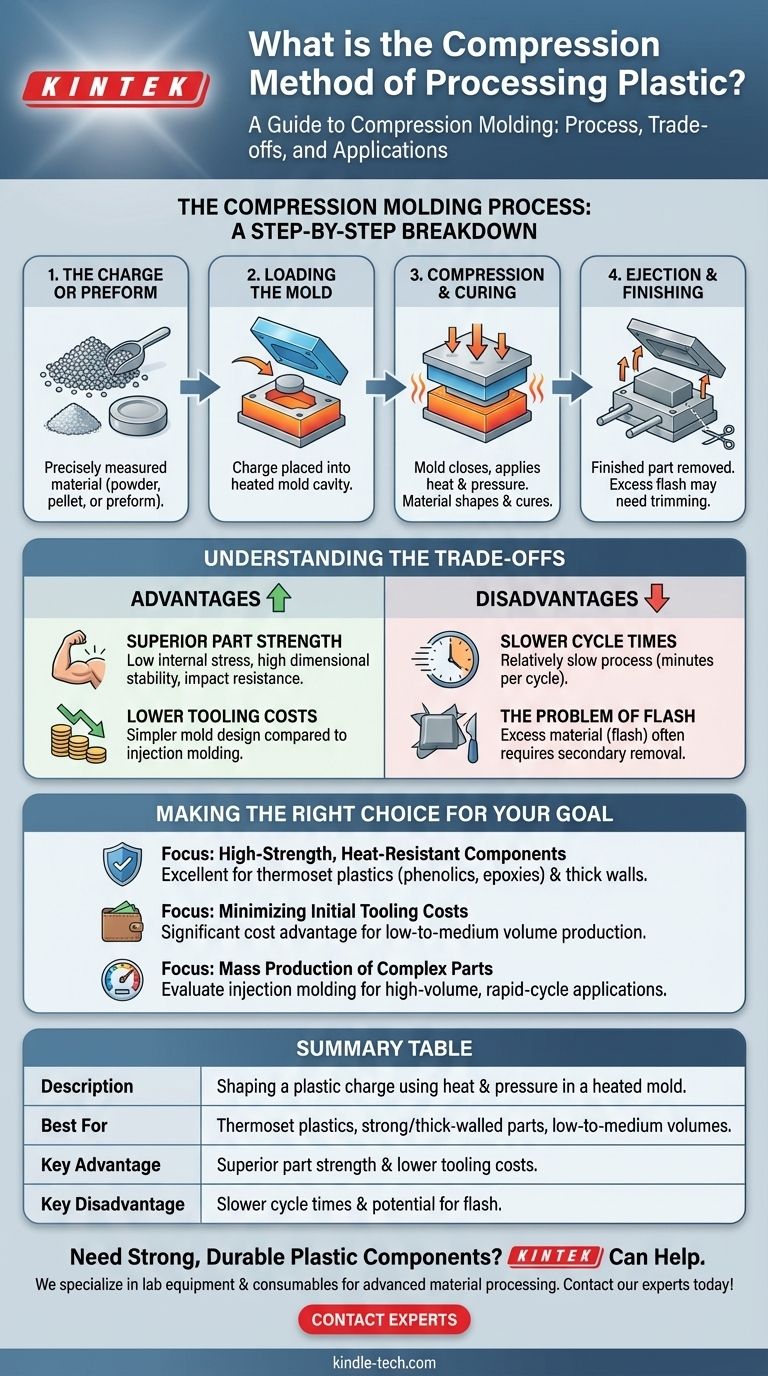
How Compression Molding Works: A Step-by-Step Breakdown

Think of compression molding like making a waffle. You place the raw material (batter) onto a heated surface, close the lid to apply pressure, and allow heat to transform it into a finished product.

The Charge or Preform

The process begins with the "charge," which is a carefully measured quantity of the molding material. This can be in powder, pellet, or a pre-formed shape designed to roughly match the mold's contours.

Loading the Mold

The charge is placed directly into the bottom half of a heated, open mold. The mold halves are typically made of high-strength steel and are heated to a specific temperature required to soften the plastic and initiate the curing process.

Compression and Curing

The top half of the mold is then closed, applying significant hydraulic pressure. This pressure forces the softened material to flow and fill every part of the mold cavity. The combination of sustained heat and pressure not only shapes the part but also initiates a chemical reaction in thermoset plastics, causing them to harden permanently.

Ejection and Finishing

Once the curing cycle is complete, the mold is opened and the finished part is removed, often with the help of ejector pins. The part is now a solid, stable component.

Understanding the Trade-offs

No manufacturing process is perfect for every application. Compression molding has a distinct set of advantages and disadvantages that make it ideal for some projects and unsuitable for others.

Advantage: Superior Part Strength

Because the material flows a shorter distance and is under consistent pressure, compression-molded parts have very low internal stress. This results in components with high dimensional stability, strength, and impact resistance, especially for parts with thick walls.

Advantage: Lower Tooling Costs

Compression molds are generally simpler in design compared to the complex runner and gate systems required for injection molding. This simplicity translates directly to lower initial tooling and setup costs.

Disadvantage: Slower Cycle Times

The need to heat the material and wait for it to cure within the mold makes compression molding a relatively slow process. Cycle times can range from one to several minutes, making it less suitable for extremely high-volume production compared to injection molding.

Disadvantage: The Problem of Flash

It is common for a small amount of excess material, known as "flash," to be squeezed out at the parting line where the mold halves meet. This flash must be removed in a secondary de-flashing or trimming operation, adding a step to the overall process.

Making the Right Choice for Your Goal

Selecting a manufacturing process depends entirely on the requirements of your part, including its material, complexity, and production volume.

  • If your primary focus is high-strength, heat-resistant components with thick walls: Compression molding is an excellent choice, especially when using thermoset plastics like phenolics or epoxies.
  • If your primary focus is minimizing initial tooling costs for simpler, larger parts: Compression molding offers a significant cost advantage for low-to-medium volume production runs.
  • If your primary focus is mass production of complex, thin-walled parts at high speed: You should evaluate injection molding, as it is far better suited for high-volume, rapid-cycle applications.

Ultimately, understanding the fundamental trade-offs between strength, speed, and cost is the key to selecting the ideal manufacturing process for your product.

Summary Table:

Aspect Description
Process Shaping a plastic charge using heat and pressure in a heated mold.
Best For Thermoset plastics, strong/thick-walled parts, low-to-medium volumes.
Key Advantage Superior part strength and lower tooling costs.
Key Disadvantage Slower cycle times and potential for flash (excess material).

Need to produce strong, durable plastic components? The compression molding process might be the perfect solution for your laboratory or manufacturing needs. At KINTEK, we specialize in providing the lab equipment and consumables necessary for advanced material processing. Our expertise can help you select the right technology to achieve superior part strength and optimize your production costs. Contact our experts today via our contact form to discuss how we can support your project with reliable equipment and tailored solutions!

Visual Guide
What is the compression method of processing plastic? A Guide to Strong, Cost-Effective Molding Visual Guide

Related Products

People Also Ask

Related Products

Anti-Cracking Press Mold for Lab Use

Anti-Cracking Press Mold for Lab Use

The anti-cracking press mold is a specialized equipment designed for molding various shapes and sizes of film using high pressure and electric heating.

Small Injection Molding Machine for Lab Use

Small Injection Molding Machine for Lab Use

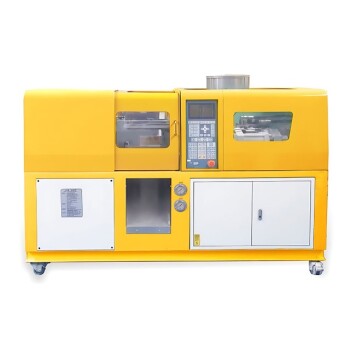
The small injection molding machinehas fast and stable movements; good controllability and repeatability, super energy saving; the product can be automatically dropped and formed; the machine body is low, convenient for feeding, easy to maintain, and no height restrictions on the installation site.

HFCVD Machine System Equipment for Drawing Die Nano-Diamond Coating

HFCVD Machine System Equipment for Drawing Die Nano-Diamond Coating

The nano-diamond composite coating drawing die uses cemented carbide (WC-Co) as the substrate, and uses the chemical vapor phase method ( CVD method for short ) to coat the conventional diamond and nano-diamond composite coating on the surface of the inner hole of the mold.

Laboratory Test Sieves and Sieving Machines

Laboratory Test Sieves and Sieving Machines

Precision lab test sieves & sieving machines for accurate particle analysis. Stainless steel, ISO-compliant, 20μm-125mm range. Request specs now!

Benchtop Laboratory Vacuum Freeze Dryer

Benchtop Laboratory Vacuum Freeze Dryer

Benchtop laboratory freeze dryer for efficient lyophilization of biological, pharmaceutical, and food samples. Features intuitive touchscreen, high-performance refrigeration, and durable design. Preserve sample integrity—consult now!

Laboratory Disc Rotary Mixer for Efficient Sample Mixing and Homogenization

Laboratory Disc Rotary Mixer for Efficient Sample Mixing and Homogenization

Efficient Laboratory Disc Rotary Mixer for Precise Sample Mixing, Versatile for Various Applications, DC Motor and Microcomputer Control, Adjustable Speed and Angle.

Vacuum Hot Press Furnace Machine for Lamination and Heating

Vacuum Hot Press Furnace Machine for Lamination and Heating

Experience clean and precise lamination with Vacuum Lamination Press. Perfect for wafer bonding, thin-film transformations, and LCP lamination. Order now!

Three-dimensional electromagnetic sieving instrument

Three-dimensional electromagnetic sieving instrument

KT-VT150 is a desktop sample processing instrument for both sieving and grinding. Grinding and sieving can be used both dry and wet. The vibration amplitude is 5mm and the vibration frequency is 3000-3600 times/min.

CVD Diamond Cutting Tool Blanks for Precision Machining

CVD Diamond Cutting Tool Blanks for Precision Machining

CVD Diamond Cutting Tools: Superior Wear Resistance, Low Friction, High Thermal Conductivity for Non-Ferrous Materials, Ceramics, Composites Machining

Benchtop Laboratory Freeze Dryer for Lab Use

Benchtop Laboratory Freeze Dryer for Lab Use

Premium benchtop laboratory freeze dryer for lyophilization, preserving samples with ≤ -60°C cooling. Ideal for pharmaceuticals & research.

Engineering Advanced Fine Ceramics Aluminum Oxide Al2O3 Heat Sink for Insulation

Engineering Advanced Fine Ceramics Aluminum Oxide Al2O3 Heat Sink for Insulation

The hole structure of the ceramic heat sink increases the heat dissipation area in contact with the air, which greatly enhances the heat dissipation effect, and the heat dissipation effect is better than that of super copper and aluminum.

Precision Machined Yttrium Stabilized Zirconia Ceramic Rod for Engineering Advanced Fine Ceramics

Precision Machined Yttrium Stabilized Zirconia Ceramic Rod for Engineering Advanced Fine Ceramics

Zirconia ceramic rods are prepared by isostatic pressing, and a uniform, dense and smooth ceramic layer and transition layer are formed at high temperature and high speed.

Laboratory Vibratory Sieve Shaker Machine Slap Vibrating Sieve

Laboratory Vibratory Sieve Shaker Machine Slap Vibrating Sieve

KT-T200TAP is a slapping and oscillating sieving instrument for laboratory desktop use, with 300 rpm horizontal circular motion and 300 vertical slapping motions to simulate manual sieving to help sample particles pass through better.

Laboratory Sterilizer Lab Autoclave Pulse Vacuum Lifting Sterilizer

Laboratory Sterilizer Lab Autoclave Pulse Vacuum Lifting Sterilizer

The pulse vacuum lifting sterilizer is a state-of-the-art equipment for efficient and precise sterilization. It uses pulsating vacuum technology, customizable cycles, and a user-friendly design for easy operation and safety.

Laboratory Sterilizer Lab Autoclave Vertical Pressure Steam Sterilizer for Liquid Crystal Display Automatic Type

Laboratory Sterilizer Lab Autoclave Vertical Pressure Steam Sterilizer for Liquid Crystal Display Automatic Type

Liquid crystal display automatic vertical sterilizer is a safe, reliable and automatic control sterilization equipment, which is composed of heating system, microcomputer control system and overheating and overvoltage protection system.

915MHz MPCVD Diamond Machine Microwave Plasma Chemical Vapor Deposition System Reactor

915MHz MPCVD Diamond Machine Microwave Plasma Chemical Vapor Deposition System Reactor

915MHz MPCVD Diamond Machine and its multi-crystal effective growth, the maximum area can reach 8 inches, the maximum effective growth area of single crystal can reach 5 inches. This equipment is mainly used for the production of large-size polycrystalline diamond films, the growth of long single crystal diamonds, the low-temperature growth of high-quality graphene, and other materials that require energy provided by microwave plasma for growth.

Silicon Carbide SiC Thermal Heating Elements for Electric Furnace

Silicon Carbide SiC Thermal Heating Elements for Electric Furnace

Experience the advantages of Silicon Carbide (SiC) Heating Element: Long service life, high corrosion and oxidation resistance, fast heating speed, and easy maintenance. Learn more now!

Custom PTFE Teflon Parts Manufacturer for Gaskets and More

Custom PTFE Teflon Parts Manufacturer for Gaskets and More

Gaskets are materials placed between two flat surfaces to enhance the seal. To prevent fluid leakage, sealing elements are arranged between static sealing surfaces.

Variable Speed Peristaltic Pump

Variable Speed Peristaltic Pump

KT-VSP Series Smart Variable Speed Peristaltic Pumps offer precise flow control for labs, medical, and industrial applications. Reliable, contamination-free liquid transfer.

Precision Machined Zirconia Ceramic Ball for Engineering Advanced Fine Ceramics

Precision Machined Zirconia Ceramic Ball for Engineering Advanced Fine Ceramics

zirconia ceramic ball have the characteristics of high strength, high hardness, PPM wear level, high fracture toughness, good wear resistance, and high specific gravity.


Leave Your Message