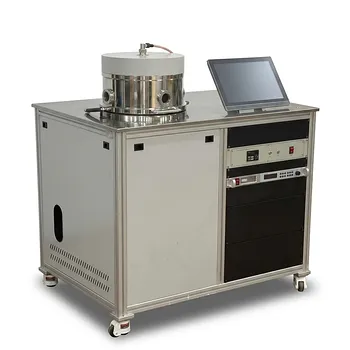
The core function of an external gas generator is to serve as a precise chemical synthesis unit located outside the main deposition chamber. It produces essential aluminum chloride precursors by passing reactive gases, specifically hydrogen chloride, over aluminum granules at strictly controlled temperatures.
By isolating the generation of precursor gases from the main reaction chamber, the external generator decouples the source chemistry from the deposition process. This separation is the key to achieving independent control over both the growth rate and the specific chemical makeup of the coating.
The Mechanics of Precursor Generation
Synthesizing the Reactive Medium
The primary mechanical role of the generator is to facilitate a specific chemical reaction before the deposition phase begins.
By introducing reactive gases like hydrogen chloride to a bed of aluminum granules, the unit manufactures the aluminum chlorides required for the coating.
Thermal Precision
This reaction occurs at specific, controlled temperatures within the generator itself.
Because this happens externally, the thermal conditions for generating the gas do not interfere with the thermal conditions required for the coating process in the main chamber.
Strategic Advantages of External Generation
Independent Regulation
The most critical advantage of this setup is the ability to separate growth kinetics from other process variables.
Operators can adjust how fast the coating grows without necessarily altering the conditions inside the main coating chamber. This granular control is impossible if the source material is simply placed inside the main reactor.
Controlling Aluminum Activity
The generator allows for the precise manipulation of aluminum activity in the vapor phase.
By controlling the flow and temperature in the generator, operators determine exactly how much active aluminum is available to react with the substrate.
Tailoring Chemical Composition
This external control loop enables the fine-tuning of the coating layers' chemical composition.
Operators can modulate the precursor delivery to create specific coating structures, ensuring the final product meets exact metallurgical specifications.
Understanding the Trade-offs
Increased System Complexity
Using an external generator adds a layer of mechanical and operational complexity to the CVD system.
Operators must manage two distinct thermal zones—the generator and the reactor—rather than just one, requiring more sophisticated monitoring equipment.
Dependency on Calibration
The quality of the coating becomes heavily dependent on the precise calibration of the external unit.
If the temperature or flow rates within the generator drift, the aluminum activity will fluctuate, potentially compromising the coating even if the main chamber is functioning perfectly.
Making the Right Choice for Your Goal
To maximize the utility of an external gas generator, align its capabilities with your specific processing targets:
- If your primary focus is Coating Composition: Utilize the external controls to modulate aluminum activity, ensuring precise stoichiometry in the deposited layers.
- If your primary focus is Process Efficiency: Leverage the independent regulation to optimize growth kinetics, maximizing deposition rates without sacrificing quality.
An external gas generator transforms the CVD process from a passive reaction into a tunable, precision-engineered manufacturing method.
Summary Table:
| Feature | Internal Generation | External Gas Generator |
|---|---|---|
| Precursor Source | Inside reaction chamber | Separate external unit |
| Process Control | Coupled with chamber temperature | Independent thermal/flow control |
| Aluminum Activity | Fixed by chamber conditions | Precisely tunable |
| Growth Kinetics | Limited by chamber variables | Independently regulated |
| System Complexity | Low | High (Dual-zone management) |
| Coating Precision | Standard | High (Advanced stoichiometry) |
Elevate Your Thin-Film Research with KINTEK Precision
Unlock superior control over your chemical vapor deposition processes with KINTEK’s advanced laboratory solutions. Whether you are optimizing aluminum activity for protective coatings or developing next-generation materials, our high-performance CVD and PECVD systems, high-temperature furnaces, and specialized ceramic consumables provide the thermal precision your research demands.
Why choose KINTEK?
- Comprehensive Range: From rotary and vacuum furnaces to hydraulic presses and high-pressure reactors.
- Process Excellence: Achieve independent regulation of growth kinetics with equipment designed for exact metallurgical specifications.
- Expert Support: Our team helps you navigate system complexity to ensure perfect calibration and repeatable results.
Ready to transform your CVD process into a tunable, precision-engineered manufacturing method? Contact our experts today to find the perfect equipment for your lab!
References
- Jakub Jopek, Marcin Drajewicz. High Temperature Protective Coatings for Aeroengine Applications. DOI: 10.21062/mft.2023.052
This article is also based on technical information from Kintek Solution Knowledge Base .
Related Products
- Chemical Vapor Deposition CVD Equipment System Chamber Slide PECVD Tube Furnace with Liquid Gasifier PECVD Machine
- HFCVD Machine System Equipment for Drawing Die Nano-Diamond Coating
- Customer Made Versatile CVD Tube Furnace Chemical Vapor Deposition Chamber System Equipment
- Custom CVD Diamond Coating for Lab Applications
- RF PECVD System Radio Frequency Plasma-Enhanced Chemical Vapor Deposition RF PECVD
People Also Ask
- What are the advantages of chemical vapor deposition? Achieve Superior Thin Films for Your Lab
- What types of substrates are used in CVD to facilitate graphene films? Optimize Graphene Growth with the Right Catalyst
- What is the chemical vapor deposition growth process? Build Superior Thin Films from the Atom Up
- How expensive is chemical vapor deposition? Understanding the True Cost of High-Performance Coating
- Why is Chemical Vapor Deposition (CVD) equipment uniquely suited for constructing hierarchical superhydrophobic structures?