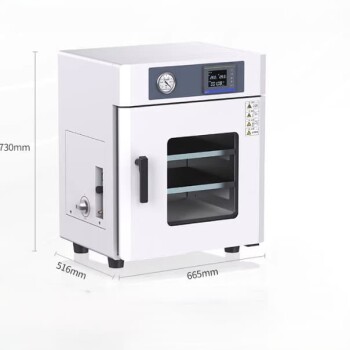
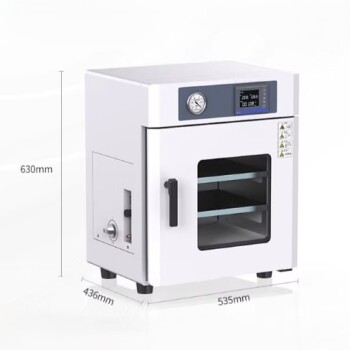
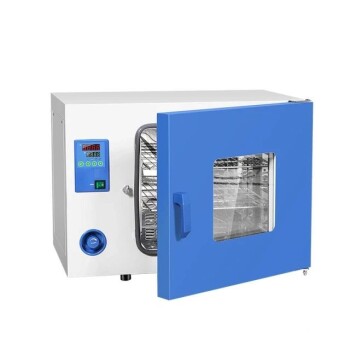
The critical role of a vacuum oven in preparing PEO/LiTFSI membranes is to facilitate the complete removal of organic solvents while strictly preventing environmental contamination. By maintaining a constant temperature (e.g., 50°C) under reduced pressure, the oven transforms the wet slurry into a dry, uniform solid electrolyte without exposing the hygroscopic materials to atmospheric moisture.
The Core Objective This process goes beyond simple drying; it is an active preservation of electrochemical stability. The vacuum environment ensures the final membrane is physically uniform and chemically pure, preventing the residual solvents and moisture that lead to poor interfacial contact and degraded battery cycling.
The Mechanisms of Membrane Formation
Solvent Extraction
The primary function of the vacuum oven is to remove organic solvents, such as acetonitrile, from the polymer electrolyte slurry.
Under vacuum, the boiling point of these solvents is lowered, allowing them to evaporate efficiently at moderate temperatures like 50°C.
Prevention of Moisture Ingress
Standard ovens circulate air, which inevitably introduces humidity.
A vacuum oven creates an isolated environment that prevents moisture from the air from entering the mixture during the drying phase. This is vital because water molecules can degrade the electrochemical performance of the LiTFSI salt and the PEO polymer.
Ensuring Physical Uniformity
The drying process dictates the physical structure of the electrolyte.
By controlling the evaporation rate and environment, the vacuum oven facilitates the creation of a uniformly thick membrane. Uniformity is essential for preventing hot spots or short circuits within the cell.
Impact on Battery Performance
Interfacial Stability
The quality of the drying process directly impacts how well the electrolyte connects with the anode and cathode.
A solvent-free, moisture-free surface ensures robust contact at the interface. This stability is required to facilitate efficient ion transfer between the solid electrolyte and the electrodes.
Long-Term Cycling
Contaminants are the enemy of longevity in all-solid-state batteries.
By eliminating trace solvents and moisture, the vacuum oven minimizes side reactions that typically shorten the battery's lifespan. This results in significantly improved cycling performance.
Understanding the Trade-offs
The Risk of Standard Drying
Using a conventional oven instead of a vacuum oven is a critical error in this application.
Without the vacuum, you risk trapping residual solvent within the polymer matrix or allowing the material to absorb moisture from the heated air. This leads to "puffy" membranes with poor ionic conductivity.
Balancing Temperature and Time
There is a temptation to increase temperature to speed up the process.
However, excessive heat can degrade the polymer structure. The vacuum allows for effective drying at lower, safer temperatures over an extended period, protecting the material's integrity while ensuring thoroughness.
Making the Right Choice for Your Goal
To maximize the performance of your PEO/LiTFSI electrolytes, align your drying protocol with your specific performance metrics.
- If your primary focus is Interfacial Stability: Prioritize maintaining a consistent vacuum level to prevent any moisture re-absorption that could disrupt electrode contact.
- If your primary focus is Cycling Longevity: Ensure the drying duration is sufficiently extended to remove every trace of organic solvent, as even microscopic residues can trigger degradation over time.
Ultimately, the vacuum oven is the gatekeeper of quality, determining whether your slurry becomes a high-performance electrolyte or a chemically compromised failure.
Summary Table:
| Feature | Role in PEO/LiTFSI Preparation | Impact on Battery Quality |
|---|---|---|
| Vacuum Environment | Lowers solvent boiling points & removes air | Prevents oxidation & moisture contamination |
| Controlled Temperature | Maintains steady drying (e.g., 50°C) | Preserves polymer integrity & prevents degradation |
| Solvent Extraction | Complete removal of Acetonitrile/organics | Eliminates side reactions & enhances cycling life |
| Uniform Drying | Ensures consistent slurry-to-solid transition | Prevents hot spots & ensures stable interfacial contact |
Elevate Your Battery Research with KINTEK Precision
Unlock the full potential of your all-solid-state battery materials with KINTEK’s high-performance vacuum ovens. Our specialized laboratory equipment is engineered to provide the precise temperature control and rigorous vacuum environments essential for preparing moisture-sensitive PEO/LiTFSI electrolytes.
Beyond drying solutions, KINTEK offers a comprehensive suite of tools for energy storage innovation, including battery research consumables, planetary ball mills for slurry preparation, and hydraulic pellet presses. Whether you are optimizing interfacial stability or extending cycle life, our team is dedicated to providing the technical excellence your lab requires.
Ready to refine your electrolyte drying protocol? Contact KINTEK today to find the perfect equipment solution for your research!
Related Products
- 56L Vertical Laboratory Vacuum Drying Oven
- 23L Laboratory Vacuum Drying Oven
- Vacuum Heat Treat Sintering Brazing Furnace
- 2200 ℃ Graphite Vacuum Heat Treat Furnace
- Dental Porcelain Zirconia Sintering Ceramic Vacuum Press Furnace
People Also Ask
- Why is a laboratory vacuum drying oven recommended for rice straw residues? Protect Your Biomass Integrity
- What role does a laboratory vacuum drying oven play in the preparation of modified multi-walled carbon nanotubes?
- What is the importance of using a laboratory vacuum drying oven? Preserving Slow-Release Microcapsule Integrity
- Why is a Laboratory Vacuum Drying Oven recommended for PBAT microspheres? Protect Sensitive Polymer Integrity
- What role does a laboratory vacuum drying oven play in processing nanoparticle powder samples? Protect Sample Integrity