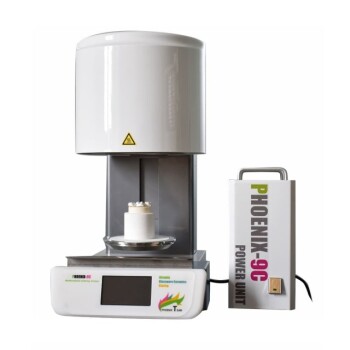
The critical function of Spark Plasma Sintering (SPS) furnaces in preparing titanium-based biomedical alloys lies in their ability to apply pulsed electric current and axial pressure simultaneously. This unique combination drives rapid material densification and chemical homogenization at temperatures between 1300 and 1500°C, achieving results that traditional sintering cannot replicate.
The SPS process leverages the plasma effect to accelerate atomic diffusion, enabling the production of orthopedic implants with a vital dual characteristic: a low elastic modulus for biocompatibility and high mechanical strength exceeding 900 MPa.
The Mechanics of Rapid Densification
Simultaneous Pressure and Current
Unlike conventional furnaces that rely solely on external heating elements, SPS utilizes a modified hot-pressing setup. A pulsed electric current flows directly through the pressing die and the titanium powder component.
Accelerated Atomic Diffusion
This direct current induces a plasma effect between powder particles. According to the primary technical data, this phenomenon significantly accelerates atomic diffusion, which is the fundamental mechanism required to bond the particles together.
Shortened Process Cycles
Because the heating is internal and assisted by axial pressure, the sintering cycle is drastically shorter than traditional methods. This efficiency is not merely about speed; it is a critical factor in determining the final microstructure of the alloy.
Overcoming Alloying Challenges
Homogenizing Refractory Elements
Titanium alloys often include refractory elements like Niobium (Nb) to improve biocompatibility. These elements typically suffer from slow diffusion rates, making them difficult to mix evenly.
Ensuring Chemical Uniformity
The SPS process overcomes this diffusion barrier. By utilizing high heating efficiency and the plasma effect, it ensures the chemical composition is uniform throughout the material, preventing distinct "clumps" of alloying elements.
Controlling Grain Growth
Traditional sintering requires long "hold times" at high heat, which causes grains to grow large and weak. The short holding times of SPS effectively inhibit abnormal grain growth, resulting in a fine-grained structure that is superior for medical applications.
Critical Biomedical Performance Metrics
Achieving High Strength
The direct result of this rapid densification and fine grain structure is superior mechanical performance. SPS-processed Ti-Nb-Zr alloys consistently achieve a strength exceeding 900 MPa.
Low Elastic Modulus
For orthopedic implants, the material must be strong yet flexible enough to mimic natural bone. The SPS process, specifically through its fast cooling rates, helps stabilize the beta phase of the titanium, which is responsible for the desired low elastic modulus.
Understanding the Trade-offs
Specific Tooling Requirements
The process typically requires specialized dies, often made of graphite, to facilitate the flow of current. This differs from processes that can use non-conductive ceramic molds or binder-jetting approaches.
Shape and Size Constraints
Because the process relies on axial pressure within a die, it is generally best suited for simple geometries or billets. Complex, net-shape components with internal voids may require post-processing or alternative fabrication methods compared to casting.
Strategic Application for Implant Development
To maximize the value of Spark Plasma Sintering for your biomedical projects, assess your specific material goals:
- If your primary focus is chemical homogeneity: Utilize SPS to overcome the slow diffusion kinetics of refractory alloying elements like Niobium without extending cycle times.
- If your primary focus is mechanical compatibility: Leverage the fast cooling rates and beta-phase stabilization to minimize elastic modulus while maintaining high tensile strength.
The SPS furnace is not just a heating device; it is a microstructural engineering tool essential for creating safer, longer-lasting orthopedic implants.
Summary Table:
| Feature | Traditional Sintering | Spark Plasma Sintering (SPS) |
|---|---|---|
| Heating Mechanism | External Heating Elements | Internal Pulsed Electric Current |
| Sintering Time | Long Cycle Times | Rapid (Shortened) Cycles |
| Grain Structure | Prone to Abnormal Growth | Fine-grained (Growth Inhibited) |
| Mechanical Strength | Lower/Moderate | High (>900 MPa) |
| Biocompatibility | Difficult to Stabilize Phase | Stabilized Beta Phase (Low Modulus) |
| Chemical Homogeneity | Low for Refractory Elements | High (Accelerated Diffusion) |
Elevate Your Biomedical Research with KINTEK Precision
Unlock the full potential of advanced materials like Ti-Nb-Zr with KINTEK’s high-performance laboratory equipment. Whether you are developing next-generation orthopedic implants or exploring complex refractory alloys, our state-of-the-art solutions—including Spark Plasma Sintering (SPS) compatible systems, vacuum furnaces, and crushing & milling systems—ensure the chemical uniformity and mechanical integrity your projects demand.
From high-temperature furnaces and hydraulic presses to specialized battery research tools and cooling solutions like ULT freezers, KINTEK provides the comprehensive portfolio needed to push the boundaries of medical and material science.
Ready to engineer superior microstructures? Contact us today to discover how our expertise and equipment can streamline your production and enhance your material performance.
References
- Ashkan Ajeer, Robert Moss. A step closer to a benchtop x-ray diffraction computed tomography (XRDCT) system. DOI: 10.21175/rad.abstr.book.2023.21.2
This article is also based on technical information from Kintek Solution Knowledge Base .
Related Products
- Spark Plasma Sintering Furnace SPS Furnace
- Vacuum Heat Treat and Pressure Sintering Furnace for High Temperature Applications
- Small Vacuum Heat Treat and Tungsten Wire Sintering Furnace
- Vacuum Heat Treat and Sintering Furnace with 9MPa Air Pressure
- Dental Porcelain Zirconia Sintering Ceramic Vacuum Press Furnace
People Also Ask
- What is SPS sintering method? A Guide to High-Speed, High-Performance Material Fabrication
- Why are Spark Plasma Sintering (SPS) furnaces or hot presses utilized in the preparation of Li3PS4 solid electrolytes?
- What is the difference between spark plasma sintering and flash sintering? A Guide to Advanced Sintering Methods
- What technical advantages does a Spark Plasma Sintering (SPS) furnace offer for LZP ceramics? Enhance Ionic Conductivity
- What is the theory of spark plasma sintering? A Guide to Rapid, Low-Temperature Densification