Knowledge cvd machine What is the difference between chemical vapor transport and chemical vapor deposition? Master Vapor-Phase Material Processing
Author avatar

Tech Team · Kintek Solution

Updated 3 months ago

What is the difference between chemical vapor transport and chemical vapor deposition? Master Vapor-Phase Material Processing


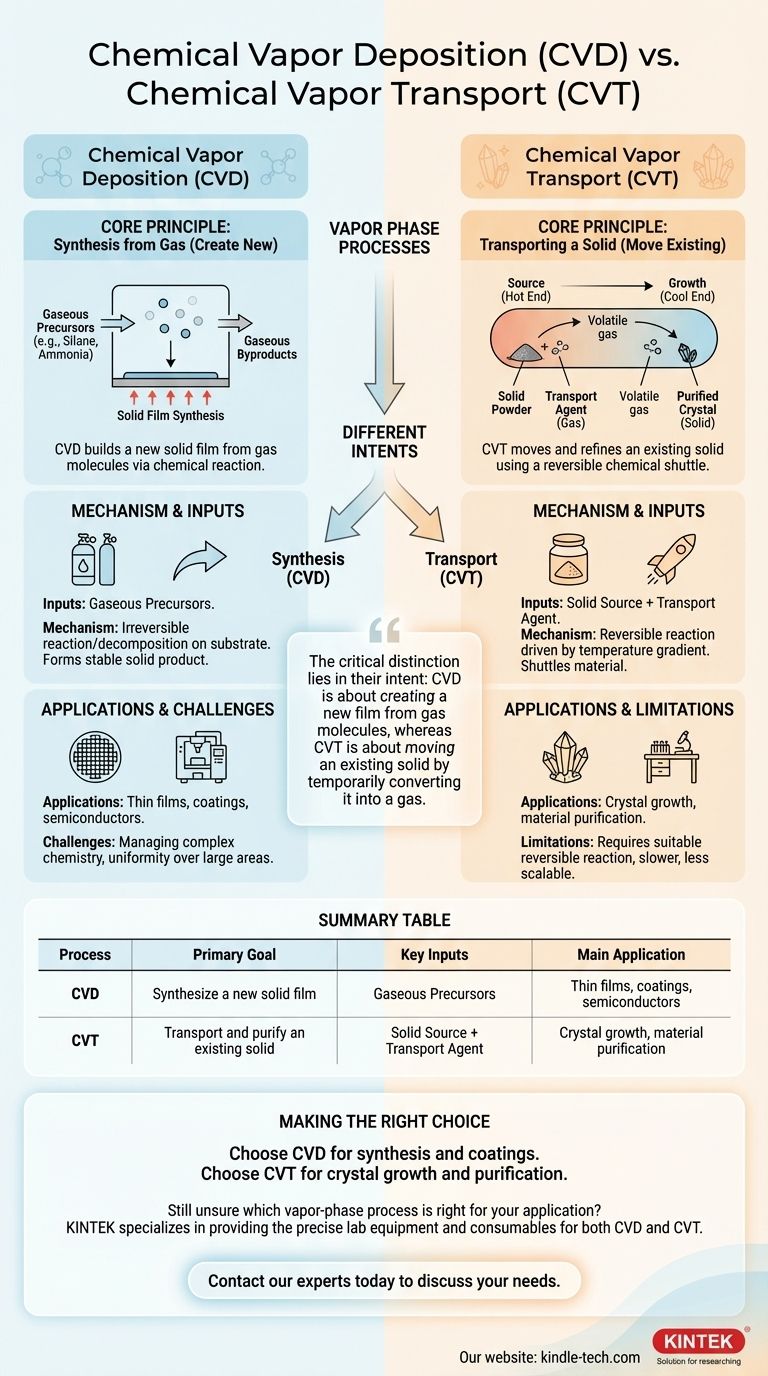
The fundamental difference is their primary purpose. Chemical Vapor Deposition (CVD) is a process that synthesizes a new, solid material directly from gaseous precursors onto a substrate. In contrast, Chemical Vapor Transport (CVT) is a process used to transport and purify an existing solid material from one location to another using a reversible chemical reaction.

While both processes operate in the vapor phase, the critical distinction lies in their intent: CVD is about creating a new film from gas molecules, whereas CVT is about moving an existing solid by temporarily converting it into a gas.
What is the difference between chemical vapor transport and chemical vapor deposition? Master Vapor-Phase Material Processing

Deconstructing Chemical Vapor Deposition (CVD)

CVD is a versatile and widely used technique for producing high-quality thin films and coatings. Its foundation is the synthesis of a new material directly on a surface.

The Core Principle: Synthesis from Gas

The goal of CVD is to build a solid film from the ground up. This is achieved by introducing one or more reactive gases, known as precursors, into a reaction chamber containing the object to be coated (the substrate).

The Mechanism of Deposition

The process involves a series of carefully controlled steps. Gaseous precursors are transported to the substrate's surface, where the heat (or plasma) provides the energy for a chemical reaction or decomposition to occur.

This reaction forms a stable solid product that deposits and grows on the surface, creating the desired film. Gaseous byproducts from the reaction are then transported away and exhausted from the chamber.

Key Inputs: Gaseous Precursors

In CVD, the starting materials are the gases themselves. For example, to deposit a silicon nitride film, gaseous precursors like silane (SiH₄) and ammonia (NH₃) might be used. These gases react to form solid Si₃N₄ on the substrate.

Deconstructing Chemical Vapor Transport (CVT)

CVT is a more specialized technique, often used in research and for producing high-purity single crystals. Its purpose is not to create a new material but to move and refine an existing one.

The Core Principle: Transporting a Solid

Imagine you have a solid powder of a material and you want to grow a perfect, large crystal of that same material. CVT is the process to achieve this. It uses a chemical "shuttle" to pick up the material at one end and drop it off at the other.

The Reversible Reaction Mechanism

CVT relies entirely on a reversible chemical reaction. The process occurs in a sealed tube with a temperature gradient (one end is hotter than the other).

  1. Forward Reaction (Source): At the "source" end, the solid material you want to transport reacts with a gaseous transport agent. This reaction converts the solid into a new, volatile gas molecule.
  2. Reverse Reaction (Growth): This new gas molecule diffuses to the other end of the tube (the "growth" end), which is at a different temperature. The temperature change causes the reaction to reverse, re-depositing the original solid material—often in a much purer, crystalline form. The transport agent gas is released and is free to shuttle more material.

Key Inputs: Solid Source + Transport Agent

The starting materials for CVT are the solid powder of the substance you wish to transport and a separate transport agent gas. The transport agent's only job is to act as a temporary chemical taxi for the solid material.

Understanding the Trade-offs and Applications

The fundamental difference in mechanism dictates where these processes are used and what challenges they present.

CVD Applications and Challenges

CVD is an industrial workhorse for creating protective coatings, semiconductor layers, and optical films. Its main challenge lies in managing the complex chemistry of precursors and ensuring uniform temperature and gas flow to achieve a consistent film over a large area.

CVT Applications and Limitations

CVT is primarily a laboratory technique for crystal growth and material purification. Its major limitation is the need for a suitable, reversible chemical reaction and a compatible transport agent for the specific material, which is not always available. The process is generally slower and less scalable than CVD.

Making the Right Choice for Your Goal

Your objective determines which process is appropriate.

  • If your primary focus is applying a new coating or thin film onto a substrate (e.g., depositing titanium nitride on a tool bit): CVD is the correct choice because its purpose is to synthesize a new material layer from gaseous precursors.
  • If your primary focus is purifying an existing solid or growing a large, high-quality single crystal of a specific compound (e.g., growing a MoS₂ crystal from powder): CVT is the appropriate method because it is designed to transport and recrystallize an existing material.

Ultimately, understanding this core difference between synthesis and transport is the key to mastering vapor-phase material processing.

Summary Table:

Process Primary Goal Key Inputs Main Application
Chemical Vapor Deposition (CVD) Synthesize a new solid film Gaseous Precursors Thin films, coatings, semiconductors
Chemical Vapor Transport (CVT) Transport and purify an existing solid Solid Source + Transport Agent Crystal growth, material purification

Still unsure which vapor-phase process is right for your application?

KINTEK specializes in providing the precise lab equipment and consumables needed for both CVD and CVT processes. Whether you are developing new thin films or growing high-purity crystals, our expertise can help you achieve superior results.

Contact our experts today to discuss your specific material processing needs and find the perfect solution for your laboratory.

Visual Guide
What is the difference between chemical vapor transport and chemical vapor deposition? Master Vapor-Phase Material Processing Visual Guide

Related Products

People Also Ask

Related Products

Chemical Vapor Deposition CVD Equipment System Chamber Slide PECVD Tube Furnace with Liquid Gasifier PECVD Machine

Chemical Vapor Deposition CVD Equipment System Chamber Slide PECVD Tube Furnace with Liquid Gasifier PECVD Machine

KT-PE12 Slide PECVD System: Wide power range, programmable temp control, fast heating/cooling with sliding system, MFC mass flow control & vacuum pump.

RF PECVD System Radio Frequency Plasma-Enhanced Chemical Vapor Deposition RF PECVD

RF PECVD System Radio Frequency Plasma-Enhanced Chemical Vapor Deposition RF PECVD

RF-PECVD is an acronym for "Radio Frequency Plasma-Enhanced Chemical Vapor Deposition." It deposits DLC (Diamond-like carbon film) on germanium and silicon substrates. It is utilized in the 3-12um infrared wavelength range.

915MHz MPCVD Diamond Machine Microwave Plasma Chemical Vapor Deposition System Reactor

915MHz MPCVD Diamond Machine Microwave Plasma Chemical Vapor Deposition System Reactor

915MHz MPCVD Diamond Machine and its multi-crystal effective growth, the maximum area can reach 8 inches, the maximum effective growth area of single crystal can reach 5 inches. This equipment is mainly used for the production of large-size polycrystalline diamond films, the growth of long single crystal diamonds, the low-temperature growth of high-quality graphene, and other materials that require energy provided by microwave plasma for growth.

Customer Made Versatile CVD Tube Furnace Chemical Vapor Deposition Chamber System Equipment

Customer Made Versatile CVD Tube Furnace Chemical Vapor Deposition Chamber System Equipment

Get your exclusive CVD furnace with KT-CTF16 Customer Made Versatile Furnace. Customizable sliding, rotating, and tilting functions for precise reactions. Order now!

Microwave Plasma Chemical Vapor Deposition MPCVD Machine System Reactor for Lab and Diamond Growth

Microwave Plasma Chemical Vapor Deposition MPCVD Machine System Reactor for Lab and Diamond Growth

Get high-quality diamond films with our Bell-jar Resonator MPCVD machine designed for lab and diamond growth. Discover how Microwave Plasma Chemical Vapor Deposition works for growing diamonds using carbon gas and plasma.

HFCVD Machine System Equipment for Drawing Die Nano-Diamond Coating

HFCVD Machine System Equipment for Drawing Die Nano-Diamond Coating

The nano-diamond composite coating drawing die uses cemented carbide (WC-Co) as the substrate, and uses the chemical vapor phase method ( CVD method for short ) to coat the conventional diamond and nano-diamond composite coating on the surface of the inner hole of the mold.

Split Chamber CVD Tube Furnace with Vacuum Station Chemical Vapor Deposition System Equipment Machine

Split Chamber CVD Tube Furnace with Vacuum Station Chemical Vapor Deposition System Equipment Machine

Efficient split chamber CVD furnace with vacuum station for intuitive sample checking and quick cooling. Up to 1200℃ max temperature with accurate MFC mass flowmeter control.

Inclined Rotary Plasma Enhanced Chemical Vapor Deposition PECVD Equipment Tube Furnace Machine

Inclined Rotary Plasma Enhanced Chemical Vapor Deposition PECVD Equipment Tube Furnace Machine

Introducing our inclined rotary PECVD furnace for precise thin film deposition. Enjoy automatic matching source, PID programmable temperature control, and high accuracy MFC mass flowmeter control. Built-in safety features for peace of mind.

Multi Heating Zones CVD Tube Furnace Machine Chemical Vapor Deposition Chamber System Equipment

Multi Heating Zones CVD Tube Furnace Machine Chemical Vapor Deposition Chamber System Equipment

KT-CTF14 Multi Heating Zones CVD Furnace - Precise Temperature Control and Gas Flow for Advanced Applications. Max temp up to 1200℃, 4 channels MFC mass flow meter, and 7" TFT touch screen controller.

Cylindrical Resonator MPCVD Machine System Reactor for Microwave Plasma Chemical Vapor Deposition and Lab Diamond Growth

Cylindrical Resonator MPCVD Machine System Reactor for Microwave Plasma Chemical Vapor Deposition and Lab Diamond Growth

Learn about Cylindrical Resonator MPCVD Machine, the microwave plasma chemical vapor deposition method used for growing diamond gemstones and films in the jewelry and semi-conductor industries. Discover its cost-effective advantages over traditional HPHT methods.

Inclined Rotary Plasma Enhanced Chemical Vapor Deposition PECVD Equipment Tube Furnace Machine

Inclined Rotary Plasma Enhanced Chemical Vapor Deposition PECVD Equipment Tube Furnace Machine

Upgrade your coating process with PECVD coating equipment. Ideal for LED, power semiconductors, MEMS and more. Deposits high-quality solid films at low temps.

CVD Diamond for Thermal Management Applications

CVD Diamond for Thermal Management Applications

CVD diamond for thermal management: High-quality diamond with thermal conductivity up to 2000 W/mK, ideal for heat spreaders, laser diodes, and GaN on Diamond (GOD) applications.

Custom CVD Diamond Coating for Lab Applications

Custom CVD Diamond Coating for Lab Applications

CVD Diamond Coating: Superior Thermal Conductivity, Crystal Quality, and Adhesion for Cutting Tools, Friction, and Acoustic Applications

CVD Diamond Dressing Tools for Precision Applications

CVD Diamond Dressing Tools for Precision Applications

Experience the Unbeatable Performance of CVD Diamond Dresser Blanks: High Thermal Conductivity, Exceptional Wear Resistance, and Orientation Independence.

Molybdenum Tungsten Tantalum Evaporation Boat for High Temperature Applications

Molybdenum Tungsten Tantalum Evaporation Boat for High Temperature Applications

Evaporation boat sources are used in thermal evaporation systems and are suitable for depositing various metals, alloys and materials. Evaporation boat sources are available in different thicknesses of tungsten, tantalum and molybdenum to ensure compatibility with a variety of power sources. As a container, it is used for vacuum evaporation of materials. They can be used for thin film deposition of various materials, or designed to be compatible with techniques such as electron beam fabrication.

Hemispherical Bottom Tungsten Molybdenum Evaporation Boat

Hemispherical Bottom Tungsten Molybdenum Evaporation Boat

Used for gold plating, silver plating, platinum, palladium, suitable for a small amount of thin film materials. Reduce the waste of film materials and reduce heat dissipation.

Electron Beam Evaporation Coating Oxygen-Free Copper Crucible and Evaporation Boat

Electron Beam Evaporation Coating Oxygen-Free Copper Crucible and Evaporation Boat

Electron Beam Evaporation Coating Oxygen-Free Copper Crucible enables precise co-deposition of various materials. Its controlled temperature and water-cooled design ensure pure and efficient thin film deposition.

Aluminized Ceramic Evaporation Boat for Thin Film Deposition

Aluminized Ceramic Evaporation Boat for Thin Film Deposition

Vessel for depositing thin films; has an aluminum-coated ceramic body for improved thermal efficiency and chemical resistance. making it suitable for various applications.

Evaporation Boat for Organic Matter

Evaporation Boat for Organic Matter

The evaporation boat for organic matter is an important tool for precise and uniform heating during the deposition of organic materials.

Vacuum Cold Mounting Machine for Sample Preparation

Vacuum Cold Mounting Machine for Sample Preparation

Vacuum Cold Mounting Machine for precise sample prep. Handles porous, fragile materials with -0.08MPa vacuum. Ideal for electronics, metallurgy, and failure analysis.


Leave Your Message