Knowledge What is the energy efficiency of biomass? Understanding the 20-40% Range for Power Generation
Author avatar

Tech Team · Kintek Solution

Updated 6 days ago

What is the energy efficiency of biomass? Understanding the 20-40% Range for Power Generation


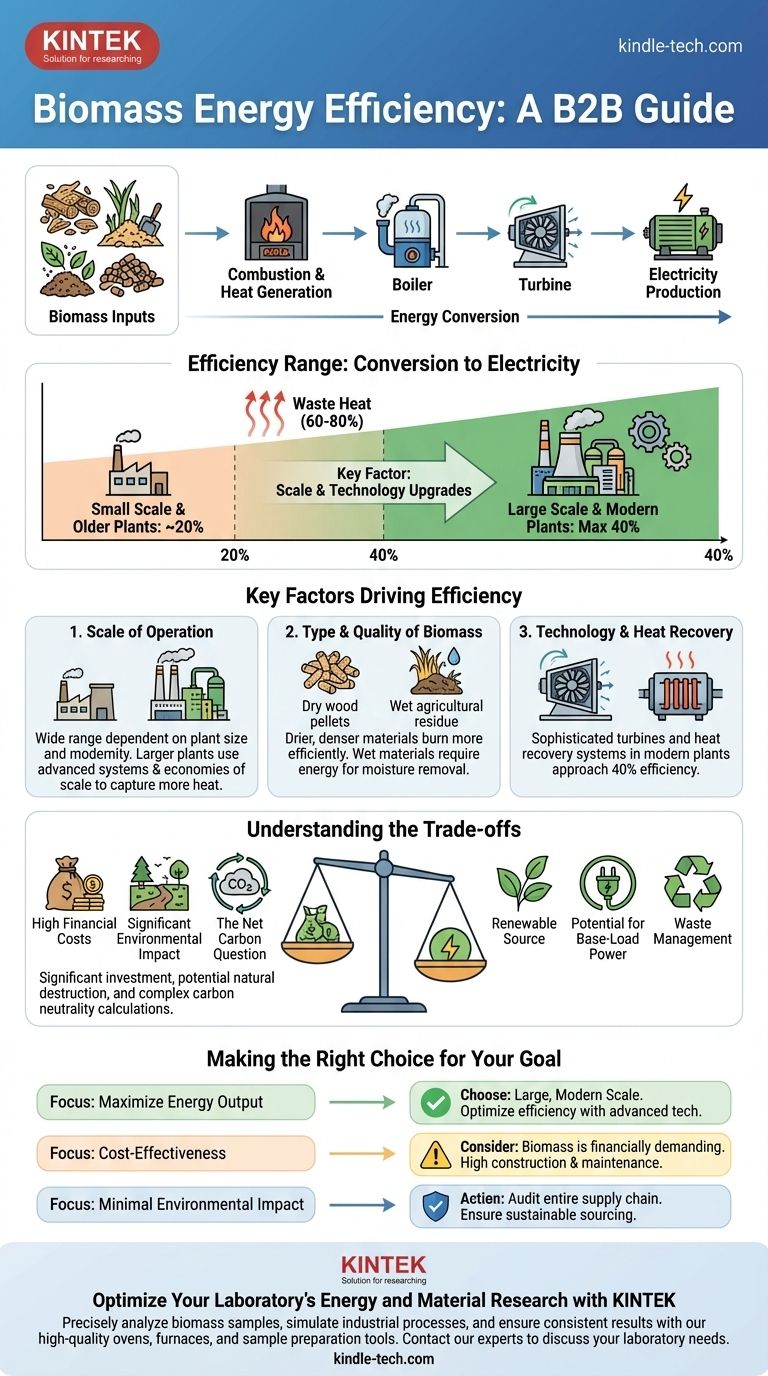
The energy efficiency of producing electricity from biomass typically ranges from 20% for smaller operations to a maximum of 40% for large-scale, modern power plants. This efficiency measures how much of the organic matter's stored chemical energy is successfully converted into usable electrical energy through combustion.

While the 20-40% efficiency range is a critical starting point, the true viability of biomass as an energy source depends less on this number and more on the scale of the operation and the significant economic and environmental trade-offs involved.
What is the energy efficiency of biomass? Understanding the 20-40% Range for Power Generation

What "Efficiency" Means for Biomass

The Core Process: Conversion to Electricity

Biomass energy is generated from organic materials such as wood, agricultural waste, or other plant-based matter. The most common method involves burning this biomass to produce heat, which creates steam to turn a turbine and generate electricity.

Measuring the Conversion Rate

Energy efficiency, in this context, is the percentage of the biomass's potential energy that is successfully converted into electricity. An efficiency of 40% means that for every 100 units of energy stored in the raw biomass, only 40 units become usable electricity, with the remaining 60 units lost, primarily as waste heat.

Key Factors Driving Biomass Efficiency

The Critical Role of Scale

The wide efficiency range is almost entirely dependent on the size and modernity of the power-generating facility. Smaller enterprises often lack the advanced technology and economies of scale needed to capture and use heat effectively, resulting in efficiencies around 20%.

Large, modern power plants, however, can invest in more sophisticated turbines and heat recovery systems. This allows them to achieve efficiencies that approach 40%, making them twice as effective at converting fuel to power.

Type and Quality of Biomass

The specific type of organic matter used also plays a role. Drier, denser biomass like wood pellets will burn more efficiently than wetter materials like fresh agricultural residue, which requires more energy to eliminate moisture before combustion can occur.

Understanding the Trade-offs

High Financial Costs

Biomass energy is not a low-cost solution. The process involves significant financial investment in the construction of the plant, the ongoing production and processing of the biomass fuel, and regular facility maintenance. These high costs can be a major barrier to adoption.

Significant Environmental Impact

While considered renewable, biomass is not without environmental consequences. Sourcing the organic matter can lead to natural destruction if not managed sustainably, potentially contributing to deforestation or competing with land used for food production.

The Net Carbon Question

Burning biomass releases carbon dioxide into the atmosphere. The argument for its carbon neutrality rests on the idea that the CO2 released is offset by the carbon absorbed by the plants as they grew. However, this is a complex calculation that depends heavily on the entire lifecycle, from harvesting to transportation and processing.

Making the Right Choice for Your Goal

When evaluating biomass, your primary objective will determine its suitability.

  • If your primary focus is maximizing energy output from a renewable source: Biomass is most effective at a large, modern scale where its efficiency can be optimized.
  • If your primary focus is cost-effectiveness: The high construction, production, and maintenance costs make biomass a financially demanding choice compared to some other renewable technologies.
  • If your primary focus is minimal environmental impact: You must carefully audit the entire supply chain to ensure the biomass is sourced sustainably without causing land degradation or deforestation.

Ultimately, evaluating biomass requires looking beyond a single efficiency number to the complete economic and ecological system it operates within.

Summary Table:

Factor Impact on Efficiency
Scale of Operation Small plants: ~20%. Large, modern plants: Up to 40%.
Biomass Type & Quality Dry, dense materials (e.g., wood pellets) are more efficient than wet residues.
Technology & Heat Recovery Advanced systems in modern plants capture more usable energy, boosting efficiency.

Optimize Your Laboratory's Energy and Material Research with KINTEK

Whether you are developing new biomass feedstocks, analyzing combustion processes, or testing material durability under high temperatures, having the right laboratory equipment is crucial for accurate and efficient research. KINTEK specializes in providing high-quality lab equipment and consumables tailored to the needs of research and industrial laboratories.

We can help you:

  • Precisely analyze biomass samples with our reliable ovens, furnaces, and sample preparation tools.
  • Simulate industrial processes to test efficiency and outcomes in a controlled lab environment.
  • Ensure consistent, repeatable results with our durable and precise equipment.

Let KINTEK be your trusted partner in advancing your energy and materials research. Contact our experts today to discuss your specific laboratory needs and find the perfect solution.

Visual Guide
What is the energy efficiency of biomass? Understanding the 20-40% Range for Power Generation Visual Guide

Related Products

People Also Ask

Related Products

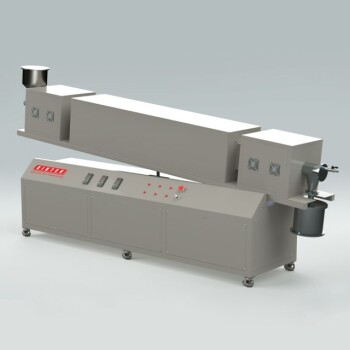
Vacuum Sealed Continuous Working Rotary Tube Furnace Rotating Tube Furnace

Vacuum Sealed Continuous Working Rotary Tube Furnace Rotating Tube Furnace

Experience efficient material processing with our vacuum-sealed rotary tube furnace. Perfect for experiments or industrial production, equipped with optional features for controlled feeding and optimized results. Order now.

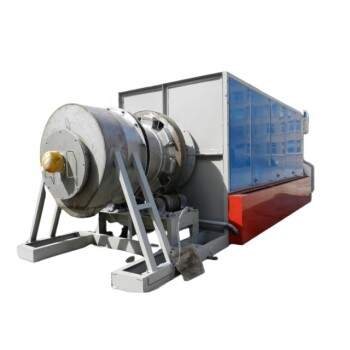
Electric Rotary Kiln Small Rotary Furnace for Activated Carbon Regeneration

Electric Rotary Kiln Small Rotary Furnace for Activated Carbon Regeneration

Revitalize your activated carbon with KinTek's Electric Regeneration Furnace. Achieve efficient and cost-effective regeneration with our highly automated rotary kiln and intelligent thermal controller.

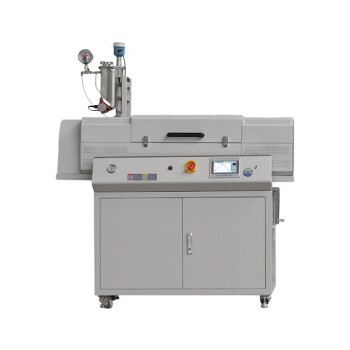
Laboratory Vacuum Tilt Rotary Tube Furnace Rotating Tube Furnace

Laboratory Vacuum Tilt Rotary Tube Furnace Rotating Tube Furnace

Discover the versatility of Laboratory Rotary Furnace: Ideal for calcination, drying, sintering, and high-temperature reactions. Adjustable rotating and tilting functions for optimal heating. Suitable for vacuum and controlled atmosphere environments. Learn more now!

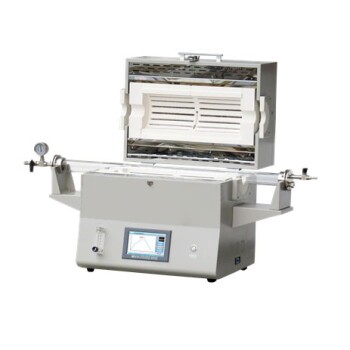
Vertical Laboratory Quartz Tube Furnace Tubular Furnace

Vertical Laboratory Quartz Tube Furnace Tubular Furnace

Elevate your experiments with our Vertical Tube Furnace. Versatile design allows for operation under various environments and heat treatment applications. Order now for precise results!

1700℃ Laboratory Quartz Tube Furnace with Alumina Tube Tubular Furnace

1700℃ Laboratory Quartz Tube Furnace with Alumina Tube Tubular Furnace

Looking for a high-temperature tube furnace? Check out our 1700℃ Tube Furnace with Alumina Tube. Perfect for research and industrial applications up to 1700C.

1400℃ Laboratory Quartz Tube Furnace with Alumina Tube Tubular Furnace

1400℃ Laboratory Quartz Tube Furnace with Alumina Tube Tubular Furnace

Looking for a tube furnace for high-temperature applications? Our 1400℃ Tube Furnace with Alumina Tube is perfect for research and industrial use.

Laboratory Muffle Oven Furnace Bottom Lifting Muffle Furnace

Laboratory Muffle Oven Furnace Bottom Lifting Muffle Furnace

Efficiently produce batches with excellent temperature uniformity using our Bottom Lifting Furnace. Features two electric lifting stages and advanced temperature control up to 1600℃.

1800℃ Muffle Oven Furnace for Laboratory

1800℃ Muffle Oven Furnace for Laboratory

KT-18 muffle furnace with Japan Al2O3 polycrystalline fibe and Silicon Molybdenum heating element, up to 1900℃, PID temperature control and 7" smart touch screen. Compact design, low heat loss, and high energy efficiency. Safety interlock system and versatile functions.

High Temperature Muffle Oven Furnace for Laboratory Debinding and Pre Sintering

High Temperature Muffle Oven Furnace for Laboratory Debinding and Pre Sintering

KT-MD High temperature debinding and pre-sintering furnace for ceramic materials with various molding processes. Ideal for electronic components such as MLCC and NFC.

1700℃ Muffle Oven Furnace for Laboratory

1700℃ Muffle Oven Furnace for Laboratory

Get superior heat control with our 1700℃ Muffle Furnace. Equipped with intelligent temperature microprocessor, TFT touch screen controller & advanced insulation materials for precise heating up to 1700C. Order now!

1200℃ Split Tube Furnace with Quartz Tube Laboratory Tubular Furnace

1200℃ Split Tube Furnace with Quartz Tube Laboratory Tubular Furnace

KT-TF12 split tube furnace: high-purity insulation, embedded heating wire coils, and max. 1200C. Widely used for new materials and chemical vapour deposition.

1400℃ Muffle Oven Furnace for Laboratory

1400℃ Muffle Oven Furnace for Laboratory

Get precise high-temperature control up to 1500℃ with KT-14M Muffle furnace. Equipped with a smart touch screen controller and advanced insulation materials.

Multi Zone Laboratory Quartz Tube Furnace Tubular Furnace

Multi Zone Laboratory Quartz Tube Furnace Tubular Furnace

Experience precise, efficient thermal testing with our Multi Zone Tube Furnace. Independent heating zones and temperature sensors allow for controlled high-temperature gradient heating fields. Order now for advanced thermal analysis!

1200℃ Controlled Atmosphere Furnace Nitrogen Inert Atmosphere Furnace

1200℃ Controlled Atmosphere Furnace Nitrogen Inert Atmosphere Furnace

Discover our KT-12A Pro Controlled atmosphere furnace - high precision, heavy duty vacuum chamber, versatile smart touch screen controller, and excellent temperature uniformity up to 1200C. Ideal for both laboratory and industrial application.

Graphite Vacuum Continuous Graphitization Furnace

Graphite Vacuum Continuous Graphitization Furnace

High-temperature graphitization furnace is a professional equipment for graphitization treatment of carbon materials. It is a key equipment for the production of high-quality graphite products. It has high temperature, high efficiency and uniform heating. It is suitable for various high-temperature treatments and graphitization treatments. It is widely used in metallurgy, electronics, aerospace, etc. industry.

Spark Plasma Sintering Furnace SPS Furnace

Spark Plasma Sintering Furnace SPS Furnace

Discover the benefits of Spark Plasma Sintering Furnaces for rapid, low-temperature material preparation. Uniform heating, low cost & eco-friendly.

Vacuum Heat Treat Sintering Brazing Furnace

Vacuum Heat Treat Sintering Brazing Furnace

A vacuum brazing furnace is a type of industrial furnace used for brazing, a metalworking process that joins two pieces of metal using a filler metal that melts at a lower temperature than the base metals. Vacuum brazing furnaces are typically used for high-quality applications where a strong, clean joint is required.

1700℃ Controlled Atmosphere Furnace Nitrogen Inert Atmosphere Furnace

1700℃ Controlled Atmosphere Furnace Nitrogen Inert Atmosphere Furnace

KT-17A Controlled atmosphere furnace: 1700℃ heating, vacuum sealing technology, PID temperature control, and versatile TFT smart touch screen controller for laboratory and industrial use.

600T Vacuum Induction Hot Press Furnace for Heat Treat and Sintering

600T Vacuum Induction Hot Press Furnace for Heat Treat and Sintering

Discover the 600T Vacuum Induction Hot Press Furnace, designed for high-temperature sintering experiments in vacuum or protected atmospheres. Its precise temperature and pressure control, adjustable working pressure, and advanced safety features make it ideal for nonmetal materials, carbon composites, ceramics, and metal powders.

Vacuum Heat Treat and Molybdenum Wire Sintering Furnace for Vacuum Sintering

Vacuum Heat Treat and Molybdenum Wire Sintering Furnace for Vacuum Sintering

A vacuum molybdenum wire sintering furnace is a vertical or bedroom structure, which is suitable for withdrawal, brazing, sintering and degassing of metal materials under high vacuum and high temperature conditions. It is also suitable for dehydroxylation treatment of quartz materials.


Leave Your Message