Knowledge evaporation boat What is the evaporation technique for deposition? A Guide to High-Purity Thin Film Coating
Author avatar

Tech Team · Kintek Solution

Updated 2 months ago

What is the evaporation technique for deposition? A Guide to High-Purity Thin Film Coating


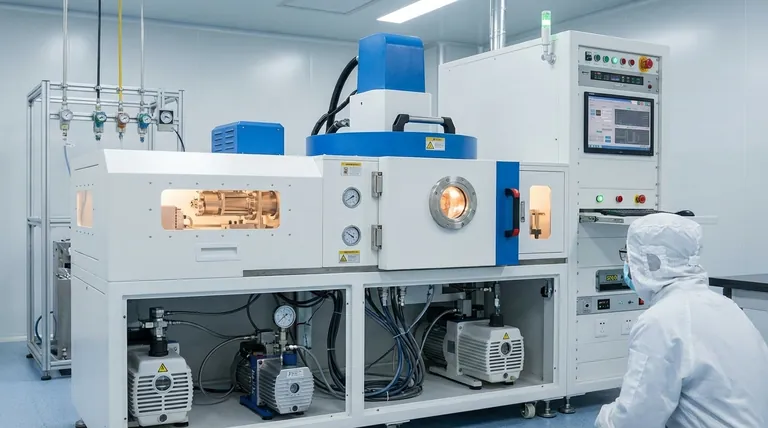
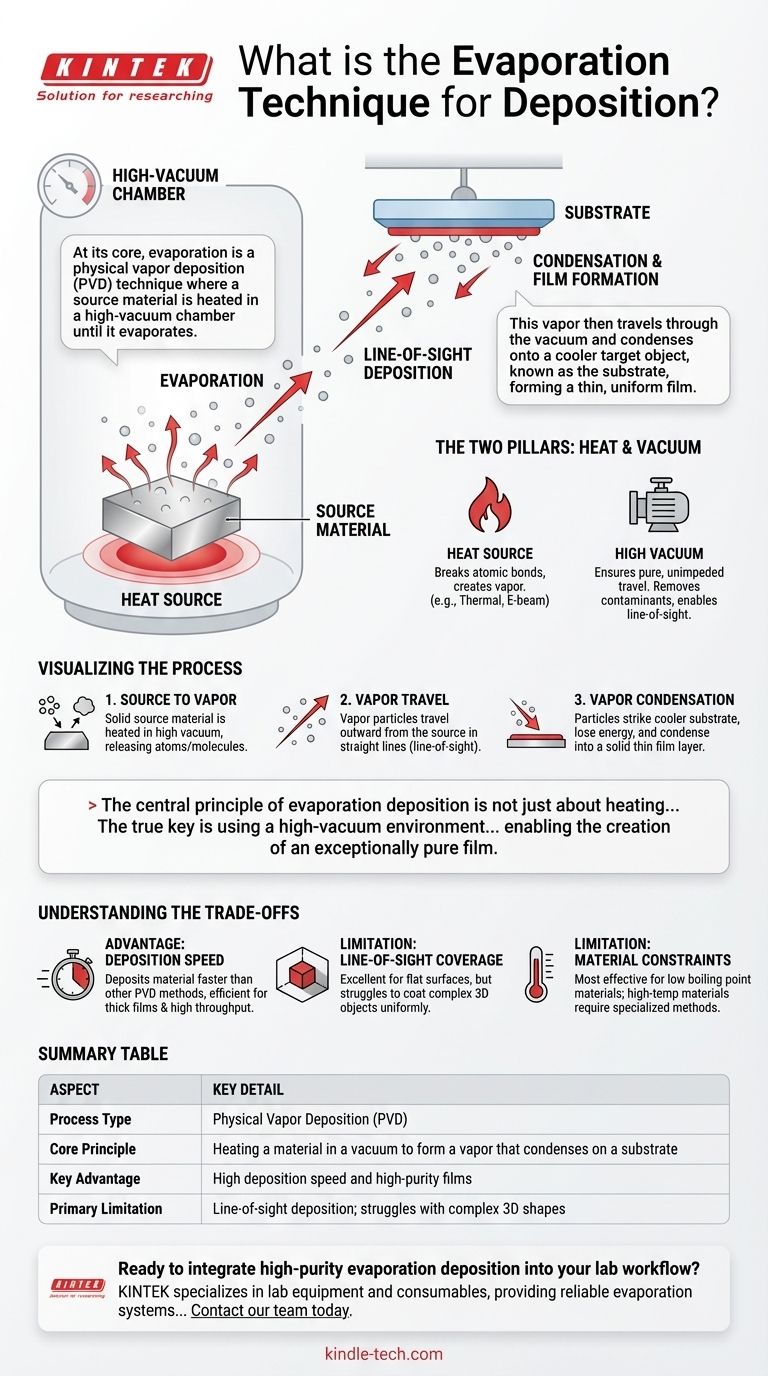
At its core, evaporation is a physical vapor deposition (PVD) technique where a source material is heated in a high-vacuum chamber until it evaporates. This vapor then travels through the vacuum and condenses onto a cooler target object, known as the substrate, forming a thin, uniform film. It is one of the most fundamental methods for creating high-purity coatings.

The central principle of evaporation deposition is not just about heating a material until it becomes a gas. The true key is using a high-vacuum environment to ensure those gas particles travel unimpeded and uncontaminated from the source to the substrate, enabling the creation of an exceptionally pure film.
What is the evaporation technique for deposition? A Guide to High-Purity Thin Film Coating

The Two Pillars of Evaporation: Heat and Vacuum

The entire process is governed by two critical environmental factors: the energy source that causes evaporation and the vacuum that enables pure deposition.

The Role of the Heat Source

The primary function of the heat source is to supply enough thermal energy to the source material to break its atomic bonds and transition it into a gaseous state. The method of heating defines the specific type of evaporation technique.

Common methods include vacuum thermal evaporation, which uses electrical resistance to heat the material, and electron beam evaporation, which uses a focused beam of high-energy electrons.

The Critical Function of the Vacuum

The vacuum is not merely an empty space; it is an active component of the process. A high-vacuum environment is essential for two reasons.

First, it removes atmospheric and other unwanted gas molecules. This prevents the source material vapor from reacting with contaminants like oxygen or nitrogen, which would compromise the purity of the final film.

Second, the near-absence of other particles allows the evaporated material to travel in a straight, uninterrupted path to the substrate. This is known as line-of-sight deposition.

Visualizing the Deposition Process

To understand the process intuitively, you can compare it to the condensation that forms on the lid of a boiling pot of water.

The Journey from Source to Substrate

A solid source material, often in the form of pellets or a small ingot, is placed inside the vacuum chamber. Once the chamber is pumped down to a high vacuum, the heat source is activated.

As the material heats up, it begins to evaporate, releasing atoms or molecules into the chamber. These vapor particles travel outward from the source in straight lines.

When these particles strike the cooler substrate, they lose their energy and condense back into a solid state, gradually building up a thin film layer by layer.

Understanding the Trade-offs

Like any technical process, evaporation has distinct advantages and disadvantages that make it suitable for some applications but not others.

Advantage: Deposition Speed

Generally, thermal evaporation can deposit material at a much faster rate than other PVD methods like sputtering. This makes it highly efficient for creating thicker films or for high-throughput manufacturing processes, such as producing metallized plastic films for packaging.

Limitation: Line-of-Sight Coverage

The straight-line path of the vapor particles means that evaporation is excellent for coating flat, simple surfaces. However, it struggles to uniformly coat complex, three-dimensional objects with sharp edges or deep trenches, as some surfaces will be in the "shadow" of the source.

Limitation: Material Constraints

Evaporation is most effective for materials with a relatively low boiling point. Materials that require extremely high temperatures to evaporate can be difficult or impossible to process with standard thermal evaporation techniques, often requiring more specialized methods like electron beam evaporation.

Making the Right Choice for Your Application

Selecting the right deposition technique requires aligning the method's characteristics with your project's primary goal.

  • If your primary focus is high-speed coating of simple surfaces: Thermal evaporation is often the most cost-effective and efficient choice.
  • If your primary focus is achieving the highest possible film purity for sensitive electronics: A highly controlled variant like Molecular Beam Epitaxy (MBE) is the industry standard.
  • If your primary focus is uniformly coating complex, 3D geometries: You may need to consider an alternative PVD process like sputtering, which is less directional.

Understanding these fundamental principles empowers you to select the precise tool required to achieve your desired outcome.

Summary Table:

Aspect Key Detail
Process Type Physical Vapor Deposition (PVD)
Core Principle Heating a material in a vacuum to form a vapor that condenses on a substrate
Key Advantage High deposition speed and high-purity films
Primary Limitation Line-of-sight deposition; struggles with complex 3D shapes

Ready to integrate high-purity evaporation deposition into your lab workflow? KINTEK specializes in lab equipment and consumables, providing reliable evaporation systems for applications in electronics, optics, and materials science. Our experts can help you select the right equipment to achieve superior thin film coatings with high efficiency and purity. Contact our team today to discuss your specific deposition needs and enhance your research or production capabilities.

Visual Guide
What is the evaporation technique for deposition? A Guide to High-Purity Thin Film Coating Visual Guide

Related Products

People Also Ask

Related Products

HFCVD Machine System Equipment for Drawing Die Nano-Diamond Coating

HFCVD Machine System Equipment for Drawing Die Nano-Diamond Coating

The nano-diamond composite coating drawing die uses cemented carbide (WC-Co) as the substrate, and uses the chemical vapor phase method ( CVD method for short ) to coat the conventional diamond and nano-diamond composite coating on the surface of the inner hole of the mold.

Chemical Vapor Deposition CVD Equipment System Chamber Slide PECVD Tube Furnace with Liquid Gasifier PECVD Machine

Chemical Vapor Deposition CVD Equipment System Chamber Slide PECVD Tube Furnace with Liquid Gasifier PECVD Machine

KT-PE12 Slide PECVD System: Wide power range, programmable temp control, fast heating/cooling with sliding system, MFC mass flow control & vacuum pump.

Aluminized Ceramic Evaporation Boat for Thin Film Deposition

Aluminized Ceramic Evaporation Boat for Thin Film Deposition

Vessel for depositing thin films; has an aluminum-coated ceramic body for improved thermal efficiency and chemical resistance. making it suitable for various applications.

Customer Made Versatile CVD Tube Furnace Chemical Vapor Deposition Chamber System Equipment

Customer Made Versatile CVD Tube Furnace Chemical Vapor Deposition Chamber System Equipment

Get your exclusive CVD furnace with KT-CTF16 Customer Made Versatile Furnace. Customizable sliding, rotating, and tilting functions for precise reactions. Order now!

Tungsten Evaporation Boat for Thin Film Deposition

Tungsten Evaporation Boat for Thin Film Deposition

Learn about tungsten boats, also known as evaporated or coated tungsten boats. With a high tungsten content of 99.95%, these boats are ideal for high-temperature environments and widely used in various industries. Discover their properties and applications here.

Hemispherical Bottom Tungsten Molybdenum Evaporation Boat

Hemispherical Bottom Tungsten Molybdenum Evaporation Boat

Used for gold plating, silver plating, platinum, palladium, suitable for a small amount of thin film materials. Reduce the waste of film materials and reduce heat dissipation.

Electron Beam Evaporation Coating Oxygen-Free Copper Crucible and Evaporation Boat

Electron Beam Evaporation Coating Oxygen-Free Copper Crucible and Evaporation Boat

Electron Beam Evaporation Coating Oxygen-Free Copper Crucible enables precise co-deposition of various materials. Its controlled temperature and water-cooled design ensure pure and efficient thin film deposition.

Molybdenum Tungsten Tantalum Evaporation Boat for High Temperature Applications

Molybdenum Tungsten Tantalum Evaporation Boat for High Temperature Applications

Evaporation boat sources are used in thermal evaporation systems and are suitable for depositing various metals, alloys and materials. Evaporation boat sources are available in different thicknesses of tungsten, tantalum and molybdenum to ensure compatibility with a variety of power sources. As a container, it is used for vacuum evaporation of materials. They can be used for thin film deposition of various materials, or designed to be compatible with techniques such as electron beam fabrication.

RF PECVD System Radio Frequency Plasma-Enhanced Chemical Vapor Deposition RF PECVD

RF PECVD System Radio Frequency Plasma-Enhanced Chemical Vapor Deposition RF PECVD

RF-PECVD is an acronym for "Radio Frequency Plasma-Enhanced Chemical Vapor Deposition." It deposits DLC (Diamond-like carbon film) on germanium and silicon substrates. It is utilized in the 3-12um infrared wavelength range.

Evaporation Boat for Organic Matter

Evaporation Boat for Organic Matter

The evaporation boat for organic matter is an important tool for precise and uniform heating during the deposition of organic materials.

Microwave Plasma Chemical Vapor Deposition MPCVD Machine System Reactor for Lab and Diamond Growth

Microwave Plasma Chemical Vapor Deposition MPCVD Machine System Reactor for Lab and Diamond Growth

Get high-quality diamond films with our Bell-jar Resonator MPCVD machine designed for lab and diamond growth. Discover how Microwave Plasma Chemical Vapor Deposition works for growing diamonds using carbon gas and plasma.

Ceramic Evaporation Boat Set Alumina Crucible for Laboratory Use

Ceramic Evaporation Boat Set Alumina Crucible for Laboratory Use

It can be used for vapor deposition of various metals and alloys. Most metals can be evaporated completely without loss. Evaporation baskets are reusable.1

Inclined Rotary Plasma Enhanced Chemical Vapor Deposition PECVD Equipment Tube Furnace Machine

Inclined Rotary Plasma Enhanced Chemical Vapor Deposition PECVD Equipment Tube Furnace Machine

Introducing our inclined rotary PECVD furnace for precise thin film deposition. Enjoy automatic matching source, PID programmable temperature control, and high accuracy MFC mass flowmeter control. Built-in safety features for peace of mind.

Multi Heating Zones CVD Tube Furnace Machine Chemical Vapor Deposition Chamber System Equipment

Multi Heating Zones CVD Tube Furnace Machine Chemical Vapor Deposition Chamber System Equipment

KT-CTF14 Multi Heating Zones CVD Furnace - Precise Temperature Control and Gas Flow for Advanced Applications. Max temp up to 1200℃, 4 channels MFC mass flow meter, and 7" TFT touch screen controller.

Inclined Rotary Plasma Enhanced Chemical Vapor Deposition PECVD Equipment Tube Furnace Machine

Inclined Rotary Plasma Enhanced Chemical Vapor Deposition PECVD Equipment Tube Furnace Machine

Upgrade your coating process with PECVD coating equipment. Ideal for LED, power semiconductors, MEMS and more. Deposits high-quality solid films at low temps.

Electron Beam Evaporation Coating Gold Plating Tungsten Molybdenum Crucible for Evaporation

Electron Beam Evaporation Coating Gold Plating Tungsten Molybdenum Crucible for Evaporation

These crucibles act as containers for the gold material evaporated by the electron evaporation beam while precisely directing the electron beam for precise deposition.

Evaporation Crucible for Organic Matter

Evaporation Crucible for Organic Matter

An evaporation crucible for organic matter, referred to as an evaporation crucible, is a container for evaporating organic solvents in a laboratory environment.

High Purity Pure Graphite Crucible for Evaporation

High Purity Pure Graphite Crucible for Evaporation

Vessels for high temperature applications, where materials are kept at extremely high temperatures to evaporate, allowing thin films to be deposited on substrates.

Electron Beam Evaporation Coating Conductive Boron Nitride Crucible BN Crucible

Electron Beam Evaporation Coating Conductive Boron Nitride Crucible BN Crucible

High-purity and smooth conductive boron nitride crucible for electron beam evaporation coating, with high temperature and thermal cycling performance.

High Purity Pure Graphite Crucible for Electron Beam Evaporation

High Purity Pure Graphite Crucible for Electron Beam Evaporation

A technology mainly used in the field of power electronics. It is a graphite film made of carbon source material by material deposition using electron beam technology.


Leave Your Message