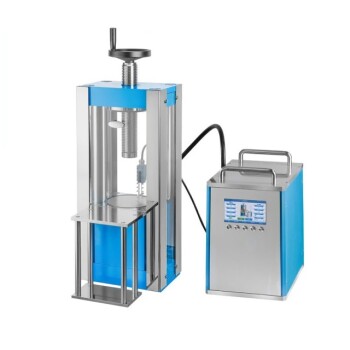
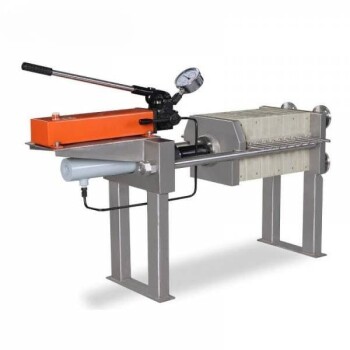
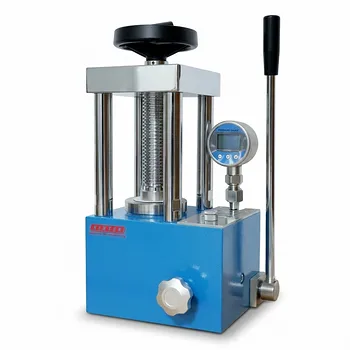
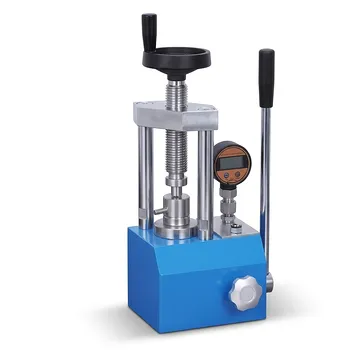
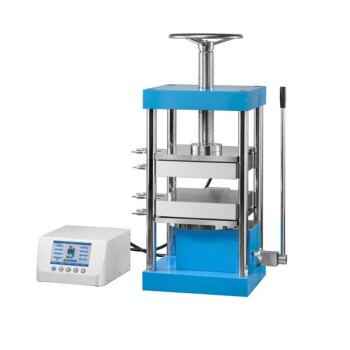
The high-pressure hydraulic press or universal testing machine serves as the primary mechanical driver for densifying Cu/SiC powder mixtures into a solid preform. By applying controlled axial pressure—frequently reaching levels up to 450 MPa—these machines overcome the internal friction between individual particles. This process transforms loose powder into a "green compact," providing the structural integrity and particle contact necessary for successful high-temperature sintering.
Core Takeaway: The function of the hydraulic press is to convert loose composite powders into a cohesive green body by maximizing particle contact and eliminating air voids, thereby establishing the essential physical foundation for atomic diffusion and final densification.
Overcoming Internal Resistance and Particle Rearrangement
Mechanically Breaking the Friction Barrier
Loose Cu/SiC powder naturally resists densification due to internal friction between the metallic copper and ceramic silicon carbide particles. The hydraulic press applies a high-magnitude axial load that forces these particles to slide past one another, overcoming this resistance.
Facilitating Particle Rearrangement and Deformation
Under high pressure, particles undergo rearrangement and plastic deformation, filling the macroscopic gaps within the mold. This movement is critical for reducing the volume of the powder mass and creating a stable geometric shape, such as a pellet or a rectangular billet.
Expelling Entrapped Air
The application of mechanical force effectively expels the majority of air trapped between the loose particles. Eliminating these air pockets is vital to prevent internal defects and bloating during the subsequent thermal processing stages.
Enhancing Green Density and Contact Area
Maximizing Particle-to-Particle Interface
High-pressure compaction significantly increases the effective contact area between the Cu and SiC constituents. This intimate contact is the most critical factor for ensuring the material can undergo solid-state diffusion during the sintering process.
Controlling Green Density
The magnitude of the compaction load—often measured in tons or MPa—directly determines the green density of the compact. A higher initial density reduces the amount of shrinkage that occurs during sintering and improves the final mechanical properties of the composite.
Achieving Geometric Precision
Using high-hardness steel or carbon steel molds, the hydraulic press ensures the powder mixture assumes a specific, regular geometry. This precision is necessary for components that require machining or specific fitment in later manufacturing stages.
Establishing Structural Integrity for Processing
Providing Necessary Green Strength
The compaction process creates a mechanical interlocking between particles, giving the "green" body enough strength to be handled. Without this strength, the compact would crumble when being moved from the mold to the sintering furnace.
Creating the Foundation for Atomic Diffusion
By forcing the copper and silicon carbide particles into a dense network, the press creates the physical pathways required for atoms to move across particle boundaries. This contact network is what allows the separate powders to eventually fuse into a high-performance composite.
Understanding the Trade-offs and Pitfalls
Pressure vs. Die Longevity
While increasing pressure generally improves density, it also accelerates tool wear on the high-hardness steel molds. Excessive pressure can lead to die deformation or "galling," where the powder adheres to the mold walls, complicating the ejection process.
Density Gradients and Friction
In axial pressing, friction between the powder and the mold walls can lead to non-uniform density throughout the compact. The areas furthest from the pressing ram may be less dense, potentially leading to warping or uneven shrinkage during the sintering phase.
Material Springback
When the pressure is released, some materials experience "springback," a slight elastic expansion that can cause internal micro-cracking. This is particularly common in mixtures with high ceramic content, like SiC, which does not deform plastically as easily as the copper matrix.
How to Apply Compaction Parameters to Your Project
Recommendations Based on Production Goals
- If your primary focus is maximum final density: Utilize the highest recommended pressure (up to 450 MPa) to maximize particle contact points and minimize the porosity that must be closed during sintering.
- If your primary focus is tool longevity and cost: Opt for moderate pressure levels (100–200 MPa) and use high-quality lubricants on the mold walls to reduce friction and wear.
- If your primary focus is complex geometry: Ensure the powder is uniformly mixed and consider a dual-action press to minimize density gradients within the green body.
By precisely controlling the mechanical compaction of Cu/SiC powders, you establish the fundamental structural parameters that dictate the success of all subsequent thermal and chemical treatments.
Summary Table:
| Key Function | Impact on Cu/SiC Compact | Critical Parameter |
|---|---|---|
| Densification | Eliminates air voids and maximizes green density | Axial Pressure (up to 450 MPa) |
| Particle Rearrangement | Overcomes internal friction for a cohesive preform | Particle Size & Distribution |
| Interface Maximization | Creates pathways for atomic diffusion during sintering | Effective Contact Area |
| Structural Integrity | Provides "green strength" for safe handling and transport | Mechanical Interlocking |
| Geometric Precision | Ensures regular shapes (pellets/billets) for machining | Mold/Die Hardness |
Elevate Your Composite Manufacturing with KINTEK Precision
Achieving the perfect Cu/SiC green compact requires more than just force—it requires precision and reliability. KINTEK specializes in high-performance laboratory equipment designed to meet the rigorous demands of material science.
Whether you need manual or automated hydraulic presses (pellet, hot, isostatic) to reach critical compaction pressures, or high-temperature furnaces (muffle, vacuum, atmosphere) for the subsequent sintering phase, our solutions ensure uniform density and superior structural integrity. We also provide high-hardness molds, crushing and milling systems, and ceramic crucibles to streamline your entire workflow.
Ready to optimize your densification process? Contact our experts today to discuss your specific application, explore our OEM/ODM support, and discover how KINTEK can enhance your lab's efficiency and research outcomes.
References
- M.M. Sadawy, I. G. El-Batanony. Microstructure, Corrosion and Electrochemical Properties of Cu/SiC Composites in 3.5 wt% NaCl Solution. DOI: 10.1007/s12540-023-01521-8
This article is also based on technical information from Kintek Solution Knowledge Base .
Related Products
- Heated Hydraulic Press Machine with Heated Plates for Vacuum Box Laboratory Hot Press
- Automatic High Temperature Heated Hydraulic Press Machine with Heated Plates for Lab
- Manual High Temperature Heated Hydraulic Press Machine with Heated Plates for Lab
- 24T 30T 60T Heated Hydraulic Press Machine with Heated Plates for Laboratory Hot Press
- Heated Hydraulic Press Machine with Integrated Manual Heated Plates for Lab Use
People Also Ask
- Why is a heated laboratory hydraulic press necessary for composite laminates? Achieve Void-Free Structural Integrity
- What role does a heated hydraulic press play in Cold Sintering (CSP)? Enhancing LATP-Halide Densification
- What is the core function of a laboratory heated hydraulic press in CSP? Revolutionize Low-Temp Ceramic Sintering
- Why is the heating function of a laboratory hydraulic press essential for MEA assembly in DEFC? Optimize Cell Bonding
- How is a heated hydraulic press used for Li-LLZO batteries? Optimize Interfacial Bonding with Thermal-Pressure