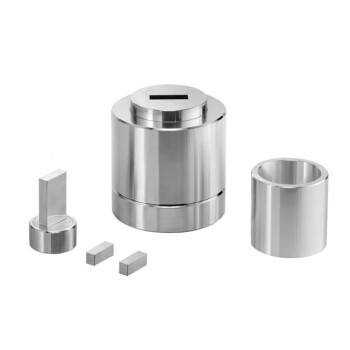
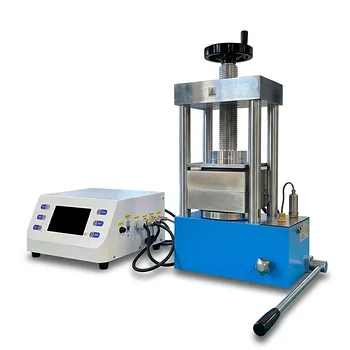
The hydraulic pellet press acts as a critical preparation stage in the chlorination volatilization process by transforming loose cyanide tailings and additives into dense, uniform pellets. By applying high pressure to a mixture of tailings and calcium chloride ($CaCl_2$), the press ensures intimate contact between reactants. This densification is essential for facilitating the mass transfer required to convert gold and silver into volatile chlorides during the subsequent high-temperature roasting phase.
A hydraulic pellet press optimizes the recovery of gold and silver by increasing reactant contact density, which significantly enhances the kinetics and efficiency of the chlorination volatilization reaction during roasting.
Enhancing Reaction Kinetics through Densification
Improving Solid-Solid Contact
The primary mechanical function of the press is to reduce the void space between the cyanide tailings and the chlorinating agent. This physical proximity allows for more efficient chemical interactions at the microscopic level.
Facilitating Mass Transfer
In high-temperature roasting, the reaction rate depends heavily on how easily reactants can migrate and interact. Compressed pellets ensure that the chlorinating agents are perfectly positioned to react with the gold and silver particles embedded within the tailings.
Standardizing Particle Geometry
Pressing the material into a uniform size, such as 20mm, ensures consistent heat distribution and gas permeability during the volatilization stage. This standardization leads to a more predictable and controlled recovery process.
Comparison with Other Pelletizing Applications
Laboratory vs. Industrial Requirements
While spectral analysis requires smooth, homogeneous surfaces for X-ray fluorescence (XRF) or infrared spectroscopy, metallurgical pelletizing focuses on structural integrity and chemical reactivity. The goal here is not light penetration, but chemical transformation.
Structural Stability under Heat
Unlike catalyst wafers that must be incredibly thin for transmission measurements, metallurgical pellets must be robust. They are designed to remain structurally stable enough to withstand the mechanical stress of a roasting furnace without disintegrating into dust.
Understanding the Trade-offs and Challenges
Pressure Calibration
Applying too little pressure results in fragile pellets that crumble before roasting, while excessive pressure can reduce the porosity needed for volatile gases to escape. Finding the optimal density is vital for maximizing the rate at which gold and silver chlorides can exit the pellet.
Additive Distribution
The pellet press cannot compensate for a poorly mixed precursor. If the calcium chloride is not evenly distributed before pressing, the resulting pellets will have localized areas of low reaction efficiency regardless of the pressure applied.
Equipment Maintenance and Wear
Handling abrasive cyanide tailings can lead to rapid wear on the press dies. Regular maintenance and the use of hardened materials are required to ensure that the pellets maintain their specified dimensions and density over time.
Optimizing the Pelletization Process for Recovery
To achieve the best results in gold and silver recovery, the pelletization stage must be tailored to the specific characteristics of your tailings.
- If your primary focus is maximizing metal yield: Ensure the mixing phase prior to pressing is thorough to guarantee that every gold and silver particle is in direct contact with the chlorinating additives.
- If your primary focus is furnace efficiency: Focus on achieving a consistent pellet size to maintain optimal airflow and uniform heat transfer during the roasting stage.
- If your primary focus is material handling: Increase the compression force slightly to improve the mechanical "green strength" of the pellets, preventing dust generation during transport to the kiln.
By mastering the balance of pressure and mixture consistency, operators can transform waste tailings into a highly reactive feedstock for efficient precious metal recovery.
Summary Table:
| Key Function | Mechanical Action | Impact on Recovery Efficiency |
|---|---|---|
| Densification | Reduces void space between tailings and $CaCl_2$ | Enhances solid-solid reaction kinetics |
| Mass Transfer | Facilitates migration of reactants at high temps | Accelerates conversion to volatile chlorides |
| Standardization | Creates uniform 20mm particle geometry | Ensures consistent heat and gas permeability |
| Structural Integrity | Provides mechanical "green strength" | Prevents pellet disintegration during roasting |
Maximize Your Metal Recovery with KINTEK Precision
Are you looking to optimize your chlorination volatilization process? KINTEK specializes in high-performance hydraulic pellet presses (manual, electric, and isostatic) engineered to withstand the abrasive nature of metallurgical tailings. Our equipment ensures the precise pressure calibration and material density required for superior reaction kinetics and consistent yields.
From high-temperature furnaces for roasting to crushing and milling systems for sample preparation, KINTEK provides a comprehensive suite of laboratory and industrial solutions tailored to the mining and metallurgy sectors.
Ready to enhance your lab's throughput? Contact our experts today to find the perfect equipment for your gold and silver recovery needs.
References
- Weiwei Wang, Shaochun Hou. Kinetics of simultaneous recovering of Au and Ag from CTs by chloridizing volatilization methods. DOI: 10.37190/ppmp/172522
This article is also based on technical information from Kintek Solution Knowledge Base .
Related Products
- Laboratory Hydraulic Pellet Press for XRF KBR FTIR Lab Applications
- Automatic Laboratory Hydraulic Pellet Press Machine for Lab Use
- Automatic Laboratory Hydraulic Press for XRF & KBR Pellet Press
- Laboratory Manual Hydraulic Pellet Press for Lab Use
- Laboratory Manual Hydraulic Pellet Press for Lab Use
People Also Ask
- What is the role of a laboratory hydraulic pellet press and stainless steel molds in the fabrication of RuO2/NbC anodes?
- What is the necessity of using a laboratory hydraulic pellet press in the preparation of biomass fuel pellets? Guide
- What is the significance of applying 200 MPa of pressure with a laboratory hydraulic pellet press for composite ceramics?
- How does a laboratory hydraulic pellet press contribute to SiCw/2024 aluminum composite preforms? Optimize Densification
- What key role does a laboratory pellet press play in FTIR analysis? Master KBr Sample Preparation Excellence