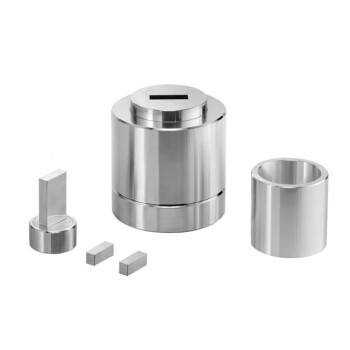
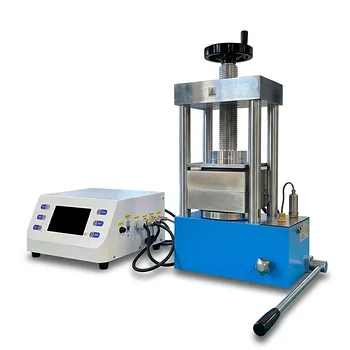
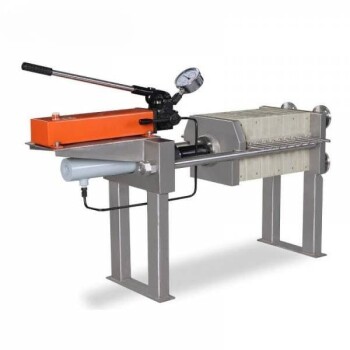
The primary function of a laboratory hydraulic press is to apply high-pressure uniaxial force to loose LAGP (Lithium Aluminum Germanium Phosphate) microcrystalline powder, consolidating it into a solid, compact disc known as a "green pellet." This mechanical molding process is the critical first step in defining the geometric shape and establishing the initial density required for the material to survive and perform during high-temperature sintering.
The press does more than shape the powder; it forces particles into intimate contact to minimize void space. This "green density" is the determining factor for the final ceramic’s mechanical strength and ionic conductivity.
The Mechanics of Pellet Formation
Consolidating Loose Powder
The hydraulic press converts loose, mixed LAGP powder into a cohesive solid. By applying significant force—often as high as 250 MPa—the equipment overcomes the friction between particles to pack them tightly together.
Establishing "Green" Density
The term "green density" refers to the density of the pellet immediately after pressing but before firing. The hydraulic press must compact the material sufficiently to eliminate large inter-particle gaps. This pre-densification is a prerequisite for the subsequent sintering process to successfully yield a high-density ceramic.
Ensuring Geometric Precision
For electrochemical testing, the geometry of the electrolyte must be controlled. The press, used with a precision mold, ensures the pellet has a consistent thickness and diameter. This geometric uniformity is vital for calculating conductivity accurately later in the process.
Impact on Electrochemical Performance
Reducing Grain Boundary Resistance
The application of high pressure establishes superior physical contact between LAGP particles. By minimizing internal porosity at this stage, you lower the grain boundary resistance in the final sintered material, which is essential for measuring high ionic conductivity.
Enhancing Interface Quality
A hydraulic press creates flat, smooth surfaces on the pellet. When you eventually apply electrodes (such as platinum paste) or assemble the cell, this flatness ensures tight physical contact at the interface. Poor contact caused by uneven pressing leads to high interfacial resistance, which skews electrochemical test data.
Understanding the Trade-offs: Uniaxial vs. Isostatic
The Limitation of Uniaxial Pressure
Standard laboratory hydraulic presses typically apply force from a single direction (uniaxial). While effective for simple disc shapes, this can sometimes lead to density gradients, where the edges of the pellet are denser than the center.
Isostatic Pressing as an Alternative
As noted in advanced processing, isostatic pressing applies pressure uniformly from all directions. While a hydraulic press is sufficient for many standard LAGP preparations, isostatic pressing generally offers superior density uniformity and fewer internal defects, which may be necessary for high-stakes performance benchmarks.
Making the Right Choice for Your Goal
To maximize the utility of your laboratory hydraulic press for LAGP preparation, consider the following:
- If your primary focus is maximizing ionic conductivity: Ensure your press can safely reach higher pressures (e.g., 250 MPa) to minimize porosity and reduce grain boundary resistance.
- If your primary focus is data reproducibility: Maintain strict consistency in the pressure applied and the duration of the hold time to ensure every pellet has identical "green" characteristics.
- If your primary focus is reducing interfacial resistance: Verify that your die set and press alignment are perfectly perpendicular to produce pellets with high surface flatness for optimal electrode contact.
Consistency in the pressing stage is the silent variable that determines the reliability of your final electrochemical data.
Summary Table:
| Feature | Function in LAGP Preparation | Impact on Performance |
|---|---|---|
| Powder Consolidation | Converts loose powder into solid "green" pellets | Provides mechanical integrity for sintering |
| Uniaxial Force | Applies high pressure (up to 250 MPa) | Eliminates voids and minimizes porosity |
| Geometric Precision | Defines consistent thickness and diameter | Ensures accurate conductivity calculations |
| Surface Flattening | Creates smooth pellet interfaces | Reduces interfacial resistance with electrodes |
Precision Compaction for Superior Battery Research
At KINTEK, we understand that reliable electrochemical data starts with perfect sample preparation. Whether you are developing next-generation solid-state electrolytes like LAGP or conducting advanced materials research, our high-performance laboratory hydraulic presses (pellet, hot, and isostatic) provide the uniform pressure and precision your lab requires.
Beyond pressing, KINTEK offers a full ecosystem of tools for your workflow, including:
- High-Temperature Muffle and Tube Furnaces for expert sintering.
- Crushing and Milling Systems for uniform powder preparation.
- Battery Research Tools and specialized consumables like crucibles and PTFE products.
Elevate your material density and ionic conductivity today. Contact our specialists to find the ideal pressing solution for your lab!
Related Products
- Automatic Laboratory Hydraulic Pellet Press Machine for Lab Use
- Laboratory Hydraulic Press Split Electric Lab Pellet Press
- Laboratory Manual Hydraulic Pellet Press for Lab Use
- Laboratory Manual Hydraulic Pellet Press for Lab Use
- Laboratory Hydraulic Press Lab Pellet Press Machine for Glove Box
People Also Ask
- What is the role of a laboratory hydraulic pellet press and stainless steel molds in the fabrication of RuO2/NbC anodes?
- What role does a laboratory pellet press play in the enhancement of biomass energy products? Optimize Fuel Efficiency
- What is the purpose of using a laboratory pellet press when evaluating the electronic conductivity of carbon powders? Guide
- How does a laboratory hydraulic pellet press contribute to SiCw/2024 aluminum composite preforms? Optimize Densification
- What is the significance of applying 200 MPa of pressure with a laboratory hydraulic pellet press for composite ceramics?