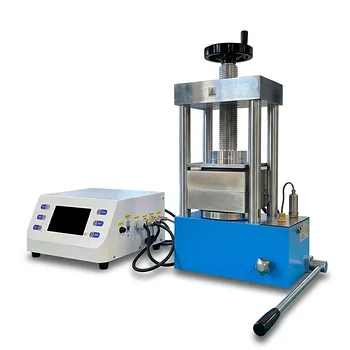
The primary function of a laboratory hydraulic press in LAGP preparation is to consolidate loose powder into a dense, solid form known as a "green pellet."
By applying high pressure—typically around 250 MPa—to a mixture of Lithium Aluminum Germanium Phosphate (LAGP) powder and binders, the press eliminates air gaps between particles. This compaction is the prerequisite step that defines the substrate's shape and structural integrity before the final high-temperature sintering process.
Core Insight: The hydraulic press does not just shape the material; it dictates the final quality of the electrolyte. Without sufficient initial compression (green density), the subsequent sintering process cannot effectively fuse the particles, leading to a porous, mechanically weak substrate with poor ionic conductivity.
The Mechanics of Densification
Compacting the Green Pellet
The immediate goal of the hydraulic press is to create a "green" body. This term refers to the compacted ceramic object before it has been fired (sintered).
The press applies uniaxial force to the LAGP powder mixed with binders. This transforms a loose, difficult-to-handle powder into a cohesive solid that can withstand handling and transfer to a furnace.
Eliminating Inter-Particle Gaps
To achieve a high-quality electrolyte, the microscopic spaces between powder particles must be minimized.
The hydraulic press utilizes high pressures, such as 250 MPa, to mechanically force particles closer together. This reduction in void volume is critical because any remaining gaps effectively become defects in the final product.
Why Pressure Matters for LAGP Performance
Enabling Ionic Conductivity
The ultimate goal of an LAGP substrate is to conduct lithium ions. Ions require a continuous physical path to travel through the material.
By compressing the mixture into a dense green pellet, the press establishes the initial particle-to-particle contact. This densification ensures that during sintering, the material fuses into a solid structure with continuous ion-conducting channels, rather than a porous structure that blocks ion movement.
Ensuring Mechanical Strength
Solid-state electrolytes must be robust enough to withstand assembly into battery cells.
The pressure applied by the hydraulic press ensures the green pellet has high density. This directly translates to the mechanical strength of the final ceramic after sintering, preventing the substrate from cracking or crumbling during operation.
Understanding the Trade-offs
Uniaxial vs. Isostatic Pressure
While a standard hydraulic press applies force from one direction (uniaxial), this can sometimes lead to uneven density within the pellet.
The primary reference highlights uniaxial pressing, but supplementary data suggests that isostatic pressing (applying pressure from all sides) can improve uniformity. If your hydraulic press yields pellets that warp during sintering, the lack of uniform pressure distribution may be the cause.
Green Density vs. Sintering Success
There is a limit to how much pressure is beneficial. The goal is to reach a specific "green density."
If the pressure is too low, the particles remain too far apart to sinter effectively. However, the press creates the potential for density; the final properties are locked in during the 850°C sintering phase. The press and the furnace must work in tandem.
Making the Right Choice for Your Goal
Depending on your specific research requirements, you should approach the pressing stage differently:
- If your primary focus is Standardizing Samples: Ensure your hydraulic press can consistently maintain 250 MPa to minimize variability between different batches of LAGP substrates.
- If your primary focus is Maximizing Ionic Conductivity: Focus on the uniformity of the pellet; consider if your hydraulic press allows for a "hold" time at peak pressure to maximize particle rearrangement and reduce pore volume.
Summary: The laboratory hydraulic press is the critical shaping tool that establishes the potential density, strength, and conductivity of the final LAGP electrolyte.
Summary Table:
| Feature | Function in LAGP Preparation | Impact on Final Electrolyte |
|---|---|---|
| Pressure Application | Consolidates powder at ~250 MPa | Eliminates air gaps & establishes particle contact |
| Green Body Formation | Shapes loose powder into a cohesive pellet | Defines structural integrity & handling durability |
| Densification | Increases initial "green density" | Enables effective sintering & continuous ion channels |
| Mechanical Force | Uniaxial or Isostatic compression | Determines final ceramic strength & crack resistance |
Elevate Your Battery Research with KINTEK Precision
Achieving the perfect green density is the first step toward high-performance solid-state electrolytes. KINTEK specializes in advanced laboratory equipment designed for rigorous material science, offering a comprehensive range of hydraulic presses (pellet, hot, and isostatic) to ensure your LAGP substrates meet the highest standards of ionic conductivity.
Beyond compaction, our portfolio supports your entire workflow with:
- High-Temperature Muffle & Tube Furnaces for precise sintering.
- Crushing & Milling Systems for optimal powder preparation.
- High-Pressure Reactors & Electrolytic Cells for comprehensive battery testing.
Don't let poor compaction compromise your results. Contact KINTEK today to find the perfect pressing solution for your lab and ensure the mechanical and electrochemical success of your research.
Related Products
- Automatic Laboratory Hydraulic Press for XRF & KBR Pellet Press
- Laboratory Hydraulic Pellet Press for XRF KBR FTIR Lab Applications
- Automatic Laboratory Hydraulic Pellet Press Machine for Lab Use
- Laboratory Hydraulic Press Split Electric Lab Pellet Press
- Laboratory Manual Hydraulic Pellet Press for Lab Use
People Also Ask
- What is the significance of applying 200 MPa of pressure with a laboratory hydraulic pellet press for composite ceramics?
- What is the role of a laboratory hydraulic pellet press and stainless steel molds in the fabrication of RuO2/NbC anodes?
- What is the necessity of using a laboratory hydraulic pellet press in the preparation of biomass fuel pellets? Guide
- How does a laboratory hydraulic pellet press contribute to SiCw/2024 aluminum composite preforms? Optimize Densification
- What role does a laboratory hydraulic pellet press play in fly ash utilization? Enhancing Adsorption and Flow Control