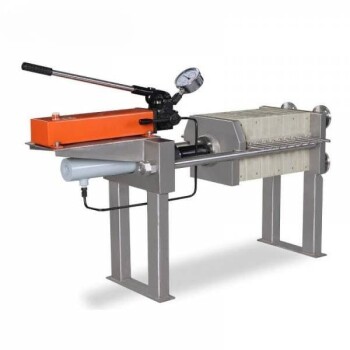
The primary function of a laboratory hydraulic press in the preparation of SnP2O7 (tin pyrophosphate) electrolytes is to mechanically compress loose powder into dense, solid pellets. By applying high pressure, the machine compacts the particles to achieve a specific thickness and sufficient mechanical strength, transforming a difficult-to-handle powder into a testable physical form.
Core Takeaway While creating high-density sintered bodies is often preferred for electrolytes, it is technically challenging with SnP2O7 during early research stages. Therefore, the hydraulic press is the critical enabler that forces sufficient particle packing to allow for the accurate measurement of intrinsic proton conductivity without full sintering.
The Mechanics of Sample Preparation
Achieving High-Density Packing
The hydraulic press applies uniaxial force to eliminate the voids typically found in loose powder.
For SnP2O7-based electrolytes, high pressure is required to force particles into a "densely packed" state. This physical proximity is not merely for shape; it is structurally necessary to create a cohesive unit that holds together during handling.
Establishing Defined Geometry
Experimental consistency requires samples to have precise dimensions.
The press allows researchers to control the exact thickness and diameter of the electrolyte pellet. A uniform thickness is vital for calculating conductivity metrics accurately, as the distance protons must travel directly influences the resistance measured during testing.
The Role in Electrochemical Evaluation
Enabling Proton Conductivity Measurement
The ultimate goal of preparing SnP2O7 samples is to measure their intrinsic proton conductivity.
Loose powders cannot facilitate the continuous transport of protons required for these measurements. The hydraulic press forces particles into intimate contact, creating the continuous pathways necessary for protons to migrate through the material.
Overcoming Synthesis Limitations
A unique aspect of SnP2O7 research is the difficulty in synthesizing high-density sintered bodies using heat alone.
Because thermal densification is technically challenging for this material, the mechanical densification provided by the press becomes the primary method for creating a usable solid electrolyte. It bridges the gap between raw synthesis and electrochemical characterization.
Understanding the Trade-offs
Mechanical Density vs. Sintered Density
While the hydraulic press significantly increases density, a pressed pellet is fundamentally different from a fully sintered ceramic.
Pressed pellets rely on mechanical interlocking and friction between particles. They may lack the grain boundary fusion seen in high-temperature sintering, which can lead to lower overall mechanical strength compared to fully processed ceramics.
Pressure Distribution Gradients
Applying uniaxial pressure can sometimes lead to uneven density within the pellet.
The edges of the pellet may be denser than the center (or vice versa) due to friction against the die walls. This inhomogeneity can create variances in conductivity measurements across different sections of the same sample.
Making the Right Choice for Your Goal
To maximize the effectiveness of your hydraulic press in SnP2O7 research, consider your specific analytical objectives:
- If your primary focus is Intrinsic Conductivity: Ensure you apply the maximum safe pressure for your die set to minimize inter-particle voids, as air gaps will artificially lower your conductivity readings.
- If your primary focus is Reproducibility: Standardize the "hold time" (how long pressure is applied) and the exact mass of powder used for every sample to ensure consistent pellet thickness and density.
The hydraulic press is not just a shaping tool; it is the prerequisite instrument that makes the electrochemical characterization of SnP2O7 physically possible.
Summary Table:
| Feature | Role in SnP2O7 Preparation | Impact on Research |
|---|---|---|
| Particle Packing | Eliminates voids in loose powder | Ensures mechanical strength for handling |
| Geometry Control | Defines precise thickness and diameter | Critical for accurate resistance & conductivity calculation |
| Path Creation | Forces particles into intimate contact | Establishes pathways for proton migration |
| Mechanical Sintering | Bridges the gap where heat sintering fails | Enables characterization of difficult-to-sinter materials |
Elevate Your Material Research with KINTEK Precision
Consistency is key when measuring the intrinsic conductivity of SnP2O7-based electrolytes. KINTEK specializes in high-performance laboratory equipment, offering a robust range of hydraulic presses (pellet, hot, isostatic) designed to provide the uniform pressure distribution your research demands.
Beyond sample preparation, our comprehensive portfolio includes:
- High-temperature furnaces for advanced material synthesis.
- Crushing and milling systems to achieve optimal powder particle sizes.
- Electrolytic cells and battery research tools for precise electrochemical evaluation.
Whether you need reliable pelletizing solutions or specialized consumables like PTFE products and crucibles, KINTEK is your partner in laboratory excellence. Contact us today to optimize your sample preparation workflow!
References
- Yongcheng Jin, Takashi Hibino. Development and Application of SnP<sub>2</sub>O<sub>7</sub>-based Proton Conductors to Intermediate-temperature Fuel Cells. DOI: 10.1627/jpi.53.12
This article is also based on technical information from Kintek Solution Knowledge Base .
Related Products
- Laboratory Hydraulic Press Lab Pellet Press Machine for Glove Box
- Laboratory Hydraulic Press Split Electric Lab Pellet Press
- Automatic Laboratory Hydraulic Press for XRF & KBR Pellet Press
- Laboratory Hydraulic Press Lab Pellet Press for Button Battery
- Automatic Laboratory Hydraulic Pellet Press Machine for Lab Use
People Also Ask
- What is the function of a laboratory hydraulic press in W-Cu composites? Control Porosity and Material Ratio
- What is the role of a laboratory hydraulic press in the initial stages of Li6PS5Cl preparation? Key to Green Pellets
- What role does a laboratory hydraulic press play in triboelectric testing? Achieve Precision Alloy Sample Prep
- How can a laboratory hydraulic press be applied to chitosan for wastewater treatment? Optimize Pores & Strength
- How do a precision laboratory hydraulic press and specialized molds contribute to the fabrication of spherical ceramic samples? Achieving High-Density Material Precision