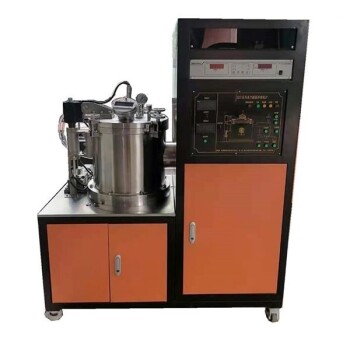
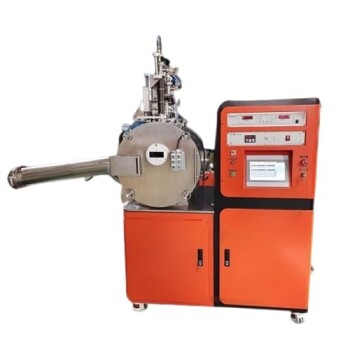
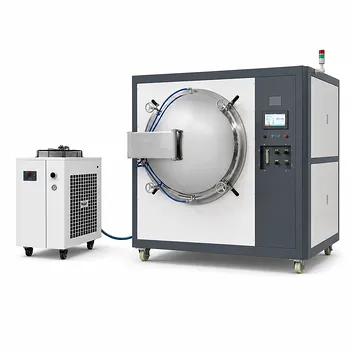
The medium-frequency induction vacuum melting furnace functions as a critical purification and alloying tool in the preparation of vanadium-containing S30403 stainless steel. By utilizing electromagnetic induction within a sealed vacuum environment, it melts the metal while isolating it from atmospheric contaminants. Its primary role is to prevent the oxidation of the molten steel, allowing for the precise retention of trace elements like vanadium and ensuring the chemical purity required for subsequent high-temperature testing.
The core value of this furnace lies in environmental isolation: it eliminates the variable of atmospheric reaction, ensuring that reactive alloying elements like vanadium remain in the steel rather than reacting with oxygen or nitrogen to form impurities.
The Mechanisms of Purity and Control
Eliminating Atmospheric Contamination
The most distinct function of this furnace is the creation of a vacuum environment during the melting process. This effectively isolates the molten steel, preventing it from coming into contact with oxygen and nitrogen present in the ambient air.
For S30403 stainless steel, this isolation is vital to prevent the formation of oxides and nitrides that would otherwise degrade the material's properties.
Precision Control of Vanadium
Vanadium is a reactive element used as a trace alloy in this specific preparation of S30403. Without a vacuum, vanadium can easily oxidize, altering the final chemical composition and reducing the effectiveness of the alloy.
The furnace allows metallurgists to add vanadium with high recovery rates, ensuring the final composition matches the strict theoretical calculations required for the alloy.
Homogenization via Electromagnetic Induction
The furnace utilizes medium-frequency induction to generate heat through eddy currents within the metal. Beyond heating, these magnetic forces create a natural stirring action within the molten bath.
This "electromagnetic stirring" ensures that the vanadium and other alloying elements are thoroughly mixed and homogeneously distributed throughout the S30403 matrix.
Reduction of Inclusions
A critical function of this process is the removal of gases and non-metallic inclusions. The vacuum conditions facilitate the degassing of the molten metal, pulling out volatile impurities.
This results in a significantly cleaner microstructure, which is a prerequisite for accurate high-temperature oxidation experiments.
Understanding the Trade-offs
Volatility Management
While the vacuum is excellent for removing harmful gases like nitrogen and oxygen, it can also lead to the evaporation of desirable elements if they have high vapor pressures.
Operators must carefully control the pressure and temperature to balance degassing (removing impurities) with retention (keeping the alloy stable).
Batch Processing Limitations
Vacuum induction melting is inherently a batch process, distinct from continuous casting methods used in lower-grade steel production.
This ensures extreme quality control but limits the production volume per cycle. It requires strict adherence to vacuum protocols (using mechanical, roots, and diffusion pumps) to maintain the integrity of the melt.
Making the Right Choice for Your Goal
When employing a medium-frequency induction vacuum melting furnace for S30403 preparation, consider your specific end-goals:
- If your primary focus is Compositional Accuracy: Prioritize the vacuum level to prevent vanadium loss, as this ensures the alloy matches your precise chemical specifications.
- If your primary focus is Material Cleanliness: Focus on the refining stage to maximize the removal of non-metallic inclusions, which is essential for validating high-temperature performance.
By isolating the melt from the atmosphere, this furnace transforms standard raw materials into high-purity, scientifically accurate test specimens.
Summary Table:
| Feature | Function in S30403 Preparation | Benefit to Material Properties |
|---|---|---|
| Vacuum Environment | Eliminates oxygen and nitrogen contact | Prevents oxidation and nitride formation |
| Induction Heating | Generates heat via internal eddy currents | Rapid melting with high energy efficiency |
| Electromagnetic Stirring | Homogenizes molten vanadium and alloys | Uniform chemical distribution and microstructure |
| Degassing | Removes volatile impurities and gases | Reduces non-metallic inclusions for better oxidation resistance |
| Precise Alloying | High recovery rate of reactive trace elements | Accurate retention of vanadium for strict specifications |
Elevate Your Metallurgical Research with KINTEK Precision
Achieving the perfect chemical composition in advanced alloys like S30403 requires equipment that offers absolute control. KINTEK specializes in high-performance laboratory solutions designed for the most demanding material science applications.
Whether you need advanced medium-frequency induction melting furnaces, high-temperature vacuum furnaces, or precision crushing and milling systems, our technology ensures your research is backed by purity and consistency. From high-pressure reactors to specialized crucibles and ceramics, we provide the end-to-end tools necessary for superior material synthesis.
Ready to optimize your alloying process? Contact KINTEK today to discover how our expert solutions can enhance your laboratory's capabilities.
References
- Yaoyao Fiona Zhao, Changrong Li. Effect of V content on high temperature oxidation resistance of S30403 austenitic stainless steel. DOI: 10.1038/s41598-025-17971-6
This article is also based on technical information from Kintek Solution Knowledge Base .
Related Products
- Lab-Scale Vacuum Induction Melting Furnace
- Vacuum Arc Induction Melting Furnace
- Vacuum Heat Treat Furnace and Levitation Induction Melting Furnace
- Vacuum Induction Melting Spinning System Arc Melting Furnace
- 600T Vacuum Induction Hot Press Furnace for Heat Treat and Sintering
People Also Ask
- How do vacuum induction or arc melting furnaces facilitate the synthesis of U-Al-C MAX phases? Precision Heat & Purity
- Why use VIM for rare earth steel? Essential Precision for Melting Reactive Lanthanum and Cerium
- What types of metals are typically processed in a vacuum induction melting furnace? High-Purity Alloys for Critical Applications
- What is the primary function of a vacuum induction melting furnace in Ni-Mo-Cr-Fe master alloy prep? Ensure High Purity
- What are the key components inside the vacuum chamber of a vacuum induction melting furnace? A Guide to the Core Melting Assembly