Adjusting holding time and pressure duration serves as the primary mechanism for controlling the microstructural evolution of the alloy. Specifically, extending these parameters allows for deeper atomic diffusion, directly governing the extent of chemical reactions between the scandium particles and the aluminum matrix.
By manipulating the duration of heat and pressure, you directly regulate how far scandium atoms travel within the matrix. This control over diffusion distances is the key to determining the final phase composition, specifically balancing the ratio of Al3Sc to Al2Sc.
The Mechanics of Atomic Diffusion
Extending the Diffusion Path
The fundamental function of increasing holding time—for example, extending the process from 1 hour to 3 hours—is to provide a longer window for atomic movement.
This extension allows for direct control over atomic diffusion distances.
Mobilizing the Core
In the preparation of Al-30%Sc, the reaction relies on scandium moving out from the particle core.
Longer pressure and holding durations permit these scandium atoms to diffuse more thoroughly from the core into the surrounding matrix.
Regulating Phase Composition
Controlling the Reaction Extent
The duration of the sintering process dictates how far the chemical reaction proceeds.
By adjusting the time, you are not merely consolidating the material, but actively tuning the chemical reaction that transforms the raw components into the final alloy phases.
Shifting the Al3Sc to Al2Sc Ratio
The most critical outcome of this adjustment is the precise regulation of the specific alloy phases formed.
Extended holding times drive the conversion process, resulting in a reduction of Al3Sc phases and a corresponding increase in Al2Sc phases.
Understanding the Trade-offs
Phase Balance vs. Process Duration
The primary trade-off in this process is the balance between the two distinct phases.
You cannot maximize both Al3Sc and Al2Sc simultaneously; favoring one requires adjusting the time at the expense of the other.
The Risk of Incomplete Diffusion
Shortening the holding time preserves the Al3Sc phase but risks incomplete reaction between the core and matrix.
Conversely, extending the time ensures thorough diffusion but significantly alters the material's phase identity toward Al2Sc.
Making the Right Choice for Your Goal
The "correct" duration depends entirely on which phase is required for your specific application.
- If your primary focus is preserving Al3Sc phases: Utilize shorter holding times to limit diffusion distances and arrest the chemical reaction before full conversion occurs.
- If your primary focus is maximizing Al2Sc content: Extend the holding and pressure duration (e.g., to 3 hours) to enable thorough diffusion of scandium atoms from the particle core.
By treating time as a variable for chemical engineering rather than just a processing step, you gain precise control over the alloy's final microstructure.
Summary Table:
| Parameter Adjustment | Atomic Diffusion Effect | Primary Phase Outcome | Microstructural Impact |
|---|---|---|---|
| Short Holding Time | Limited diffusion distance | Higher Al3Sc concentration | Preserves initial reaction phases |
| Extended Holding Time | Deep/thorough diffusion | Increased Al2Sc formation | Ensures full scandium mobilization |
| Increased Pressure Duration | Enhanced particle contact | Accelerated chemical reaction | Improved matrix consolidation |
Elevate Your Material Research with KINTEK Precision
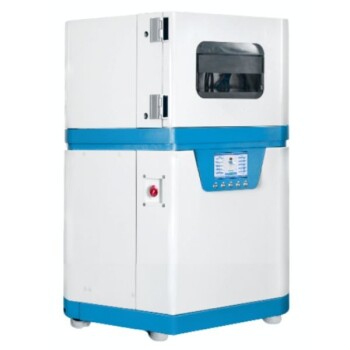
Achieving the perfect Al3Sc to Al2Sc ratio requires more than just timing—it requires the superior thermal stability and pressure precision of a professional vacuum hot pressing sintering machine.
At KINTEK, we specialize in providing high-performance laboratory equipment, including advanced hot presses, muffle furnaces, and vacuum sintering systems, designed to give researchers total control over atomic diffusion and phase evolution. Whether you are developing aerospace-grade Al-Sc alloys or exploring advanced ceramics, our team offers the technical expertise and robust hardware—from crucibles and high-temperature reactors to hydraulic pellet presses—to ensure repeatable, high-quality results.
Ready to optimize your sintering process? Contact our laboratory specialists today to find the ideal solution for your high-temperature, high-pressure research needs!
Related Products
- Vacuum Heat Treat and Pressure Sintering Furnace for High Temperature Applications
- 600T Vacuum Induction Hot Press Furnace for Heat Treat and Sintering
- Vacuum Heat Treat and Sintering Furnace with 9MPa Air Pressure
- Vacuum Hot Press Furnace Machine Heated Vacuum Press
- Vacuum Hot Press Furnace Machine for Lamination and Heating
People Also Ask
- What is the purpose of the heat treatment (sintering) step? Engineering Robust Electroactive Membranes
- What is a vacuum sintering furnace? Unlock Purity and Performance in Advanced Materials
- How does the vacuum environment impact sintering of diamond-copper composites? Protect Against Thermal Damage
- Why must green bodies produced via binder jetting undergo treatment in a vacuum sintering furnace?
- What are some alternative atmospheres to pure hydrogen for powder metallurgy sintering processes? Top Sintering Solutions