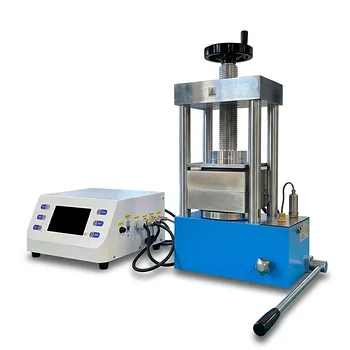
The primary function of an industrial hydraulic press using steel dies is to apply massive mechanical pressure to loose CrFeCuMnNi powder, transforming it into a cohesive, high-density solid. By exerting pressures as high as 550 MPa, the press forces the physical rearrangement of particles to eliminate internal voids and establish the compact's initial geometry.
The press serves a dual purpose: it shapes the material and, when combined with heat, acts as a densification engine. This process overcomes the particles' natural elastic resistance to induce plastic flow, creating the mechanical interlocking necessary for high green strength.
The Mechanics of Densification
Forcing Particle Rearrangement
The immediate role of the hydraulic press is to act against the friction and spacing between loose powder particles.
By applying high pressure through the steel dies, the machine forces the powder grains to slide past one another. This reorganization is the first step in minimizing the volume of the material and establishing a uniform shape.
Filling Internal Pores
As the particles rearrange, the open spaces (pores) between them are systematically closed.
The press compresses the material to fill these internal voids, significantly increasing the packing density. This reduction in porosity is critical for the structural integrity of the final component.
The Role of Hot Compaction
Overcoming Elastic Resistance
For CrFeCuMnNi alloys, pressure alone is often insufficient to achieve maximum density due to the material's elasticity.
The industrial press acts in conjunction with a heating system to perform hot compaction. This combination lowers the yield strength of the powder, allowing the applied pressure to overcome the elastic resistance that would otherwise cause the particles to spring back.
Inducing Plastic Flow
Once elastic resistance is neutralized, the continuous pressure drives plastic flow.
The powder particles deform permanently rather than elastically. This deformation allows the particles to mold into one another, maximizing the contact area and density beyond what cold pressing could achieve.
Creating Mechanical Interlocking
The result of this plastic flow is a phenomenon known as mechanical interlocking.
Particles physically key into one another, binding the compact together. This mechanism is primarily responsible for the substantial increase in green strength, ensuring the compact can be handled or processed further without crumbling.
Understanding the Trade-offs
Tooling Durability vs. Pressure
While high pressure (e.g., 550 MPa) is essential for density, it places immense stress on the tooling.
Steel dies must be engineered to withstand these forces without deforming. If the pressure exceeds the die's limits, it can lead to tooling failure or dimensional inaccuracies in the green compact.
Thermal Complexity
Introducing heat to the compaction process improves density but adds process variables.
Operating a press with a heating system requires precise thermal control. Inconsistent heating can lead to uneven plastic flow, resulting in distinct density gradients within the single compact.
Making the Right Choice for Your Goal
To maximize the effectiveness of the hydraulic press in your manufacturing workflow, consider your specific material requirements:
- If your primary focus is maximum density: Prioritize the hot compaction capability to ensure plastic flow and minimize internal porosity.
- If your primary focus is geometric precision: Ensure your steel dies are rated significantly above the 550 MPa operating pressure to prevent deflection during the cycle.
- If your primary focus is handling strength: Rely on the combination of heat and pressure to achieve mechanical interlocking, which prevents the green compact from breaking during ejection and transport.
High-pressure compaction is not just about shaping; it is the fundamental step that defines the microstructural potential of your final alloy.
Summary Table:
| Process Feature | Functional Impact | Technical Goal |
|---|---|---|
| High Pressure (550 MPa) | Forces particle rearrangement | Elimination of internal voids |
| Steel Die Tooling | Provides structural containment | Precise geometric shaping |
| Hot Compaction | Lowers yield strength | Overcoming elastic resistance |
| Plastic Flow | Permanent particle deformation | Maximum packing density |
| Mechanical Interlocking | Physical binding of grains | High green strength for handling |
Elevate Your Material Research with KINTEK Precision
Maximize the structural integrity of your alloys with KINTEK’s industry-leading hydraulic presses and precision-engineered steel dies. Whether you are working on CrFeCuMnNi green compacts or advanced battery research, our equipment delivers the consistent 550 MPa+ pressure and thermal control required for superior densification and mechanical interlocking.
Why choose KINTEK?
- Comprehensive Range: From manual pellet presses to advanced isostatic and hot presses.
- High-Temperature Expertise: Specialized muffle, tube, and vacuum furnaces to complement your compaction workflow.
- Durability & Precision: Tooling designed to withstand extreme stresses without dimensional deflection.
Ready to achieve maximum density and geometric precision in your lab? Contact our technical experts today to find the perfect crushing, milling, or pressing solution for your specific application.
References
- S. Sivasankaran, Abdel-baset H. Mekky. Influence of Oxide Dispersions (Al2O3, TiO2, and Y2O3) in CrFeCuMnNi High-Entropy Alloy on Microstructural Changes and Corrosion Resistance. DOI: 10.3390/cryst13040605
This article is also based on technical information from Kintek Solution Knowledge Base .
Related Products
- Automatic Laboratory Hydraulic Press for XRF & KBR Pellet Press
- Laboratory Hydraulic Pellet Press for XRF KBR FTIR Lab Applications
- Manual Lab Heat Press
- Laboratory Manual Hydraulic Pellet Press for Lab Use
- kbr pellet press 2t
People Also Ask
- What is the significance of applying 200 MPa of pressure with a laboratory hydraulic pellet press for composite ceramics?
- What is the role of a laboratory hydraulic pellet press and stainless steel molds in the fabrication of RuO2/NbC anodes?
- What is the necessity of using a laboratory hydraulic pellet press in the preparation of biomass fuel pellets? Guide
- How does a laboratory hydraulic pellet press contribute to SiCw/2024 aluminum composite preforms? Optimize Densification
- What role does a laboratory hydraulic pellet press play in fly ash utilization? Enhancing Adsorption and Flow Control