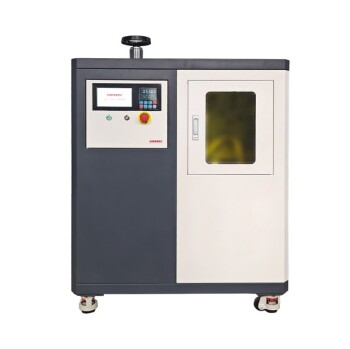
The columns in a hot press serve as the fundamental structural skeleton of the machine. Their primary engineering function is to support the overall framework and, crucially, to absorb diagonal stresses to ensure the heating platens remain perfectly rigid and aligned during the pressing cycle.
The integrity of the final wood product relies entirely on the stiffness of these columns. If the columns flex even slightly, pressure distribution becomes uneven, directly compromising the quality of the bond and the structure of the material.
The Engineering Role of Press Columns
Supporting the Framework
The most visible function of the columns is supporting the physical structure of the press. They carry the weight of the machine's components, including the heavy platens and hydraulic mechanisms.
Absorbing Diagonal Stress
Beyond simple weight-bearing, columns must manage dynamic forces. During operation, the press generates significant diagonal stresses. The columns must be sufficiently robust to absorb these forces without twisting or bending.
Preventing Platen Deflection
The ultimate goal of the column design is to prevent deflection of the platens. The platens must remain perfectly flat and parallel to apply force correctly. The columns provide the rigid boundary conditions necessary to keep the platens stable under high pressure.
Consequences of Column Deflection
Uneven Pressure Distribution
If the columns lack the necessary strength and deflection occurs, the platens will no longer apply force uniformly. This results in a pressure gradient across the wood assembly, where some areas receive too much force and others too little.
Formation of Poor Bonds
In areas where the pressure is insufficient due to deflection, the adhesive may not penetrate or cure correctly. This leads to the formation of a poor bond, creating weak spots within the panel that may fail under stress or over time.
Crushing of Wood Fibers
Conversely, deflection can cause localized high-pressure zones. In these areas, the force may exceed the material's compressive strength, resulting in the crushing of wood fibers. This permanently damages the wood structure and alters the panel's density and thickness.
Common Pitfalls in Press Operation
The Illusion of Functionality
A major pitfall is assuming that because the press is operating, it is operating correctly. Column deflection can be subtle visually but disastrous for quality.
Overlooking Structural Rigidity
Operators often focus on hydraulic pressure settings while overlooking the machine's structural limits. If the requested pressure exceeds the column's ability to remain rigid, the pressure gauge may read correctly, but the actual force applied to the product will be inconsistent.
Ensuring Manufacturing Quality
To maintain product standards, you must view the press columns not just as legs, but as critical calibration components.
- If your primary focus is Bonding Strength: Ensure the columns are rated for the maximum pressures used, as deflection creates low-pressure zones that cause delamination.
- If your primary focus is Surface Consistency: Monitor for deflection to prevent high-pressure zones that crush fibers and create uneven thicknesses.
Rigid columns are the only guarantee that the pressure on the gauge matches the pressure on the wood.
Summary Table:
| Component/Issue | Function/Impact | Consequence of Failure |
|---|---|---|
| Structural Columns | Support framework & absorb diagonal stress | Machine misalignment and structural instability |
| Platen Alignment | Maintain perfect parallelism during cycles | Uneven pressure distribution across the material |
| Deflection Prevention | Ensure uniform force application | Formation of weak bonds or delamination |
| Pressure Consistency | Matches gauge reading to actual force | Crushing of wood fibers in localized high-pressure zones |
Maximize Your Pressing Precision with KINTEK
Don't let structural deflection compromise your manufacturing quality. At KINTEK, we specialize in high-performance laboratory equipment, including advanced hot presses, isostatic presses, and vacuum furnaces designed for absolute rigidity and thermal stability. Whether you are conducting material research or industrial production, our engineering expertise ensures your processes deliver consistent, high-strength results.
Enhance your laboratory's capabilities today:
- Precision Engineering: Robust column designs to eliminate diagonal stress.
- Comprehensive Solutions: From hydraulic presses to high-temperature reactors and cooling solutions.
- Expert Support: Tailored advice for your specific bonding and pressing needs.
Contact KINTEK Experts Now to find the perfect equipment for your application!
Related Products
- Automatic High Temperature Heated Hydraulic Press Machine with Heated Plates for Lab
- Automatic Heated Hydraulic Press Machine with Heated Plates for Laboratory Hot Press
- Heated Hydraulic Press Machine with Heated Plates for Vacuum Box Laboratory Hot Press
- Automatic Heated Hydraulic Press Machine with Heated Plates for Laboratory Hot Press 25T 30T 50T
- Manual High Temperature Heated Hydraulic Press Machine with Heated Plates for Lab
People Also Ask
- What is a heated hydraulic press used for? Essential Tool for Curing, Molding, and Laminating
- Why is a heated hydraulic press used for warm pressing NASICON green tapes? Optimize Your Solid Electrolyte Density
- Why is a heated laboratory hydraulic press necessary for composite laminates? Achieve Void-Free Structural Integrity
- What is a hot hydraulic press? Harness Heat and Pressure for Advanced Manufacturing
- How is a heated hydraulic press used for Li-LLZO batteries? Optimize Interfacial Bonding with Thermal-Pressure