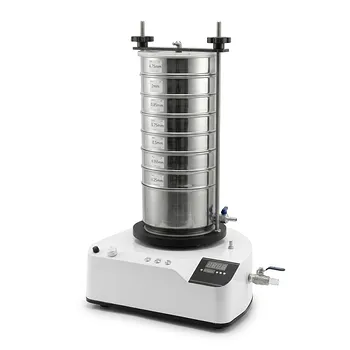
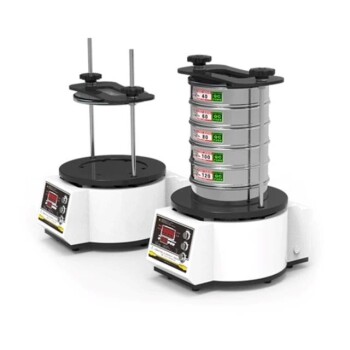
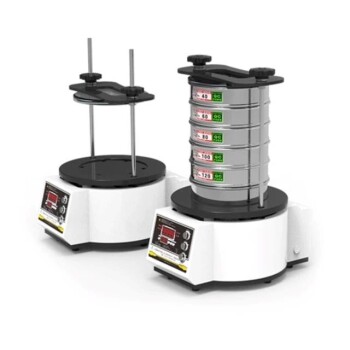
The primary function of laboratory sieving equipment in the pretreatment of chromium composite pellets is to strictly control particle size distribution, ensuring all raw materials are reduced to a fine, uniform state. This process typically targets a particle size below 0.25 mm for key components like chromium concentrate, diatomaceous earth, and special coke. By achieving this degree of fineness, the equipment maximizes the contact surface area between the reducing agent and the ore, which is essential for accelerating chemical reaction kinetics during subsequent sintering and smelting.
Laboratory sieving equipment serves as a critical quality gate that transforms raw feedstocks into a homogenized, high-surface-area medium. This precision ensures that chemical reactions occur rapidly and uniformly, while simultaneously preventing structural weaknesses in the final pellet.
Optimizing Reaction Kinetics through Particle Fineness
Maximizing Contact Surface Area
The primary goal of sieving is to ensure that all charge components, such as chromium concentrate and special coke, reach a fine level. By reducing these materials to a size below 0.25 mm, the equipment exponentially increases the available surface area for chemical interaction.
Accelerating Smelting and Sintering
A higher surface-to-volume ratio allows the reducing agent to interact more efficiently with the ore. This significantly speeds up the physical and chemical reaction kinetics, making the subsequent high-temperature processes more energy-efficient and effective.
Extracting Specific Particle Fractions
In a laboratory environment, sieving is often used to extract precise fractions, such as the -106+75 µm range, to maintain a consistent reaction interface. This level of precision is vital for accurately evaluating reduction kinetics and reducing experimental error during research and development.
Ensuring Structural Integrity and Consistency
Eliminating Coarse Impurities
Sieving acts as a physical filter to remove oversized particles, stones, or organic residues that could compromise the pellet's quality. Removing these coarse elements is critical to prevent the formation of structural cracks during the drying or firing stages.
Improving Mixing Consistency
Uniform particle sizes allow the matrix powder to fill spaces between other components more effectively. This results in a high-quality composite microstructure, ensuring that additives like diatomaceous earth are distributed evenly throughout the pellet.
Preventing Brittle Cracks and Uneven Density
Consistency in particle size ensures that the die holes are filled uniformly during the pelletizing process. This prevents uneven density distribution, which is a leading cause of brittle cracks and physical failure in finished chromium pellets.
Understanding Technical Trade-offs and Limitations
Processing Time vs. Precision
Achieving extreme fineness through multi-stage sieving can be a time-consuming process. While higher precision improves reaction kinetics, it may decrease the overall throughput of the pretreatment phase in a laboratory setting.
Screen Clogging and Material Loss
Very fine meshes, such as 325-mesh screens, are prone to "blinding" or clogging, especially with moist or cohesive materials like clay. Additionally, aggressive sieving can lead to minor material loss, which must be accounted for when calculating mass proportions for specific pellet recipes.
Implementation Strategies for Pellet Pretreatment
How to Apply This to Your Project
To achieve the best results in chromium composite pellet preparation, your sieving strategy should align with your specific metallurgical goals.
- If your primary focus is maximizing chemical reactivity: Use multi-stage precision sieving to ensure 100% of the material passes through a 0.25 mm (60 mesh) screen to maximize surface area.
- If your primary focus is structural strength: Prioritize the removal of all particles larger than 2mm to ensure uniform density and prevent internal stress points that lead to cracking.
- If your primary focus is experimental accuracy: Utilize high-precision woven wire meshes (e.g., 75μm to 200μm) to isolate narrow particle size fractions, ensuring consistent heating and reduction rates.
By treating sieving as a foundational step rather than a secondary task, you ensure the chemical and physical viability of the final chromium composite pellets.
Summary Table:
| Key Function | Primary Benefit | Typical Target Size |
|---|---|---|
| Surface Area Maximization | Accelerates chemical reaction kinetics | < 0.25 mm (60 Mesh) |
| Impurity Removal | Prevents structural cracks and failure | Removal of > 2 mm particles |
| Fraction Isolation | Ensures experimental accuracy and consistency | Narrow ranges (e.g., 75–106 µm) |
| Mixing Optimization | Ensures uniform density and microstructure | Uniform fine powder matrix |
Elevate your metallurgical research with KINTEK’s high-precision laboratory sieving equipment and crushing systems. Designed for the rigorous demands of chromium pellet pretreatment, our tools ensure perfect particle size distribution for optimized reaction kinetics and structural integrity.
Beyond sieving, KINTEK offers a comprehensive suite of laboratory solutions, including crushing and milling systems, hydraulic pellet presses, and high-temperature furnaces (muffle, tube, and vacuum) to streamline your entire production workflow. Contact us today to discover how our reliable equipment and technical expertise can enhance your lab's efficiency and experimental accuracy!
References
- Almagul Ultarakova, Zhadyra Yerzhanova. Physical and Chemical Studies of Smelting Products of Calcinated Composite Pellets Produced from Chromium Production Waste. DOI: 10.3390/jcs7090386
This article is also based on technical information from Kintek Solution Knowledge Base .
Related Products
- Automatic Laboratory Hydraulic Pellet Press Machine for Lab Use
- kbr pellet press 2t
- Laboratory Vibratory Sieve Shaker Machine for Dry and Wet Three-Dimensional Sieving
- Automatic Laboratory Hydraulic Press for XRF & KBR Pellet Press
- Laboratory Test Sieves and Sieving Machines
People Also Ask
- What is the role of a laboratory hydraulic pellet press and stainless steel molds in the fabrication of RuO2/NbC anodes?
- What role does a laboratory pellet press play in the enhancement of biomass energy products? Optimize Fuel Efficiency
- What is the purpose of using a laboratory pellet press when evaluating the electronic conductivity of carbon powders? Guide
- How does a laboratory hydraulic pellet press contribute to SiCw/2024 aluminum composite preforms? Optimize Densification
- What is the significance of applying 200 MPa of pressure with a laboratory hydraulic pellet press for composite ceramics?