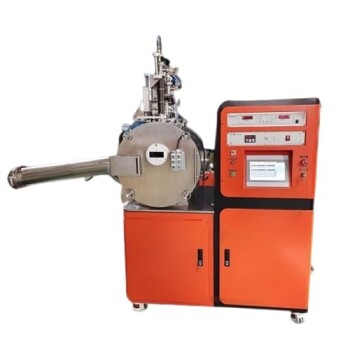
The electric arc vacuum chamber serves as the high-energy reaction vessel for the Idaho Titanium Technologies (ITT) process. Its primary function is to generate an ultra-high temperature plasma environment exceeding 3727°C. At this extreme thermal threshold, the chamber forces the thermal dissociation of titanium tetrachloride, breaking the molecules directly into titanium and chlorine atoms without the need for traditional multi-step chemical reduction.
The chamber functions as a thermal dissociation engine, utilizing extreme plasma heat to convert raw titanium chemicals into ultrafine powder in a single step, radically simplifying the production flow.
The Mechanics of Thermal Dissociation
Generating the Plasma Environment
The core operation of the chamber involves striking an electric arc within a vacuum.
This arc creates a plasma environment where temperatures rise above 3727°C.
Breaking Molecular Bonds
Titanium tetrachloride (TiCl4) is introduced directly into this high-energy state.
The intense thermal energy overcomes the chemical bonds holding the molecule together.
Consequently, the TiCl4 dissociates instantly into its constituent atoms: titanium and chlorine.
Formation of Ultrafine Powder
Once dissociated, the process relies on the chamber's integration with a rapid cooling system.
With the assistance of hydrogen, the free atoms are stabilized and converted.
This results in the production of ultrafine titanium hydride powder, rather than a solid sponge or ingot.
Understanding the Operational Considerations
Energy Intensity
While the process reduces steps, the vacuum chamber requires significant energy to maintain the electric arc.
Sustaining temperatures capable of vaporizing titanium compounds implies a heavy electrical load compared to lower-temperature chemical methods.
System Integration
The chamber does not operate in isolation; its efficacy relies on the immediate downstream cooling.
Precise synchronization between the heating phase and the hydrogen-assisted cooling phase is critical to prevent the atoms from recombining incorrectly.
Implications for Material Production
To determine if the ITT process aligns with your manufacturing goals, consider the specific output of the vacuum chamber.
- If your primary focus is process efficiency: This method bypasses the complex, multi-stage reduction and distillation procedures typical of the Kroll process.
- If your primary focus is material application: The chamber is specifically tuned to produce ultrafine titanium hydride powder, which is ideal for powder metallurgy and additive manufacturing rather than bulk casting.
The electric arc vacuum chamber effectively replaces chemical complexity with thermal intensity to streamline titanium production.
Summary Table:
| Feature | Description |
|---|---|
| Core Function | High-energy thermal dissociation vessel |
| Operating Temperature | Exceeding 3,727°C (Plasma state) |
| Input Material | Titanium Tetrachloride (TiCl4) |
| Primary Output | Ultrafine Titanium Hydride Powder |
| Key Advantage | Single-step production bypassing the Kroll process |
| Mechanism | Electric arc in vacuum breaking molecular bonds |
Elevate Your Advanced Material Research with KINTEK
Transitioning from traditional chemical reduction to high-intensity thermal processes requires precision-engineered equipment. KINTEK specializes in high-performance laboratory solutions, offering a comprehensive range of high-temperature vacuum furnaces (tube, muffle, CVD, and induction melting), high-pressure reactors, and specialized crushing and milling systems essential for processing advanced titanium powders.
Whether you are refining powder metallurgy techniques or advancing additive manufacturing, our team provides the high-temperature tools and battery research consumables needed to achieve superior results. Contact KINTEK today to discover how our high-precision furnaces and cooling solutions can optimize your lab’s thermal processing efficiency.
References
- Nyasha Matsanga, Willie Nheta. An Overview of Thermochemical Reduction Processes for Titanium Production. DOI: 10.3390/min15010017
This article is also based on technical information from Kintek Solution Knowledge Base .
Related Products
- Vacuum Arc Induction Melting Furnace
- Non Consumable Vacuum Arc Induction Melting Furnace
- 56L Vertical Laboratory Vacuum Drying Oven
- Vacuum Induction Melting Spinning System Arc Melting Furnace
- Chemical Vapor Deposition CVD Equipment System Chamber Slide PECVD Tube Furnace with Liquid Gasifier PECVD Machine
People Also Ask
- How do vacuum induction or arc melting furnaces facilitate the synthesis of U-Al-C MAX phases? Precision Heat & Purity
- What core role does a Vacuum Induction Melting furnace play in nickel-free steel production? Achieve High-Purity Alloys
- What is the primary function of a vacuum arc melting furnace in RHEA preparation? Achieving Extreme Thermal Fusion
- What is the function of vacuum arc melting equipment? Creating High-Purity Ferrochrome (CrFe) Alloys
- What is the function of a vacuum arc melting furnace? Master Homogeneity for Amorphous Alloy Ribbons