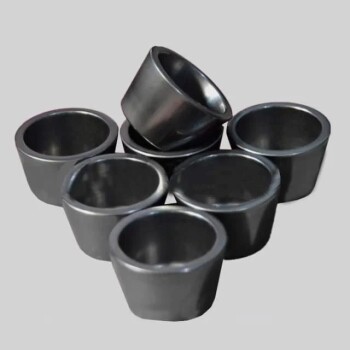
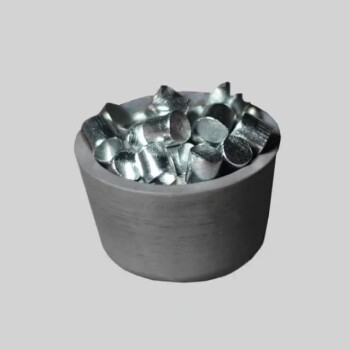
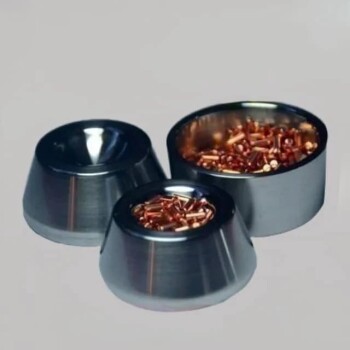
During the Hot Isostatic Pressing (HIP) of Zinc Sulfide (ZnS), the graphite crucible acts as a specialized, high-strength loading container designed to hold and protect the samples. Its primary function is to maintain structural stability and shield the platinum-wrapped ZnS from physical damage while subjected to the process's extreme environmental conditions.
The graphite crucible provides the essential mechanical integrity required to survive temperatures up to 1000°C and pressures of several hundred megapascals, ensuring the sample remains intact during densification.
The Critical Role of Environmental Resistance
The HIP process creates a harsh environment designed to eliminate internal voids and microporosity. The graphite crucible serves as the first line of defense in maintaining a stable processing zone.
Withstanding Extreme Temperatures
The crucible must possess exceptional thermal stability. It is required to endure processing temperatures that can reach up to 1000°C.
At these temperatures, standard containment materials would weaken or degrade. The graphite crucible remains stable, ensuring the thermal environment around the ZnS sample is consistent.
Enduring High Isostatic Pressure
The HIP process involves pressurizing the vessel with inert gas (typically argon) to levels reaching several hundred megapascals.
The crucible must have immense structural strength. It must withstand this crushing force without collapsing or deforming in a way that would damage the sample inside.
Physical Protection of the Sample
Beyond holding the material, the crucible protects the internal sample structure from physical damage.
By acting as a rigid barrier, it prevents the sample from shifting or suffering mechanical trauma caused by the turbulent, high-pressure gas environment within the furnace.
Sample Containment Configuration
The function of the crucible is closely tied to how the sample is prepared prior to insertion.
The Loading Assembly
The ZnS samples are not placed directly against the graphite in a raw state. They are first wrapped in platinum foil.
The Container Hierarchy
This wrapped assembly is then loaded into the graphite crucible. The crucible acts as the external "loading container," securing the foil-wrapped sample within the larger pressure vessel.
Understanding the Operational Constraints
While the graphite crucible is robust, its use is dictated by the specific demands of the HIP process. Understanding these requirements is vital to avoiding process failure.
The Necessity of High-Strength Graphite
Not all graphite is suitable for this application. The process explicitly requires high-strength graphite.
Using a crucible with lower structural integrity can lead to catastrophic failure under the multi-directional (isostatic) pressure, potentially destroying the sample and damaging the HIP furnace.
Thermal Stability is Non-Negotiable
The material must not only be strong but thermally stable. If the crucible reacts or degrades at 1000°C, it compromises the "dry and controlled environment" required for successful diffusion bonding and densification.
Making the Right Choice for Your Goal
To ensure the successful densification of ZnS components, you must verify the specifications of your containment tooling.
- If your primary focus is Sample Safety: Ensure the graphite crucible is rated for high-strength applications to prevent physical damage under hundreds of megapascals of pressure.
- If your primary focus is Process Consistency: Verify the thermal stability of the graphite grade to ensure it maintains integrity up to 1000°C without degradation.
By utilizing a high-strength graphite crucible, you ensure the ZnS samples are securely protected, allowing the isostatic pressure to effectively increase density and mechanical properties.
Summary Table:
| Feature | Specification/Role |
|---|---|
| Primary Function | High-strength loading container and physical shield |
| Temperature Resistance | Up to 1000°C thermal stability |
| Pressure Capability | Several hundred megapascals (MPa) |
| Internal Protection | Prevents sample shifting and mechanical trauma |
| Material Requirement | High-strength, thermally stable graphite grade |
| Sample Interface | Holds platinum-wrapped ZnS samples |
Elevate Your Material Processing with KINTEK
Precision in Hot Isostatic Pressing (HIP) requires more than just high pressure; it demands high-performance containment tooling that survives the toughest environments. KINTEK specializes in providing the structural integrity your research and production require.
Beyond our specialized graphite components, we offer a comprehensive range of laboratory equipment including:
- High-Temperature Furnaces: Muffle, vacuum, and atmosphere furnaces for consistent thermal results.
- Hydraulic Presses: Pellet, hot, and isostatic presses for superior material densification.
- Crucibles & Ceramics: High-purity consumables designed for extreme chemical and thermal resistance.
- Advanced Reactors: High-temperature high-pressure reactors and autoclaves for specialized synthesis.
Ready to optimize your ZnS densification or lab workflow? Contact KINTEK today to discover how our high-strength solutions can enhance your lab's efficiency and sample safety.
Related Products
- High Purity Pure Graphite Crucible for Electron Beam Evaporation
- High Purity Pure Graphite Crucible for Evaporation
- Carbon Graphite Boat -Laboratory Tube Furnace with Cover
- Electron Beam Evaporation Coating Conductive Boron Nitride Crucible BN Crucible
- Graphite Vacuum Furnace Bottom Discharge Graphitization Furnace for Carbon Materials
People Also Ask
- What is the container that holds the metal source material called in e-beam evaporation? Ensure Purity and Quality in Your Thin-Film Deposition
- What role do high-purity graphite crucibles play in molten salt corrosion research? Ensure Reactor-Grade Precision
- Why is a high-purity graphite crucible ideal for nitrogen-doped graphene at 1500 °C? Maximize Purity and Stability
- What dual roles do high-purity graphite crucibles play? Expert Insights into Fluoride Salt Testing
- What role does a high-purity graphite crucible play in CaO-MgO-Al2O3-SiO2 system equilibrium experiments? Maximize Accuracy