Knowledge rotary furnace What is the minimum temperature for pyrolysis? Control Your Output with Precise Temperature Ranges
Author avatar

Tech Team · Kintek Solution

Updated 3 months ago

What is the minimum temperature for pyrolysis? Control Your Output with Precise Temperature Ranges


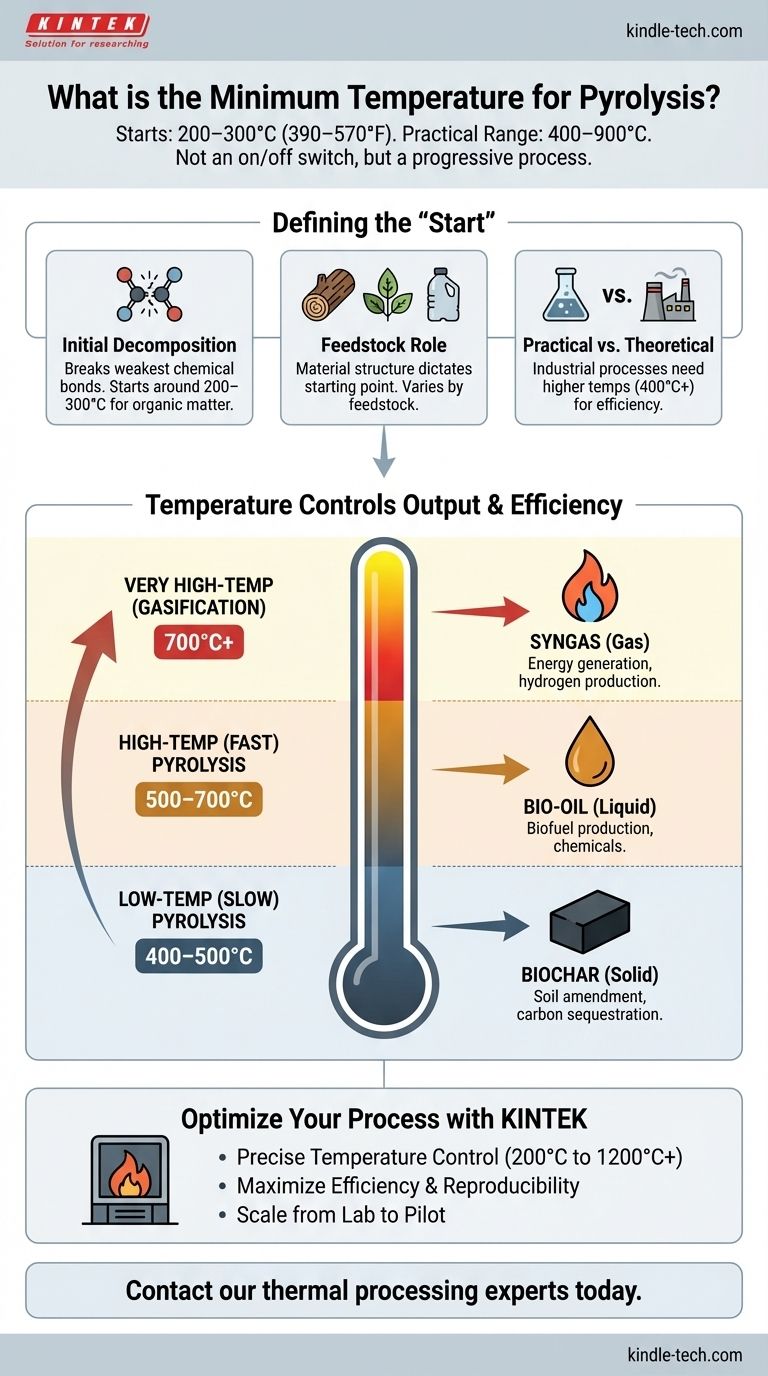
To be precise, the minimum temperature for pyrolysis to begin is generally between 200–300°C (390–570°F), but this is highly dependent on the specific material being heated. This initial stage involves the breakdown of the least stable chemical compounds within the feedstock. However, effective and practical pyrolysis for industrial applications typically requires much higher temperatures, often in the range of 400-900°C.

The key is to understand that pyrolysis isn't an on/off switch at a single temperature. Instead, it's a process that starts at a lower temperature threshold and then accelerates and changes its output as the temperature increases.
What is the minimum temperature for pyrolysis? Control Your Output with Precise Temperature Ranges

What Defines the "Start" of Pyrolysis?

The term "minimum temperature" can be misleading without context. It refers to the point where thermal decomposition first begins, not the optimal temperature for a desired outcome.

Initial Decomposition

Pyrolysis begins when enough thermal energy is introduced to start breaking the weakest chemical bonds in a material.

For organic matter like wood or biomass, this process starts in the 200-300°C range. The first components to break down are typically less stable polymers like hemicellulose.

The Critical Role of Feedstock

There is no single universal minimum temperature for pyrolysis because every material has a different chemical structure.

Materials with less stable bonds will begin to decompose at lower temperatures, while more stable materials require more energy. Wood is a common benchmark, but plastics or other forms of biomass will have their own unique starting points.

Practical vs. Theoretical Minimums

While decomposition may start around 250°C, this process is often slow and incomplete.

Industrial processes use higher temperatures (400°C and above) to ensure a rapid and efficient conversion of the entire feedstock into the desired products, whether that be biochar, bio-oil, or syngas.

Understanding the Temperature Trade-offs

The temperature you choose is the single most important variable controlling the final products of pyrolysis. This is not a mistake to be made; it is a parameter to be controlled.

Low-Temperature (Slow) Pyrolysis

Operating at the lower end of the effective range (approx. 400-500°C) with a slow heating rate maximizes the production of solid biochar.

The longer residence time allows carbon atoms to rearrange into stable, solid structures rather than vaporizing into gases and liquids.

High-Temperature (Fast) Pyrolysis

Using higher temperatures (approx. 500-700°C) with a very rapid heating rate cracks the molecules into smaller vapors. When these vapors are cooled and condensed quickly, they form a liquid bio-oil.

This process minimizes the chance for the vapors to undergo secondary reactions or form solid char.

Very High-Temperature (Gasification)

At extremely high temperatures (typically above 700°C), the process favors breaking down all components into the simplest gaseous molecules.

This maximizes the yield of non-condensable gases known as syngas (primarily hydrogen and carbon monoxide).

Matching Temperature to Your Desired Outcome

Your target temperature should be dictated entirely by the product you intend to create.

  • If your primary focus is maximizing biochar yield: Operate at lower temperatures (around 400-500°C) with slow heating rates.
  • If your primary focus is maximizing bio-oil yield: Use moderate-to-high temperatures (around 500-650°C) with very fast heating rates.
  • If your primary focus is maximizing syngas production: Employ very high temperatures (700°C+) to ensure complete thermal cracking into gaseous components.

Ultimately, temperature is the primary lever you can pull to control the output and efficiency of any pyrolysis system.

Summary Table:

Pyrolysis Type Typical Temperature Range Primary Product Key Application
Low-Temperature (Slow) 400-500°C Biochar (Maximized) Soil amendment, carbon sequestration
High-Temperature (Fast) 500-700°C Bio-Oil (Maximized) Biofuel production, chemicals
Very High-Temperature 700°C+ Syngas (Maximized) Energy generation, hydrogen production

Ready to Optimize Your Pyrolysis Process?

Precise temperature control is critical for achieving your desired product yield, whether it's biochar, bio-oil, or syngas. KINTEK provides robust and reliable lab furnaces and pyrolysis reactors designed for exact temperature management and consistent results.

Our equipment helps researchers and engineers like you:

  • Accurately control pyrolysis temperatures from 200°C to 1200°C+.
  • Maximize efficiency and reproducibility in your experiments or processes.
  • Scale your operations with confidence from lab to pilot plant.

Contact our thermal processing experts today to discuss your specific application and find the perfect solution for your needs. Get in touch via our contact form to request a quote or schedule a consultation.

Visual Guide
What is the minimum temperature for pyrolysis? Control Your Output with Precise Temperature Ranges Visual Guide

Related Products

People Also Ask

Related Products

Electric Rotary Kiln Small Rotary Furnace Biomass Pyrolysis Plant

Electric Rotary Kiln Small Rotary Furnace Biomass Pyrolysis Plant

Learn about Rotary Biomass Pyrolysis Furnaces & how they decompose organic material at high temps without oxygen. Use for biofuels, waste processing, chemicals & more.

Electric Rotary Kiln Pyrolysis Furnace Plant Machine Calciner Small Rotary Kiln Rotating Furnace

Electric Rotary Kiln Pyrolysis Furnace Plant Machine Calciner Small Rotary Kiln Rotating Furnace

Electric rotary kiln - precisely controlled, it's ideal for calcination and drying of materials like lithium cobalate, rare earths, and non-ferrous metals.

Electric Rotary Kiln Continuous Working Small Rotary Furnace Heating Pyrolysis Plant

Electric Rotary Kiln Continuous Working Small Rotary Furnace Heating Pyrolysis Plant

Efficiently calcine and dry bulk powder and lump fluid materials with an electric heating rotary furnace. Ideal for processing lithium ion battery materials and more.

Ultra-High Temperature Graphite Vacuum Graphitization Furnace

Ultra-High Temperature Graphite Vacuum Graphitization Furnace

The ultra-high temperature graphitization furnace utilizes medium frequency induction heating in a vacuum or inert gas environment. The induction coil generates an alternating magnetic field, inducing eddy currents in the graphite crucible, which heats up and radiates heat to the workpiece, bringing it to the desired temperature. This furnace is primarily used for graphitization and sintering of carbon materials, carbon fiber materials, and other composite materials.

Vertical High Temperature Graphite Vacuum Graphitization Furnace

Vertical High Temperature Graphite Vacuum Graphitization Furnace

Vertical high temperature graphitization furnace for carbonization and graphitization of carbon materials up to 3100℃.Suitable for shaped graphitization of carbon fiber filaments and other materials sintered in a carbon environment.Applications in metallurgy, electronics, and aerospace for producing high-quality graphite products like electrodes and crucibles.

Horizontal High Temperature Graphite Vacuum Graphitization Furnace

Horizontal High Temperature Graphite Vacuum Graphitization Furnace

Horizontal Graphitization Furnace: This type of furnace is designed with the heating elements placed horizontally, allowing for uniform heating of the sample. It's well-suited for graphitizing large or bulky samples that require precise temperature control and uniformity.

Large Vertical Graphite Vacuum Graphitization Furnace

Large Vertical Graphite Vacuum Graphitization Furnace

A large vertical high-temperature graphitization furnace is a type of industrial furnace used for the graphitization of carbon materials, such as carbon fiber and carbon black. It is a high-temperature furnace that can reach temperatures of up to 3100°C.

Graphite Vacuum Furnace Bottom Discharge Graphitization Furnace for Carbon Materials

Graphite Vacuum Furnace Bottom Discharge Graphitization Furnace for Carbon Materials

Bottom-out graphitization furnace for carbon materials, ultra-high temperature furnace up to 3100°C, suitable for graphitization and sintering of carbon rods and carbon blocks. Vertical design, bottom discharging, convenient feeding and discharging, high temperature uniformity, low energy consumption, good stability, hydraulic lifting system, convenient loading and unloading.

Graphite Vacuum Continuous Graphitization Furnace

Graphite Vacuum Continuous Graphitization Furnace

High-temperature graphitization furnace is a professional equipment for graphitization treatment of carbon materials. It is a key equipment for the production of high-quality graphite products. It has high temperature, high efficiency and uniform heating. It is suitable for various high-temperature treatments and graphitization treatments. It is widely used in metallurgy, electronics, aerospace, etc. industry.

1700℃ Controlled Atmosphere Furnace Nitrogen Inert Atmosphere Furnace

1700℃ Controlled Atmosphere Furnace Nitrogen Inert Atmosphere Furnace

KT-17A Controlled atmosphere furnace: 1700℃ heating, vacuum sealing technology, PID temperature control, and versatile TFT smart touch screen controller for laboratory and industrial use.

Controlled Nitrogen Inert Hydrogen Atmosphere Furnace

Controlled Nitrogen Inert Hydrogen Atmosphere Furnace

KT-AH Hydrogen atmosphere furnace - induction gas furnace for sintering/annealing with built-in safety features, dual housing design, and energy-saving efficiency. Ideal for lab and industrial use.

Vacuum Arc Induction Melting Furnace

Vacuum Arc Induction Melting Furnace

Discover the power of Vacuum Arc Furnace for melting active & refractory metals. High-speed, remarkable degassing effect, and free of contamination. Learn more now!

High Temperature Muffle Oven Furnace for Laboratory Debinding and Pre Sintering

High Temperature Muffle Oven Furnace for Laboratory Debinding and Pre Sintering

KT-MD High temperature debinding and pre-sintering furnace for ceramic materials with various molding processes. Ideal for electronic components such as MLCC and NFC.

Spark Plasma Sintering Furnace SPS Furnace

Spark Plasma Sintering Furnace SPS Furnace

Discover the benefits of Spark Plasma Sintering Furnaces for rapid, low-temperature material preparation. Uniform heating, low cost & eco-friendly.

Vacuum Heat Treat and Pressure Sintering Furnace for High Temperature Applications

Vacuum Heat Treat and Pressure Sintering Furnace for High Temperature Applications

Vacuum pressure sintering furnaces are designed for high temperature hot pressing applications in metal and ceramic sintering. Its advanced features ensure precise temperature control, reliable pressure maintenance, and a robust design for seamless operation.

Non Consumable Vacuum Arc Induction Melting Furnace

Non Consumable Vacuum Arc Induction Melting Furnace

Explore the benefits of Non-Consumable Vacuum Arc Furnace with high melting point electrodes. Small, easy to operate & eco-friendly. Ideal for laboratory research on refractory metals & carbides.

Graphite Vacuum Furnace High Thermal Conductivity Film Graphitization Furnace

Graphite Vacuum Furnace High Thermal Conductivity Film Graphitization Furnace

The high thermal conductivity film graphitization furnace has uniform temperature, low energy consumption and can operate continuously.

Graphite Vacuum Furnace IGBT Experimental Graphitization Furnace

Graphite Vacuum Furnace IGBT Experimental Graphitization Furnace

IGBT experimental graphitization furnace, a tailored solution for universities and research institutions, with high heating efficiency, user-friendliness, and precise temperature control.

600T Vacuum Induction Hot Press Furnace for Heat Treat and Sintering

600T Vacuum Induction Hot Press Furnace for Heat Treat and Sintering

Discover the 600T Vacuum Induction Hot Press Furnace, designed for high-temperature sintering experiments in vacuum or protected atmospheres. Its precise temperature and pressure control, adjustable working pressure, and advanced safety features make it ideal for nonmetal materials, carbon composites, ceramics, and metal powders.

Vacuum Heat Treat Furnace with Ceramic Fiber Liner

Vacuum Heat Treat Furnace with Ceramic Fiber Liner

Vacuum furnace with polycrystalline ceramic fiber insulation liner for excellent heat insulation and uniform temperature field. Choose from 1200℃ or 1700℃ max. working temperature with high vacuum performance and precise temperature control.


Leave Your Message