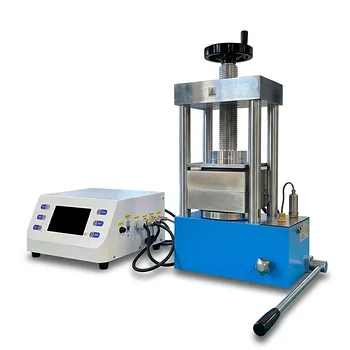
The primary function of a high-tonnage uniaxial hydraulic press in the production of AlFeTiCrZnCu high-entropy alloys is to mechanically consolidate loose, alloyed powders into a cohesive solid structure at room temperature. By applying extreme pressure (typically around 2 GPa), the press forces powder particles into intimate contact, inducing plastic deformation to create a "green body" with the specific geometry and structural strength required for subsequent processing.
Core Takeaway While the chemical composition is set during milling, the hydraulic press is responsible for the physical transition from powder to solid. It creates a "green body"—a compacted, pre-sintered form—that holds its shape solely through mechanical interlocking and cold deformation, without the application of heat.
The Mechanics of Cold Consolidation
Application of Extreme Pressure
The hydraulic press utilizes a uniaxial mechanism to exert massive force, specifically reaching pressures as high as 2 GPa.
Unlike processes that rely on heat to soften materials, this method relies entirely on brute mechanical force applied at room temperature. This distinguishes it from hot pressing methods where thermal energy aids densification.
Inducing Cold Deformation
The pressure applied is not merely for containment; it is designed to physically alter the powder particles.
The force causes cold deformation, changing the shape of the individual particles. This deformation reduces the spacing between particles, mechanically interlocking them to eliminate large voids and loose packing.
The Role of the "Green Body"
Establishing Structural Integrity
The immediate output of this process is the "green body."
This compact must have sufficient green strength to be handled, moved, and loaded into a furnace without crumbling. The hydraulic press ensures the particles adhere tightly enough to maintain the component's geometry outside the mold.
Preparation for Pressureless Sintering
The cold pressing stage is strictly a precursor to thermal treatment.
The press compacts the powder to a density that facilitates pressureless sintering. By reducing the distance between particles beforehand, the press reduces the amount of shrinkage that occurs during the final heating stage, ensuring better dimensional control.
Understanding the Trade-offs
Porosity Limitations
While effective for shaping, cold pressing rarely achieves full theoretical density on its own.
Because the process occurs at room temperature, it cannot utilize diffusion to close the smallest microscopic pores. The resulting green body will still contain residual porosity that must be eliminated during the subsequent sintering phase.
Uniformity Challenges
Uniaxial pressing applies force from one direction (or two opposing directions).
This can lead to density gradients within the green body, where the powder closer to the punch is denser than the powder in the center. For complex geometries, this lack of isotropic pressure (unlike the Isostatic pressing mentioned in supplementary contexts) can lead to uneven shrinkage during sintering.
Making the Right Choice for Your Goal
The use of a cold hydraulic press represents a specific processing route distinct from Vacuum Hot Pressing (VHP) or Hot Isostatic Pressing (HIP).
- If your primary focus is process efficiency for simple shapes: Utilize high-tonnage cold pressing to rapidly create green bodies that can be sintered in batches without occupying a complex hot-press furnace.
- If your primary focus is eliminating all residual porosity: Recognize that cold pressing is only the first step; you must strictly control the subsequent sintering parameters or consider alternative hot-consolidation methods (like VHP or HIP) to achieve near-perfect density.
Summary: The hydraulic press acts as the bridge between loose nanostructured powder and the final bulk alloy, providing the mechanical compaction necessary to create a workable solid form ready for thermal densification.
Summary Table:
| Feature | Cold Pressing Specification / Outcome |
|---|---|
| Primary Mechanism | Mechanical consolidation at room temperature |
| Applied Pressure | Up to 2 GPa (High-Tonnage) |
| Output Form | "Green Body" (Compacted solid) |
| Material Effect | Plastic deformation and mechanical interlocking |
| Purpose | Preparation for pressureless sintering and handling |
| Key Limitation | Residual porosity and potential density gradients |
Elevate Your Material Research with KINTEK Precision
Ready to achieve superior density and structural integrity in your high-entropy alloy production? KINTEK specializes in advanced laboratory equipment designed for the most demanding applications. Whether you need high-tonnage hydraulic presses (pellet, hot, isostatic) for precise green body formation or high-temperature furnaces (muffle, vacuum, CVD) for the final sintering stage, our comprehensive range of tools ensures consistent, repeatable results.
Our Value to You:
- High-Pressure Excellence: Achieve up to 2 GPa with our robust uniaxial and isostatic pressing systems.
- Comprehensive Solutions: From crushing and milling systems to high-temperature reactors and essential consumables like ceramics and crucibles.
- Expert Support: Our team helps you select the right cooling solutions, homogenizers, and battery research tools to optimize your workflow.
Don't settle for inconsistent consolidation. Contact KINTEK today to find the perfect pressing and thermal solution for your laboratory's needs!
Related Products
- kbr pellet press 2t
- 24T 30T 60T Heated Hydraulic Press Machine with Heated Plates for Laboratory Hot Press
- Automatic High Temperature Heated Hydraulic Press Machine with Heated Plates for Lab
- Manual High Temperature Heated Hydraulic Press Machine with Heated Plates for Lab
- Automatic Heated Hydraulic Press Machine with Heated Plates for Laboratory Hot Press 25T 30T 50T
People Also Ask
- How do you prepare samples for IR spectroscopy? A Step-by-Step Guide for Solids, Liquids, and Gases
- What measurement methods are commonly used for powder samples in infrared spectroscopy? Optimize Your FTIR Analysis
- Why KBr is used in IR spectrophotometry? A Key to Transparent Sample Analysis
- How are a KBr pellet press and mortar utilized in FTIR analysis of activated carbon? Expert Sample Prep Guide
- How do you prepare KBr pellets for FTIR analysis? Master the Technique for High-Quality IR Spectra