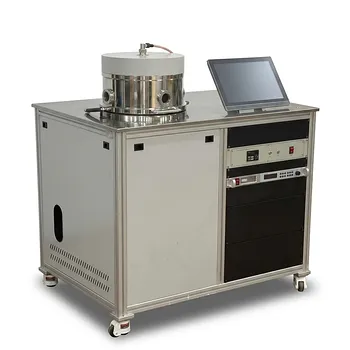
The primary function of a High Vacuum CVD Furnace is to create the specific thermal and atmospheric conditions required to decompose carbon gases and restructure them into graphene. By maintaining temperatures often exceeding 1000°C and strictly controlling pressure, the furnace enables the orderly deposition of carbon atoms onto a substrate to form high-quality films.
The High Vacuum CVD Furnace acts as the critical reaction vessel for atomic organization. It leverages extreme heat and catalytic reactions to transform raw gas into scalable, large-area graphene sheets essential for advanced electronics and filtration membranes.
The Mechanics of Graphene Growth
Creating the Thermal Environment
To initiate the growth process, the furnace must generate intense thermal energy, typically exceeding 1000°C.
This extreme heat is non-negotiable. It provides the energy required to break the chemical bonds of the precursor gases introduced into the chamber.
Catalytic Decomposition
Within this heated environment, carbon source gases—most commonly methane—are introduced alongside hydrogen.
The process relies on a metal substrate, such as copper foil, which acts as a catalyst. This metal surface facilitates the dissociation of carbon atoms from the methane gas.
Orderly Atomic Deposition
Once the carbon atoms are freed, the controlled vacuum environment allows them to settle onto the substrate.
Crucially, this is not a random accumulation. The atoms deposit in an orderly manner, growing into large-area, high-quality single-layer or multi-layer graphene structures.
Understanding the Trade-offs
Managing Impurities
While the High Vacuum CVD process is excellent for scalability, it is not without quality control challenges.
The primary difficulty involves metallic impurities. Because the graphene is grown directly on a metal catalyst like copper, trace amounts of metal can contaminate the final film.
The Transfer Challenge
Producing the film is only half the battle; moving it is the other.
Transferring the ultra-thin graphene from the growth substrate to its final application surface is a delicate process. This stage is frequently where structural defects are introduced, which can degrade the material's conductivity and mechanical strength.
Making the Right Choice for Your Goal
Whether you are developing filtration systems or next-generation electronics, the quality of your CVD process dictates the utility of the material.
- If your primary focus is high-performance separation: Prioritize precise pressure control to ensure the atomic order required for effective filtration membranes.
- If your primary focus is flexible electronics: Leverage the CVD process to create highly transparent and flexible films suitable for organic photovoltaic cells (OPV).
- If your primary focus is cost-effective scaling: Utilize the large-area capabilities of CVD, but implement rigorous post-production testing to identify transfer-related defects.
Success in graphene preparation relies on balancing high-temperature synthesis with the delicate handling required to maintain film integrity.
Summary Table:
| Feature | Description | Key Benefit |
|---|---|---|
| Temperature | Exceeds 1000°C | Enables bond breaking of precursor gases like methane |
| Catalyst Support | Copper foil substrate | Facilitates dissociation of carbon atoms for film growth |
| Vacuum Control | High vacuum environment | Ensures orderly atomic deposition and high material purity |
| Applications | Electronics & Filtration | Produces scalable, large-area graphene for advanced tech |
Elevate Your Nanomaterial Research with KINTEK
Unlock the full potential of your graphene synthesis with KINTEK’s industry-leading High Vacuum CVD and PECVD systems. Whether you are focused on next-generation filtration membranes or high-conductivity electronics, our precision-engineered furnaces provide the thermal stability and vacuum control necessary for flawless atomic deposition.
Beyond CVD furnaces, KINTEK offers a comprehensive laboratory portfolio including:
- High-temperature furnaces (muffle, tube, and vacuum systems)
- High-temperature high-pressure reactors and autoclaves
- Advanced battery research tools and electrolytic cells
- Precision hydraulic presses for pelletizing and material testing
Ready to scale your production with zero-defect integrity? Contact our laboratory specialists today to find the perfect equipment solution for your research goals.
References
- de Souza Figueiredo Katia Cecilia, André S. Ferlauto. Graphene Membranes: From Reverse Osmosis to Gas Separation. DOI: 10.15379/2410-1869.2021.08.02.01
This article is also based on technical information from Kintek Solution Knowledge Base .
Related Products
- Split Chamber CVD Tube Furnace with Vacuum Station Chemical Vapor Deposition System Equipment Machine
- Vertical High Temperature Graphite Vacuum Graphitization Furnace
- Ultra-High Temperature Graphite Vacuum Graphitization Furnace
- Horizontal High Temperature Graphite Vacuum Graphitization Furnace
- 1400℃ Controlled Atmosphere Furnace with Nitrogen and Inert Atmosphere
People Also Ask
- What is the function of a tube furnace in CVD SiC synthesis? Achieving Ultra-Pure Silicon Carbide Powders
- What is a CVD tube furnace? A Complete Guide to Thin-Film Deposition
- What are the technical advantages of using a CVD tube furnace? Optimize Silicon-Carbon Battery Anodes
- What is the function of a high-temperature CVD tube furnace in 3D graphene foam prep? Master 3D Nanomaterial Growth
- How does a CVD tube furnace inhibit the sintering of silver supports? Boost Membrane Durability and Performance