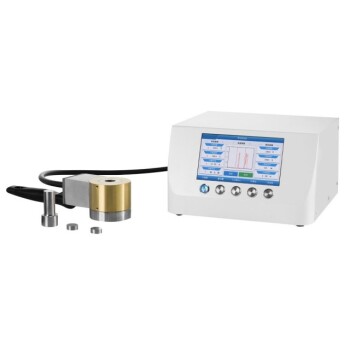
The laboratory hot press is the critical driver of chemical transformation and structural consolidation in phenolic resin composites. It functions by simultaneously applying high heat (150 °C) and mechanical pressure (10 MPa) to facilitate the cross-linking and curing of the thermosetting resin. This dual action forces the molten resin to fully infiltrate the filler matrix while expelling trapped air, resulting in a high-density, low-porosity specimen.
The primary role of a laboratory hot press is to transform loose raw materials into a dense, chemically stable composite by synchronizing thermal curing with mechanical compaction. This process is essential for eliminating internal defects and ensuring the structural integrity required for rigorous mechanical testing.
Facilitating the Chemical Curing Process
Cross-Linking and Thermal Activation
Phenolic resins are thermosetting polymers that require a specific thermal threshold to initiate cross-linking. The hot press provides a stable environment—typically at 150 °C—to trigger the chemical bonds that turn the resin into a rigid, heat-resistant matrix.
Transition from Molten to Solid State
During the initial heating phase, the resin enters a molten state, allowing it to flow. The hot press maintains precise temperature control to ensure this flow is uniform before the final curing stage permanently hardens the material into its final shape.
Achieving Structural Homogeneity
Resin Infiltration and Wetting
Mechanical pressure, often around 10 MPa, is used to drive the molten resin into the microscopic spaces of the reinforcement materials, such as Carbon Nanotube/Alumina hybrid fillers. This ensures "wetting," where the resin coats every particle to create a unified material.
Elimination of Voids and Air Bubbles
Internal air bubbles and microscopic voids are the primary causes of structural failure in composites. The simultaneous application of pressure expels internal air, preventing the formation of pores that would otherwise compromise the material's density.
Impact on Material Performance
Maximizing Density and Reducing Porosity
By removing air and ensuring full resin penetration, the hot press produces specimens with high density and low porosity. These characteristics are vital for materials intended for wear testing, where surface integrity is paramount.
Enhancing Mechanical Strength
The thermo-mechanical action of the press facilitates molecular-level bonding between the resin and the fillers. This results in high structural strength and prevents interlaminar failure when the composite is subjected to external loads.
Understanding the Trade-offs
Thermal Stress and Internal Gradients
While high heat is necessary for curing, rapid cooling or uneven heating can introduce thermal stresses. If the temperature is not distributed uniformly across the platens, the resulting specimen may suffer from warping or internal micro-cracks.
Pressure Sensitivity and Fiber Damage
Excessive pressure can lead to the "crushing" of delicate fillers or the displacement of reinforcement fibers. Finding the balance between compaction and structural preservation is critical to maintaining the intended mechanical properties of the composite.
Making the Right Choice for Your Goal
To achieve the best results with a laboratory hot press, your operational parameters should align with your specific testing requirements:
- If your primary focus is Wear Resistance: Prioritize high-pressure holding stages to ensure maximum density and the complete elimination of surface-level porosity.
- If your primary focus is Dimensional Stability: Focus on controlled, multi-stage cooling procedures to prevent warping and reduce internal thermal stresses within the molded part.
- If your primary focus is Interfacial Strength: Ensure the resin remains in its molten "flow" state long enough to fully saturate the hybrid fillers before the final curing temperature is reached.
The hot press is not merely a heater or a clamp, but a precision instrument that dictates the ultimate physical and chemical identity of the composite.
Summary Table:
| Function | Action | Primary Result |
|---|---|---|
| Chemical Curing | 150°C Thermal Activation | Resin Cross-linking & Hardening |
| Structural Consolidation | 10 MPa Mechanical Pressure | Void Elimination & High Density |
| Matrix Wetting | Controlled Molten Flow | Uniform Resin Infiltration |
| Performance Enhancement | Thermo-Mechanical Sync | Superior Wear Resistance & Strength |
Elevate Your Composite Material Research with KINTEK
Precision is the difference between a failed specimen and a breakthrough. KINTEK specializes in high-performance laboratory equipment designed for rigorous material synthesis. Whether you are working with phenolic resins or advanced hybrid fillers, our hydraulic presses (pellet, hot, and isostatic) provide the stable pressure and temperature control necessary for superior structural integrity.
Beyond molding, our comprehensive portfolio supports your entire workflow:
- Sample Preparation: High-efficiency crushing and milling systems and sieving equipment.
- Heat Treatment: A wide range of muffle, vacuum, and atmosphere furnaces.
- Advanced Synthesis: CVD/PECVD systems and high-pressure reactors.
- Lab Essentials: Specialized ceramics, crucibles, and cooling solutions.
Ready to optimize your composite density and mechanical strength? Contact our technical experts today to find the perfect hot press solution for your laboratory.
References
- Siti Shuhadah Md Saleh, Norlin Nosbi. Preparation of Carbon Nanotubes/Alumina Hybrid-Filled Phenolic Composite with Enhanced Wear Resistance. DOI: 10.3390/ma16072772
This article is also based on technical information from Kintek Solution Knowledge Base .
Related Products
- 30T 40T Split Automatic Heated Hydraulic Press Machine with Heated Plates for Laboratory Hot Press
- Heated Hydraulic Press Machine with Heated Plates Split Manual Laboratory Hot Press
- Automatic Heated Hydraulic Press Machine with Heated Plates for Laboratory Hot Press
- Automatic Laboratory Heat Press Machine
- 24T 30T 60T Heated Hydraulic Press Machine with Heated Plates for Laboratory Hot Press
People Also Ask
- What are the advantages of using a laboratory hydraulic press for hot pressing? Achieve Peak Nano-Composite Density
- What are the core advantages of using a laboratory hot press to produce Bi2Se3? Achieve 93% Density & High Conductivity
- Why is a laboratory hydraulic hot press essential for high-density, additive-free Silicon Carbide? Unlock Pure SiC.
- How does a laboratory hydraulic hot press ensure the quality of PHBV/natural fiber composites? Expert Guide
- What is the function of a laboratory hydraulic hot press in the assembly of solid-state photoelectrochemical cells?